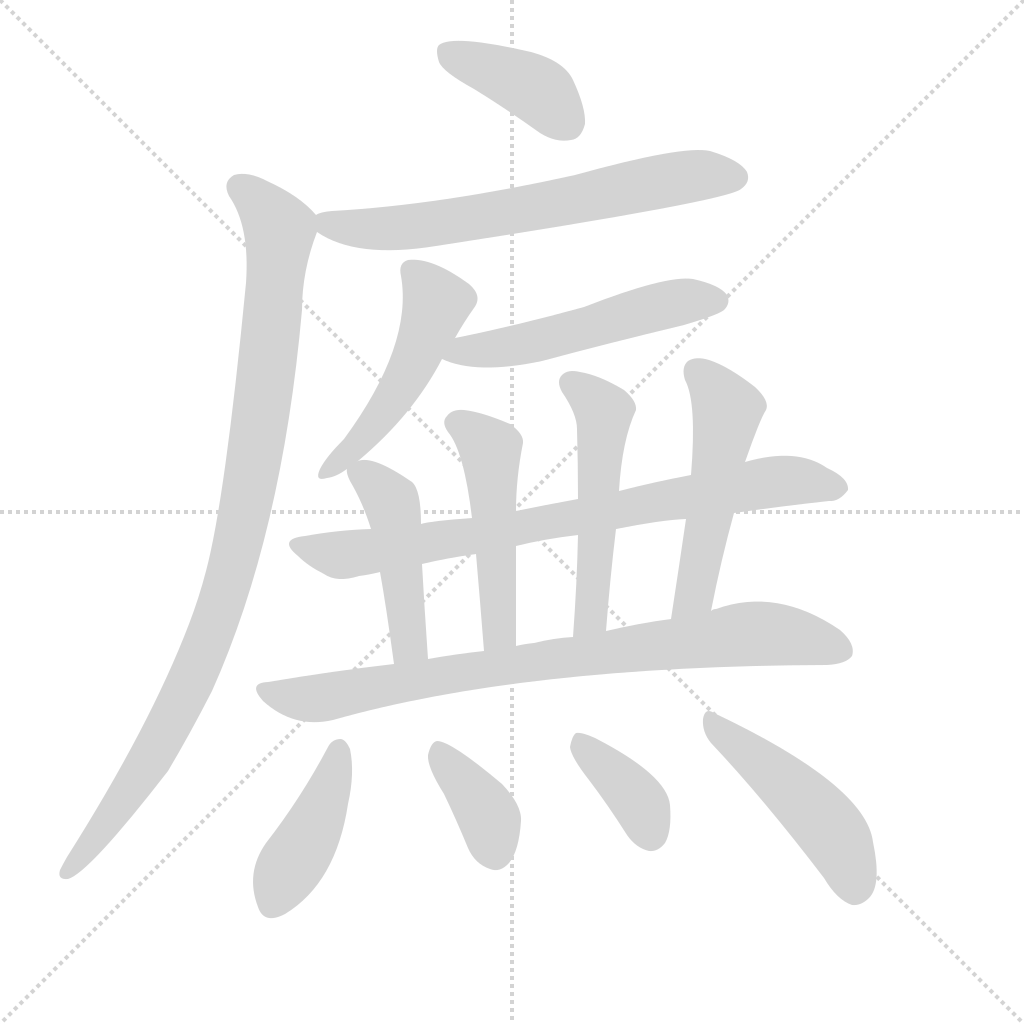
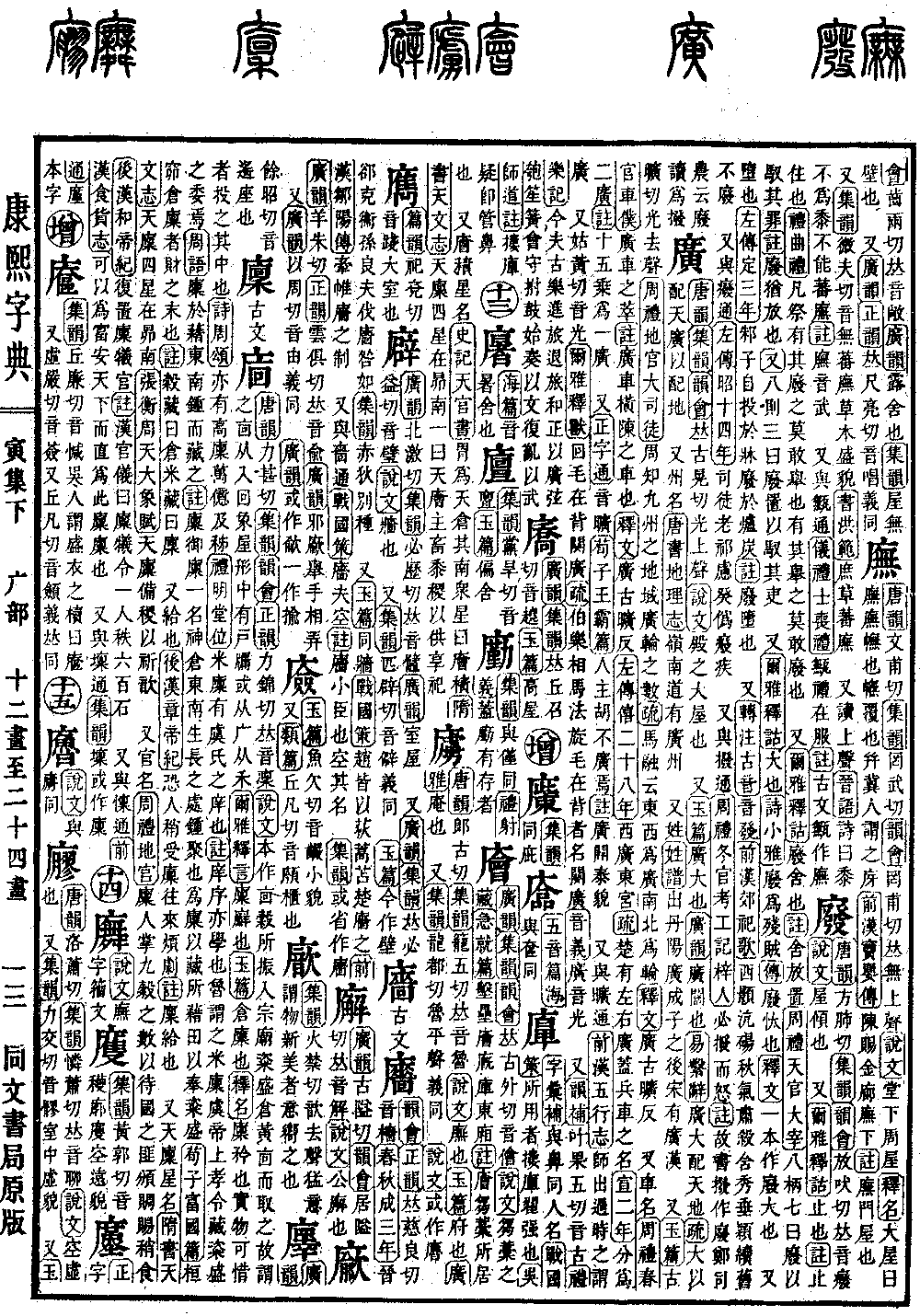
Yin Collection, Lower Volume
Radical: Wide (guǎng)
Kangxi stroke count: 15
Page 351, Entry 01
Pronounced wu (rising tone).
According to the Explaining and Analyzing Characters (Shuowen Jiezi), it refers to the peripheral rooms beneath the main hall. According to the Definitions of Names (Shiming), a large house is called a wu. Wu means covering. In the regions of Bingzhou and Jizhou, people refer to it as ya.
In the History of the Former Han (Qianhan Shu), Biography of Dou Ying, it is written that the rewarded gold was placed under the covered corridor. The commentary notes that wu refers to the gate house.
Also pronounced wu. Fanwu describes the appearance of flourishing grass and trees. In the Book of Documents (Shujing), Chapter Great Plan (Hongfan), it refers to the lush growth of a hundred grasses.
Also pronounced in the rising tone. In the Discourses of the States (Jinyu), the Book of Odes (Shijing) states that if the millet does not become millet, it cannot flourish. The commentary notes that wu is pronounced like wu.
It is also interchangeable with the character wu (a type of jar). In the Book of Etiquette and Ceremonial (Yili), Chapter of the Crown Ceremony for Scholars (Shiguan Li), there is a jar of wine placed to the side. The commentary notes that in ancient texts, this jar was written as wu.
Textual research: The citation regarding the jar ceremony in the mourning rites is corrected. This entry is from the Book of Etiquette and Ceremonial (Yili), Chapter of the Crown Ceremony for Scholars (Shiguan Li). The original text is a jar placed at the side, the sweet wine is a separate phrase, and it is located north of the ceremonial dress, rather than being a single phrase about the jar ceremony. In accordance with the original text, it has been corrected to the Book of Etiquette and Ceremonial (Yili), regarding the side placement of the jar.