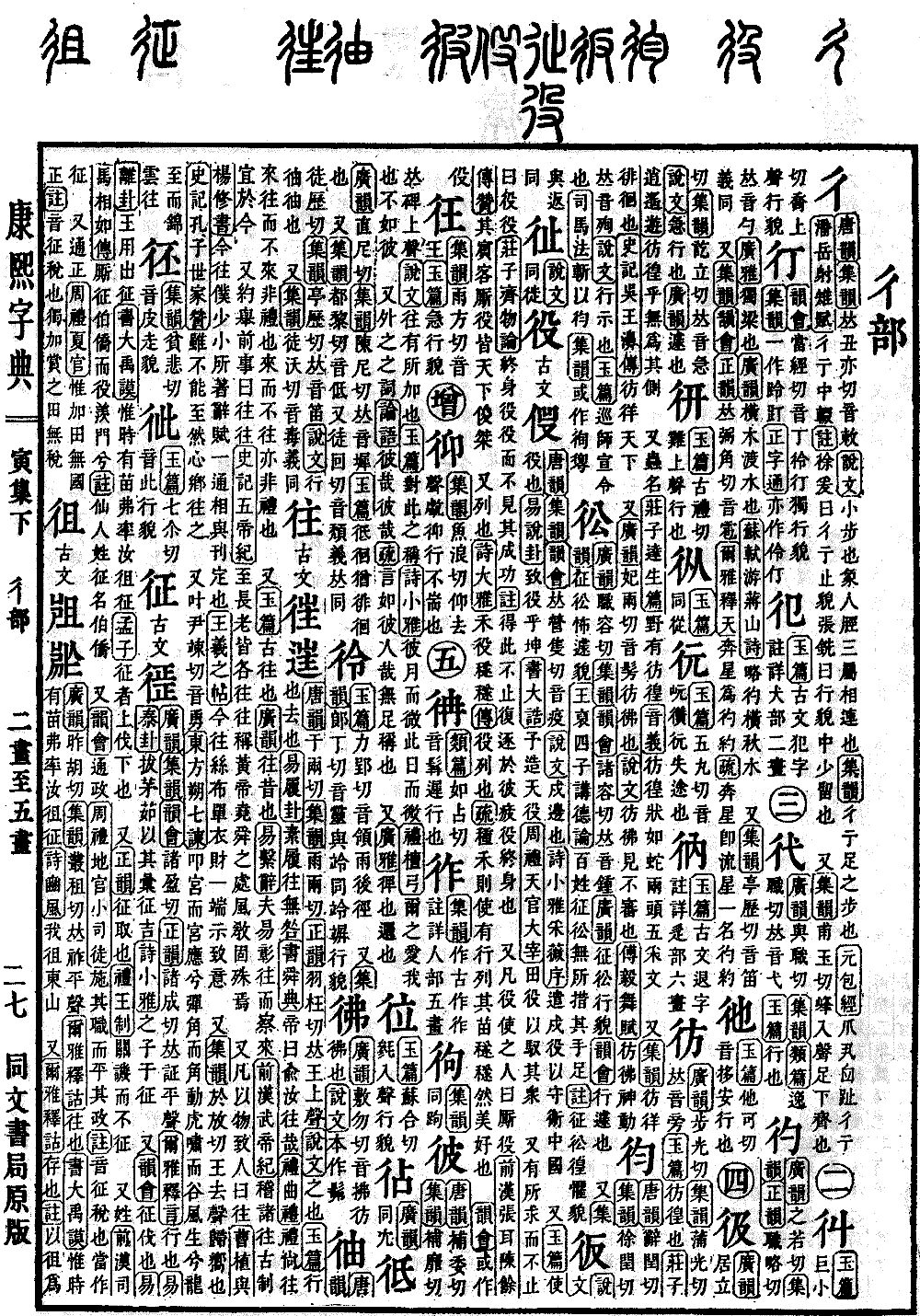
Yin Collection, Lower Volume
Radical: Step (chì)
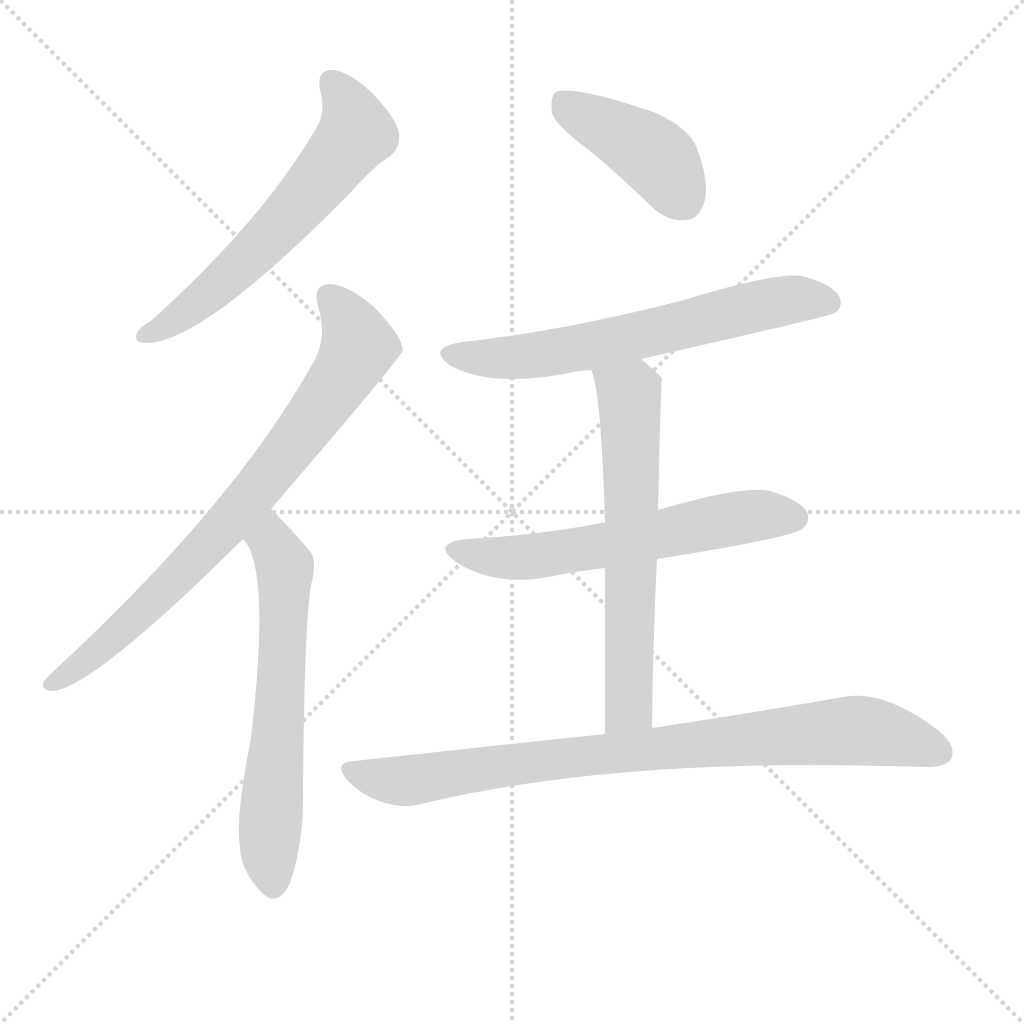
Entry:往
Kangxi Dictionary Strokes: 8
Page 365, Entry 32
Ancient script. Pronounced wang (rising tone) according to Tang Rhymes (Tangyun), Collected Rhymes (Jiyun), and Correct Rhymes (Zhengyun).
Shuowen Jiezi states: To go.
Yupian states: To travel, to depart.
Book of Changes (Yijing), Lu Gua: To walk on plain paths; going brings no blame.
Book of Documents (Shujing), Canon of Shun: The Emperor said: Yes, you may go.
Book of Rites (Liji), Quli: Propriety emphasizes exchange. To go without return is not proper; to come without return is also not proper.
Also, Yupian states: Ancient times.
Guangyun states: Wang means formerly.
Book of Changes (Yijing), Xici: The Book of Changes clarifies the past and examines the future.
History of the Former Han (Qianhan), Annals of Emperor Wu: Verify against ancient history to establish what is suitable for the present.
Also, referring to past events as wangwang.
Records of the Grand Historian (Shiji), Annals of the Five Emperors: Even the elders all spoke of the places of the Yellow Emperor, Yao, and Shun; the customs and teachings were indeed distinct.
Also, sending objects to a person is called wang.
Letter to Yang Xiu by Cao Zhi: I am sending a collection of my early poems and rhapsodies for you to edit.
Letter by Wang Xizhi: I am sending a roll of silk cloth to express my regards.
Also, pronounced wang (falling tone) according to Collected Rhymes (Jiyun). To return or incline toward.
Records of the Grand Historian (Shiji), Biography of Confucius: Although I cannot reach it, my heart yearns toward it.
Also, rhyming with yong (rising tone).
Seven Admonitions (Qijian) by Dongfang Shuo: Striking the gong and it responds; plucking the horn and it vibrates. The tiger roars and the valley wind arises; the dragon arrives and the brocade clouds depart.