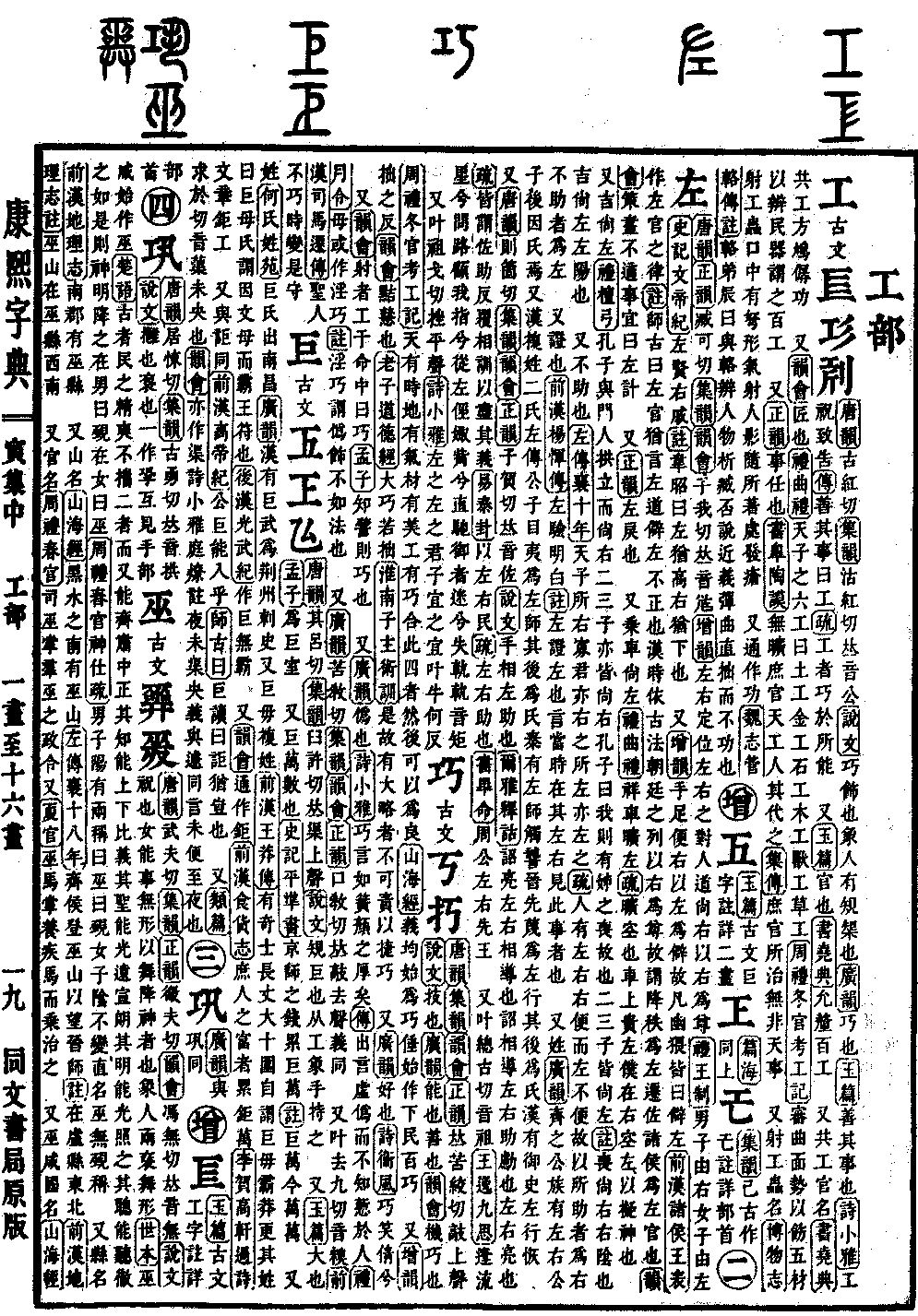
Yin Collection, Middle Volume. Radical: Work (gōng). Kangxi strokes: 7. Page 325, Entry 19.
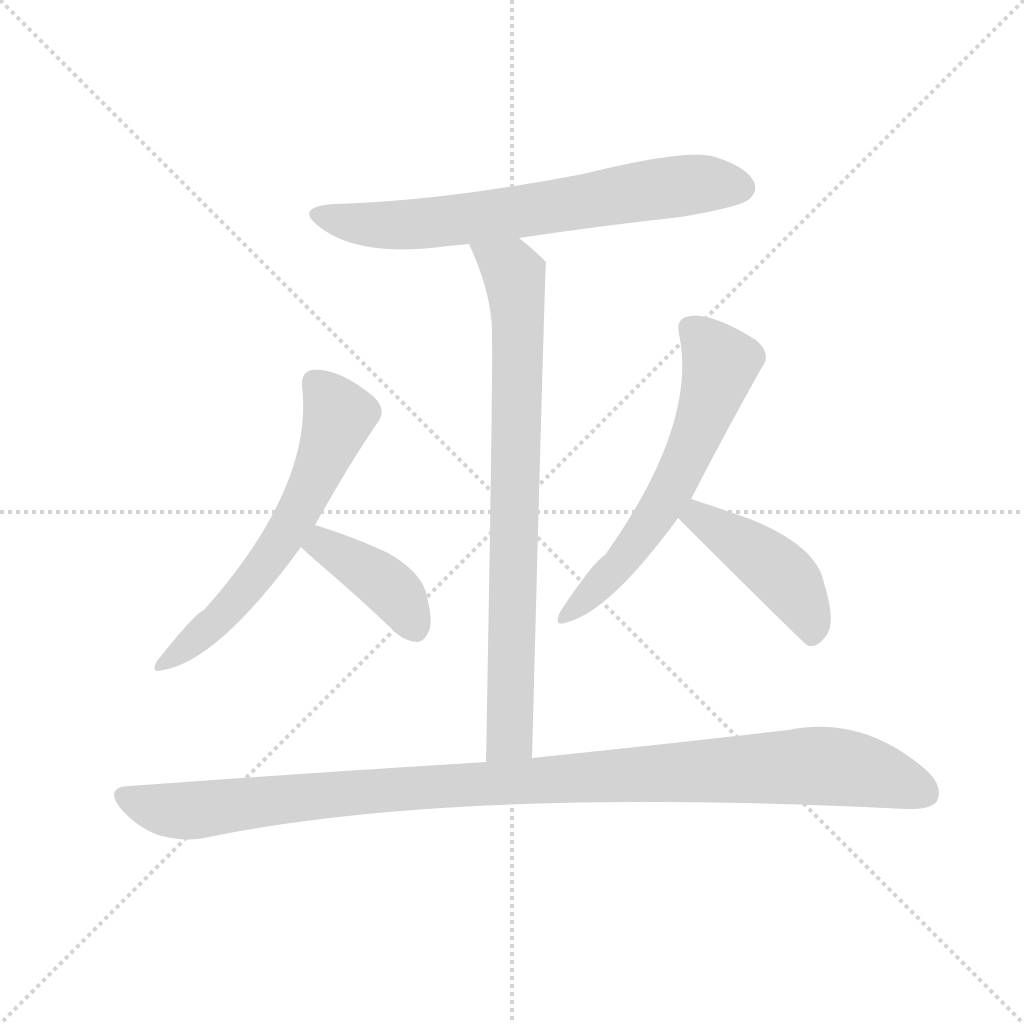
Ancient script. Pronounced wu. According to the Tang Rhyme (Tangyun), the Collection Rhymes (Jiyun), and the Correct Rhymes (Zhengyun), the sound is wu. According to the Rhyme Compendium (Yunhui), the sound is wu. As explained in the Explaining Graphs and Analyzing Characters (Shuowen), it refers to a shaman or spirit medium. Women who could serve the formless by dancing to bring down the spirits. The character resembles the form of a person dancing with two sleeves. According to the Genealogies of Generations (Shiben), Wu Xian was the first to practice shamanism. According to the Discourses of the States (Chuyu), in ancient times, the people whose spirits were not dispersed, who were able to be respectful and upright, whose knowledge could align the high and the low, whose wisdom could spread light and clarity, whose brilliance could illuminate, and whose hearing could penetrate, were the ones whom the spirits would descend upon. Among men, these are called xi; among women, these are called wu. According to the Rites of Zhou (Zhouli), Spring Offices, Commentary on Spirit Service, men, who are of the yang principle, have two titles, wu and xi. Women, who are of the yin principle, remain unchanged and are simply called wu; there is no title of xi. Also the name of a district. According to the History of the Former Han (Qianhan), Geography Treatise, Nanjun had Wu District. Also the name of a mountain. According to the Classic of Mountains and Seas (Shanhaijing), south of the Black River is Mount Wu. According to the Zuo Commentary (Zuozhuan), 18th Year of Duke Xiang, the Marquis of Qi climbed Mount Wu to observe the troops of Jin. The commentary notes that it is located northeast of Lu District. The Commentary to the Geography Treatise of the History of the Former Han states that Mount Wu is southwest of Wu District. Also the name of an official post. According to the Rites of Zhou, Spring Offices, the Master of Shamans managed the decrees of the various shamans. Also, in the Summer Offices, the Shaman Horse official was in charge of raising sick horses and using them for transport, and overseeing their treatment. Also Wu Xian, the name of a state. According to the Classic of Mountains and Seas, in the state of Wu Xian, the people hold a green snake in their right hand and a red snake in their left, located on Mount Dengbao, where the various shamans ascend and descend. It is also the name of a mountain. Guo Pu’s Preface to Mount Wu Xian states that Wu Xian was a man of great medical skill who served Emperor Yao, lived as a high duke, and died as a brilliant spirit. Was it not for this that the mountain was named after him? Also a personal name. According to the Classic of Mountains and Seas, east of the Open Brightness mountains are Wu Peng, Wu Di, Wu Yang, Wu Li, Wu Fan, and Wu Xiang. The commentary notes these were all divine physicians. Also the name of a spirit. According to the History of the Former Han, Treatise on Suburban Sacrifices, the Jin shamans sacrificed to the Wu Shrine and the Wu Temple; the Qin shamans sacrificed to the Wu Protector; the Chu shamans sacrificed to the Wu Ancestor. The commentary notes these were all ancient shaman deities. Wu Ancestor was the earliest of the shamans. Also a surname. According to the Customs of the World (Fengsutong), those who adopted surnames based on their occupations include shamans, diviners, potters, and craftsmen. In the Book of Documents (Shujing), Chapter of Lord Shi, it is mentioned that during the time of Ancestor Yi, there was a man named Wu Xian. According to the Broad Rhymes (Guangyun), there was a Han dynasty Inspector of Jizhou named Wu Jie. Also Wuma, a compound surname. As seen in the Analects (Lunyu), Wuma Qi.