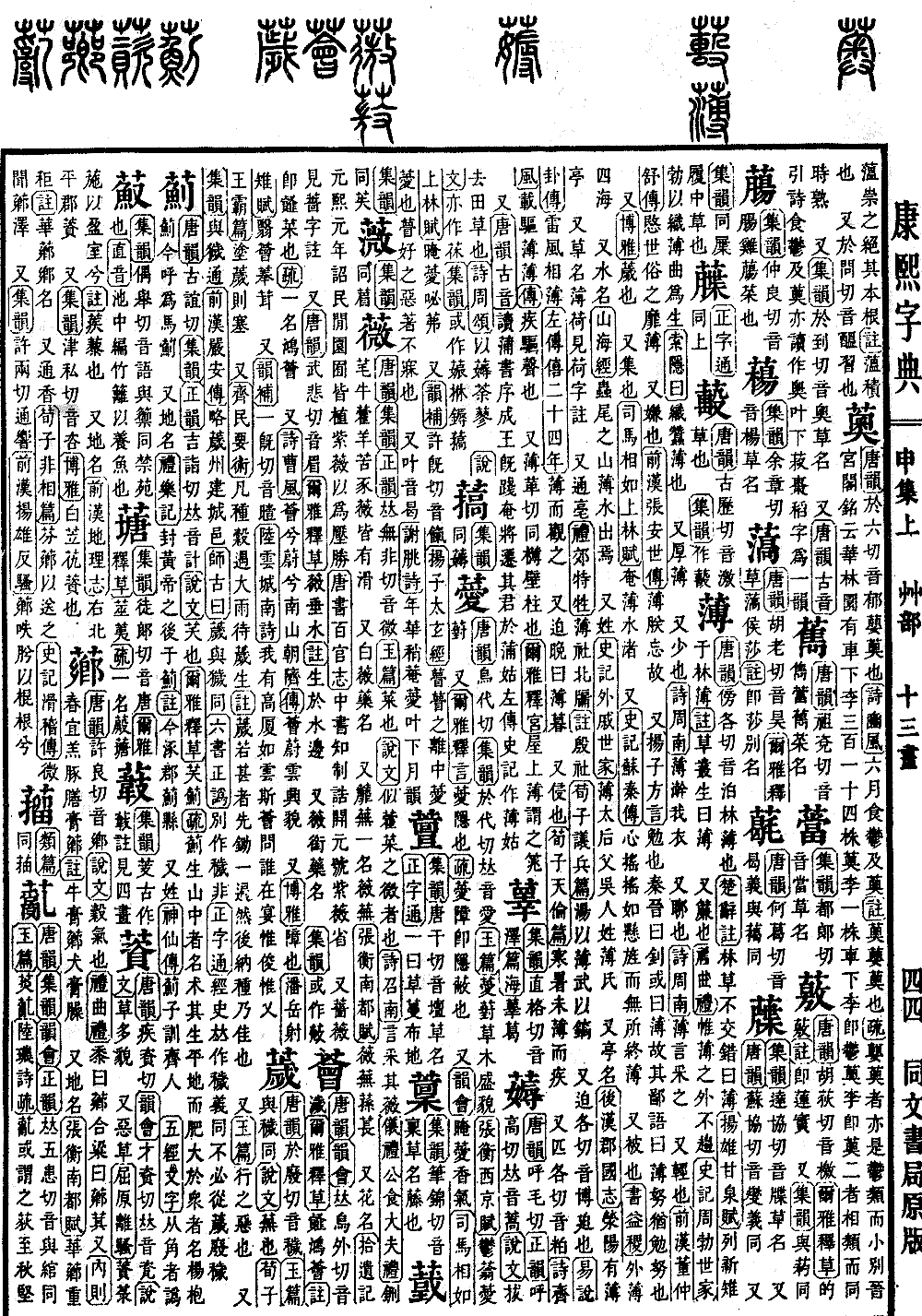
Shen Collection, Upper Volume
Radical: Grass (cǎo)
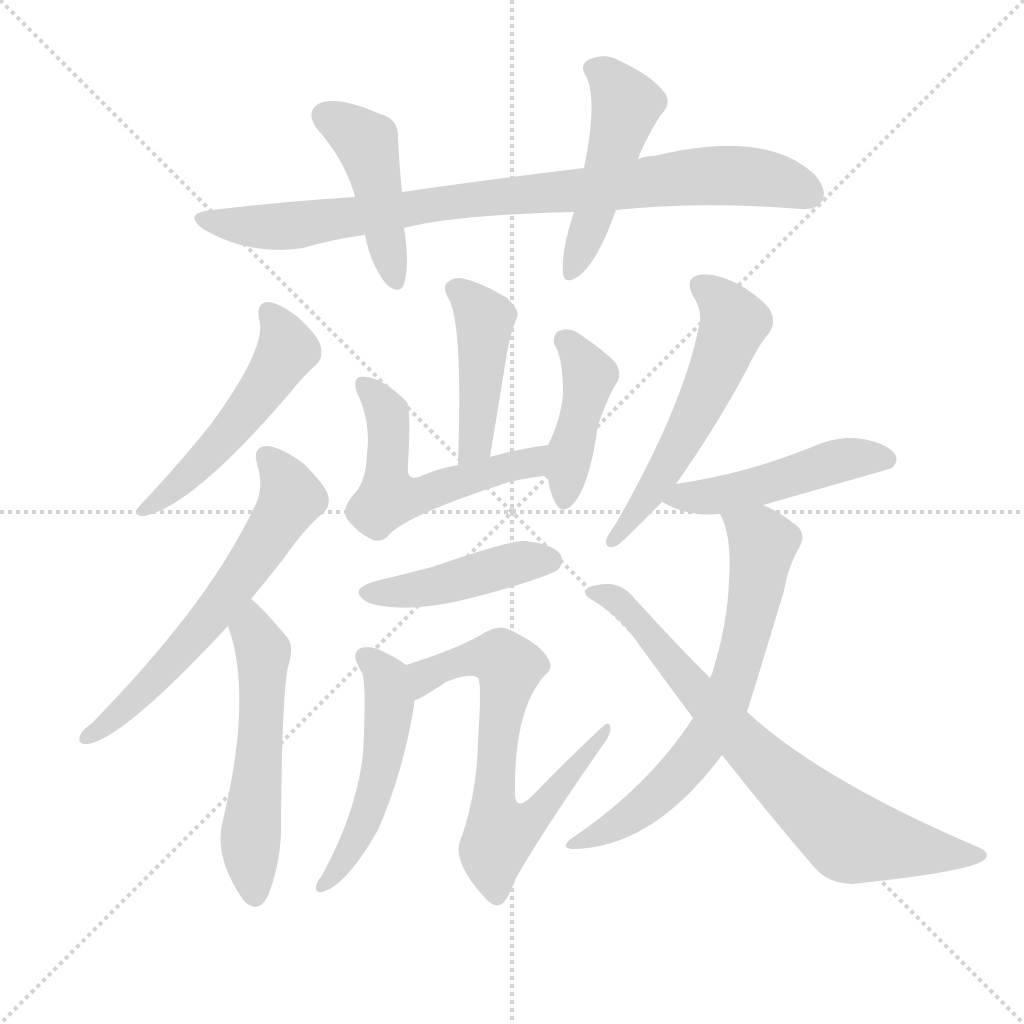
Wei
Kangxi Stroke Count: 19
Page 1060, Entry 21
Pronounced wei.
In the Jade Chapter (Yupian), it is defined as a vegetable. In the Analytical Dictionary of Characters (Shuowen), it is described as a type of vegetable similar to bean leaves but smaller. In the Book of Odes (Shijing), it is said: "Picking the wei vegetables." In the Book of Etiquette and Ceremonial (Yili), it describes vegetables used for seasoning served in tureen vessels: beef served with bean leaves, mutton with bitter greens, and pork with wei vegetables, all prepared with seasonings to make them tender and smooth.
Also, baiwei, a type of medicine. Also, miwu, which is also known as weiwu. In the Southern Capital Rhapsody (Nandufu) by Zhang Heng, it is mentioned as weiwu, sun, and chang.
Also, the name of a flower. In the Records of Gleanings (Shiyiji), it is recorded that in the first year of the Yuanxi era, an imperial decree ordered the planting of crape myrtle in gardens throughout the realm to ward off evil. In the Old Book of Tang (Tangshu), the Secretariat is responsible for drafting imperial decrees; during the Kaiyuan era, it was referred to as the Crape Myrtle Secretariat. Also, qiangwei, see the entry for the character qiang.
Pronounced mei.
In the Er-Ya (Erya), it is described as wei that hangs over the water. The commentary notes that it grows by the water's edge. Also, weixian, a type of medicine. In the Collected Rhymes (Jiyun), it is sometimes written in a variant form.