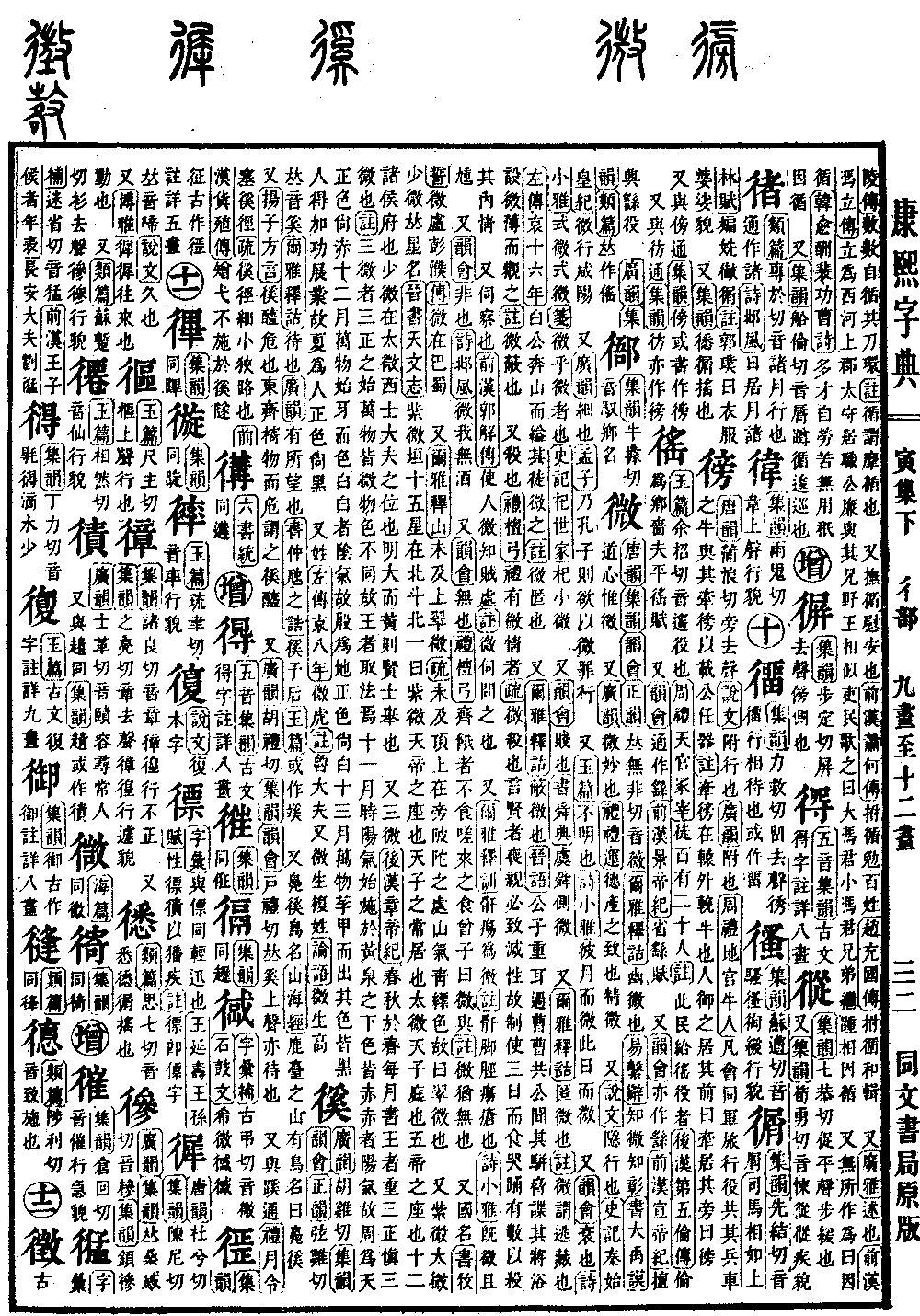
Yin Collection, Lower Volume
Radical: Step (chì)
Kangxi Strokes: 13
Page 370, Entry 12
Pronounced wei
Literary Expositor (Erya), Explanation of Words: Hidden and subtle.
Book of Changes (Yijing), Appended Remarks: Knowing the subtle and knowing the manifest.
Book of Documents (Shujing), Counsels of the Great Yu: The heart of the Way is subtle.
Broad Rhymes (Guangyun): Subtle, wondrous.
Book of Rites (Liji), Conveyance of Rites: The extremity of virtue produced is refined and subtle.
Explanation of Simple and Compound Characters (Shuowen): To walk in hiding.
Records of the Grand Historian (Shiji), Annals of Qin Shi Huang: He traveled in hiding through Xianyang.
Broad Rhymes (Guangyun): Small, fine.
Mencius: As for Confucius, he wished to leave due to a minor offense.
Jade Chapters (Yupian): Not bright, obscure.
Book of Odes (Shijing), Lesser Odes of the Kingdom: That moon is eclipsed, this sun is eclipsed.
Rhyme Collection (Yunhui): To decline, to wane.
Book of Odes (Shijing), Lesser Odes of the Kingdom: In decline, in decline.
Commentary: The subtle of the subtle.
Records of the Grand Historian (Shiji), House of Qi: Qi was small and in decline.
Rhyme Collection (Yunhui): Lowly, humble.
Preface to the Book of Documents: Yu Shun was from a humble background.
Literary Expositor (Erya), Explanation of Words: To hide.
Commentary: To hide or to flee into concealment.
Zuo Tradition (Zuo Zhuan), Sixteenth Year of Duke Ai: Duke Bai fled to the mountains and hanged himself; his followers hid him.
Commentary: To hide.
Literary Expositor (Erya), Explanation of Words: To screen, to hide.
Narratives of the States (Guoyu), Jin: When Prince Chong'er passed through Cao, Duke Gong of Cao heard of his distinctive ribs, spied on him while he was bathing, and set up a screen to observe him.
Commentary: To hide/screen.
To diminish, to lessen.
Book of Rites (Liji), Tan Gong: Rites have those that diminish emotion.
Commentary: To diminish; it means that when a virtuous person loses a parent, they must inevitably reach a state of physical collapse, therefore the rites stipulate that after three days they eat, and there are fixed numbers for crying and leaping, in order to diminish their internal feelings.
To spy, to observe.
History of the Former Han (Qianhan), Biography of Guo Jie: He sent people to secretly learn the location of the thieves.
Commentary: To spy or inquire secretly.
Literary Expositor (Erya), Explanation of Teaching: A sore on the shin is called wei.
Commentary: The lower leg. An ulcer or sore.
Book of Odes (Shijing), Lesser Odes of the Kingdom: Both suffering from sores and swollen legs.
Rhyme Collection (Yunhui): No, not.
Book of Odes (Shijing), Odes of Bei: Were it not for me, there would be no wine.
Rhyme Collection (Yunhui): None, nothing.
Book of Rites (Liji), Tan Gong: For those starving in Qi, do not offer "hey there" food. Zengzi said: Is there none?
Commentary: It means none.
Name of a state.
Book of Documents (Shujing), Oath at Mu: Wei, Lu, Peng, Pu.
Commentary: Wei was located in the Ba-Shu region.
Literary Expositor (Erya), Explanation of Mountains: Not yet reaching the green mists above.
Commentary: Before reaching the summit, in the sloping areas to the side, the mountain air is of a light blue-green color, hence it is called green mist.
Purple Palace (Ziwei), Supreme Palace (Taiwei), and Lesser Palace (Shaowei) are names of stars.
History of the Jin (Jinshu), Treatise on Astronomy: The Purple Palace Enclosure consists of fifteen stars located near the North Star. The northern one is called the Purple Palace, which is the throne of the Celestial Emperor and the constant residence of the Son of Heaven. The Supreme Palace is the court of the Son of Heaven, the seat of the Five Emperors, and the offices of the twelve feudal lords. The Lesser Palace is located to the west of the Supreme Palace; it is the position of the scholar-officials. If it is bright and large and yellow, it means that worthy scholars are being promoted.
The Three Subtleties.
History of the Later Han (Houhan), Annals of Emperor Zhang: In the Spring and Autumn Annals, the king is recorded every month in spring, emphasizing the three beginnings and the caution of the three subtleties.
Commentary: The three subtleties are the beginnings of the three correct standards; all things are subtle, and the character of things differs, so the king takes them as a model. In the eleventh month, the time when yang energy first begins to manifest below the Yellow Springs, the color is red; red represents yang energy, so the Zhou Dynasty took it as the heavenly standard and honored red. In the twelfth month, all things begin to bud and the color is white; white represents yin energy, so the Yin Dynasty took it as the earthly standard and honored white. In the thirteenth month, all things sprout and emerge, and their color is black, which allows people to add effort and expand their work, so the Xia Dynasty took it as the human standard and honored black.
A surname.
Zuo Tradition (Zuo Zhuan), Eighth Year of Duke Ai: Wei Hu.
Commentary: A grand officer of the state of Lu.
Weisheng, a compound surname.
Analects (Lunyu): Weisheng Gao.