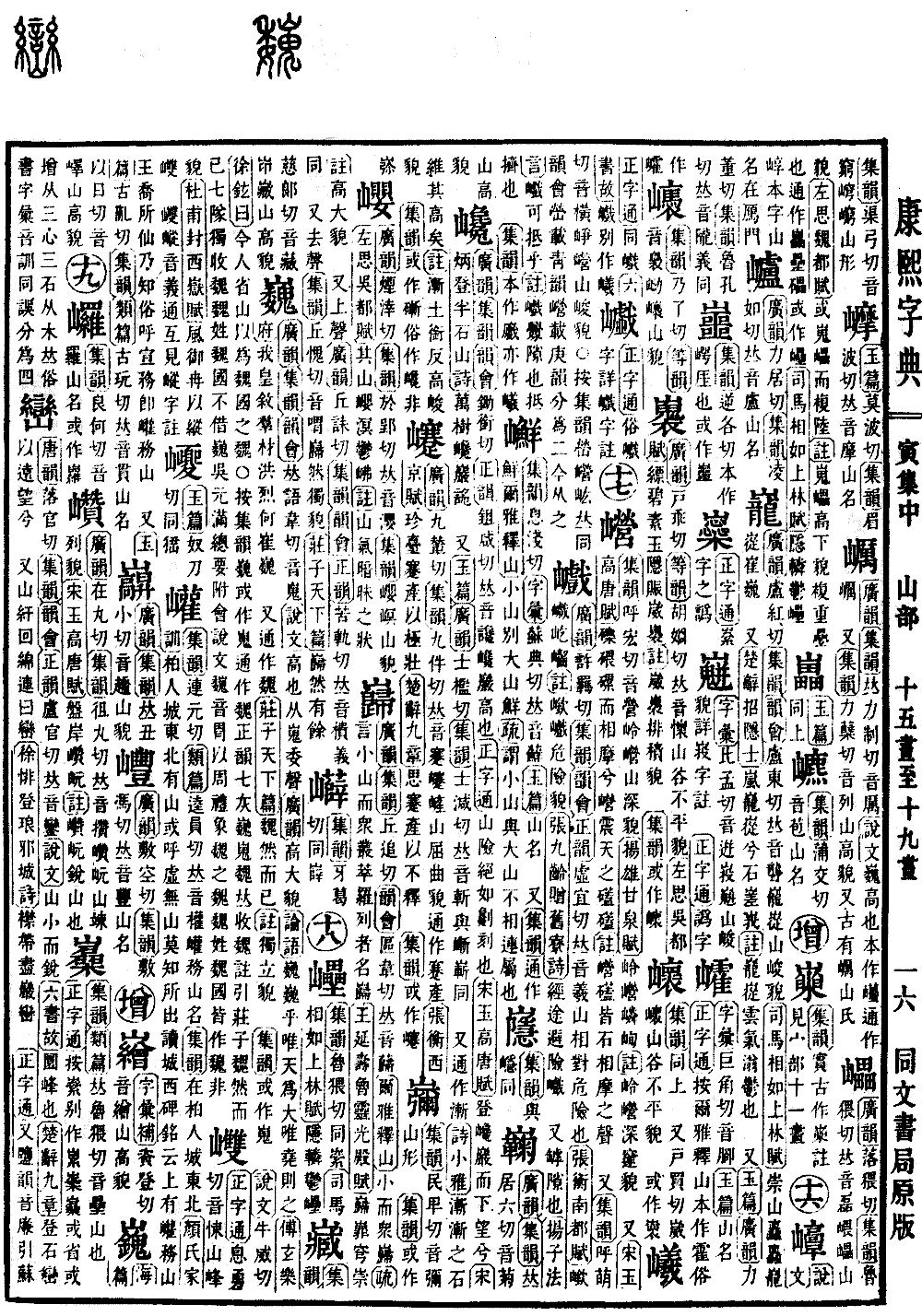
Yin Collection, Middle Volume
Radical: Mountain (shān)
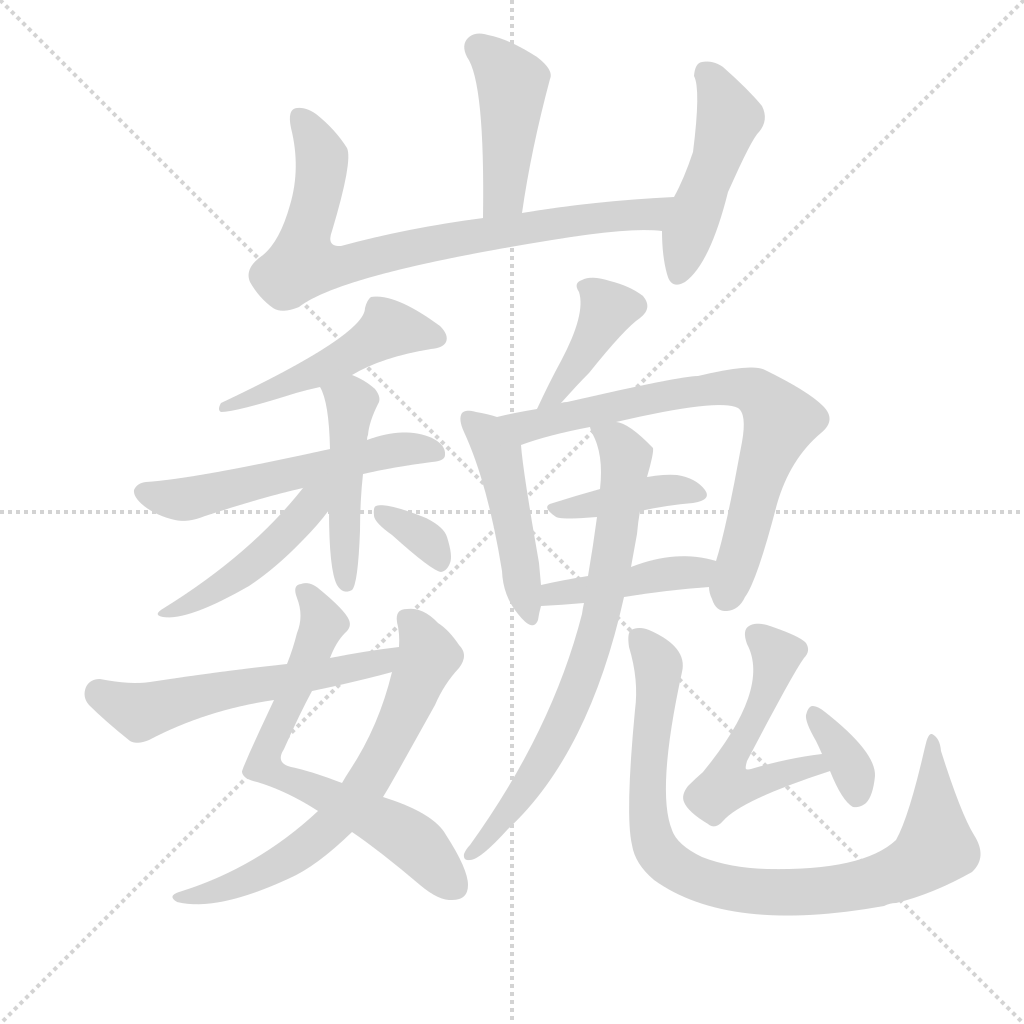
Wei
Kangxi strokes: 21
Page 322, Entry 32
Pronounced wei (rising tone). Matches the sound of wei.
According to the Explaining Graphs and Analyzing Characters (Shuowen Jiezi), it means high. It is composed of the radical for high mountain and the phonetic component for wei.
According to the Expanded Rhymes (Guangyun), it refers to the appearance of being high and great.
Analects (Lunyu): High and great is heaven alone; only Emperor Yao took it as a model.
Fu Music Bureau (Fu Yuefu): My emperor arranges the various talents, his grand achievements are so high and great.
It is also commonly written as the variant form (wei).
Zhuangzi, World Chapter (Tianxia pian): Towering and nothing more.
Commentary: The appearance of standing alone.
Collected Rhymes (Jiyun): Sometimes written as the variant form (wei).
According to the Explaining Graphs and Analyzing Characters (Shuowen Jiezi): Pronounced wei (level tone).
Xu Xuan stated: People today omit the mountain radical, taking it to be the wei of the State of Wei.
Note: According to the Collected Rhymes (Jiyun), wei may be written as the variant form (wei), and is interchangeably used with (wei). The Correct Rhymes (Zhengyun) states that in the rhyme group for seven-hui, the characters wei, wei, and wei are collected together; the note on the wei in the Zhuangzi cites it as towering and nothing more. In the seven-dui group, only the character wei is collected; the wei for the surname and the State of Wei do not borrow the character wei. Wu Yuanman's General Essentials (Zongyao) notes that it is a forced connection to claim in the Explaining Graphs and Analyzing Characters (Shuowen Jiezi) that the wei of the State of Wei is pronounced wei (falling tone), and that because of the wei in the elephant-tower (xiangwei) mentioned in the Rites of Zhou (Zhouli), the wei of the surname and the State of Wei should all be written with the mountain radical is incorrect. The character wei is composed of the components wei and wei.