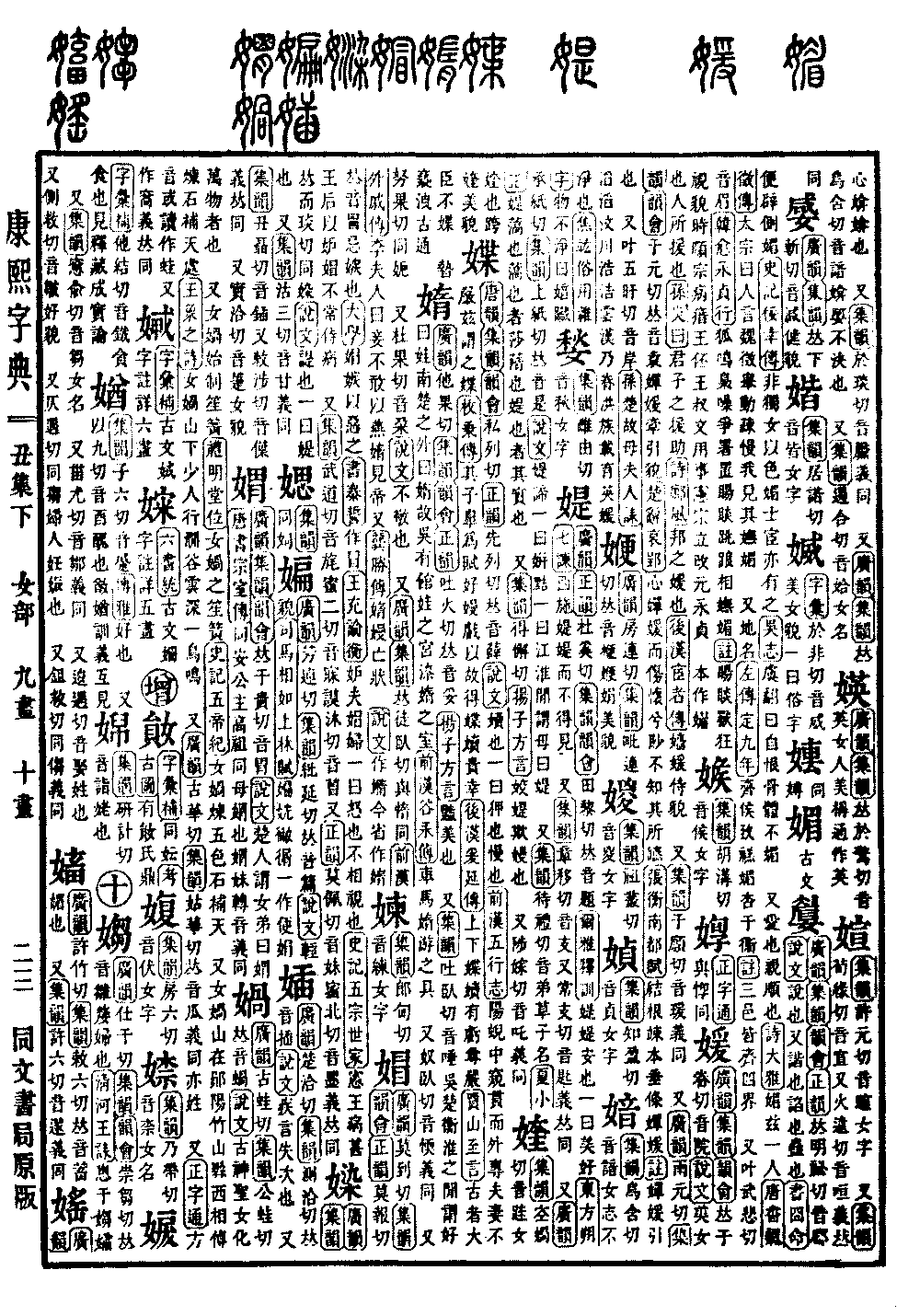
Chou Collection, Lower Volume
Radical: Woman (nǚ)
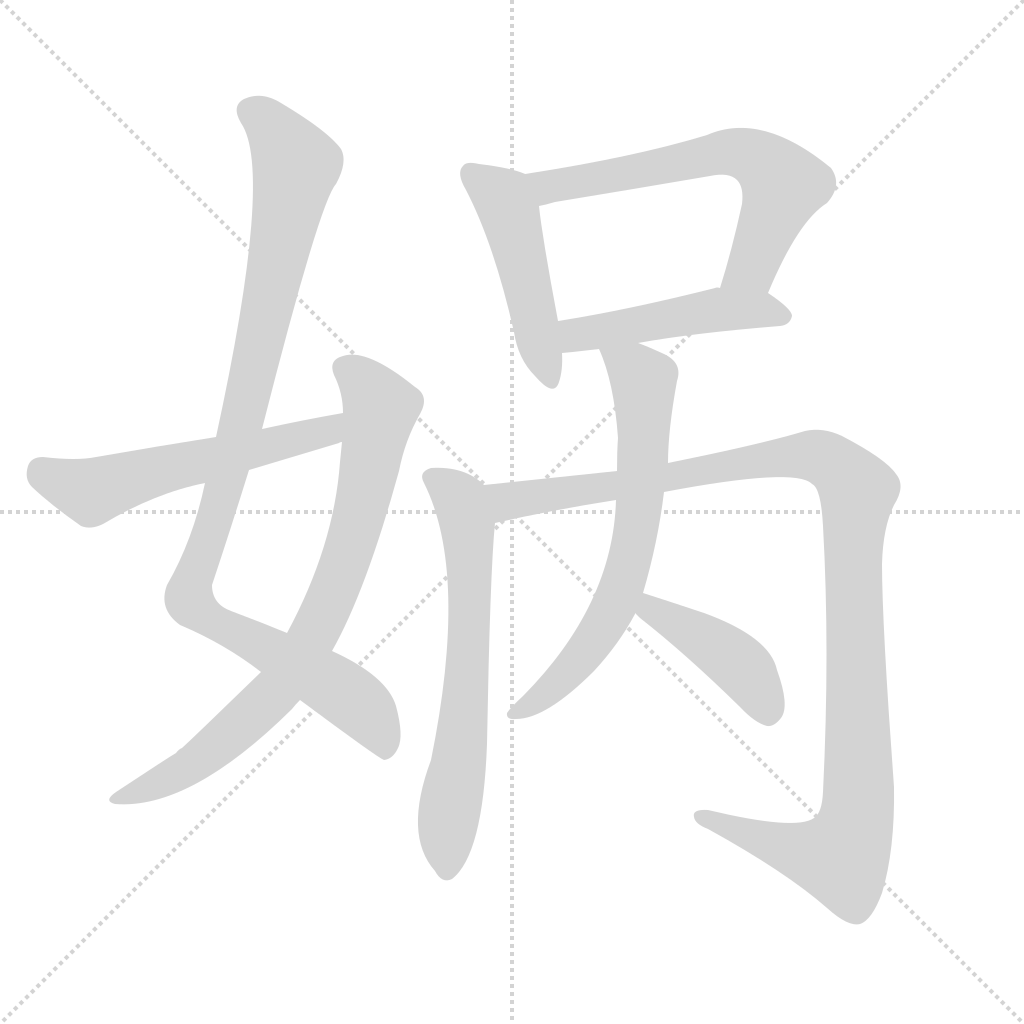
Entry: Wa
Kangxi strokes: 12
Page 267, Entry 02
According to the Extensive Rhymes (Guangyun) and Collected Rhymes (Jiyun), the pronunciation is wa. According to the Explanation of Simple and Compound Characters (Shuowen), she was a holy woman of antiquity who nurtured and transformed all things. Nüwa was also the first to create the sheng and huang reed instruments. According to the Book of Rites (Liji), specifically the Bright Hall Position section, these are the sheng and huang of Nüwa. According to the Records of the Grand Historian (Shiji), specifically the Chronicle of the Five Emperors, Nüwa smelted five-colored stones to mend the heavens. Furthermore, Nüwa Mountain is located west of Zhushan County in Yunyang; legend holds that this is where she smelted the stones to mend the heavens. According to the poem by Wang Xiangzhi, travelers are few beneath Nüwa Mountain, where deep valleys are shrouded in mist and clouds, and only the cry of a lone bird is heard.
Also, according to the Extensive Rhymes (Guangyun) and Collected Rhymes (Jiyun), the pronunciation is gua. The meaning is the same. It is also a surname. According to the Correction of Character Forms (Zhengzitong), in some dialects, it is pronounced wa. It is also written in a variant form (wo), with the same meaning.