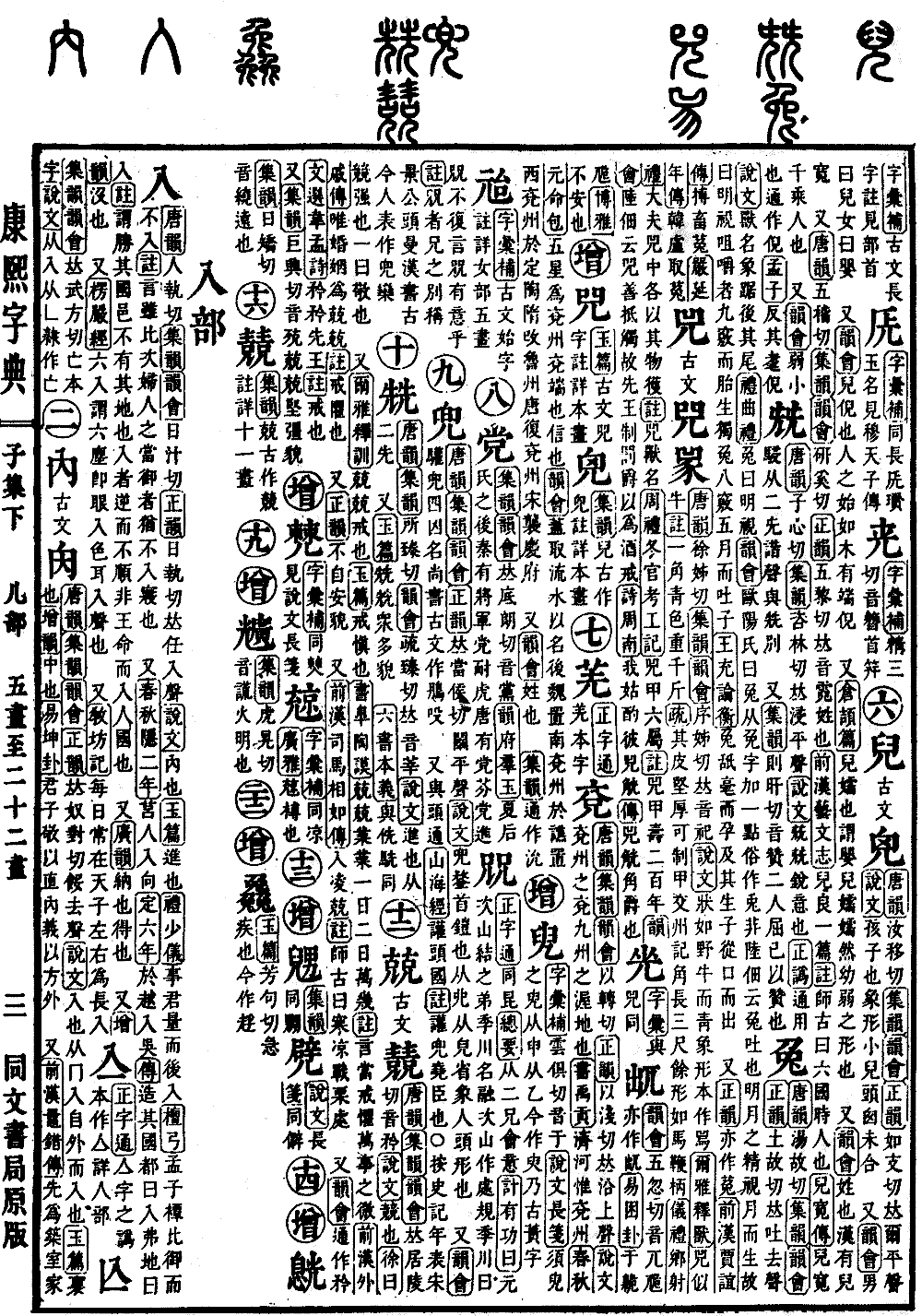
Zi Collection, Page Position: Lower
Radical: Legs (ér)
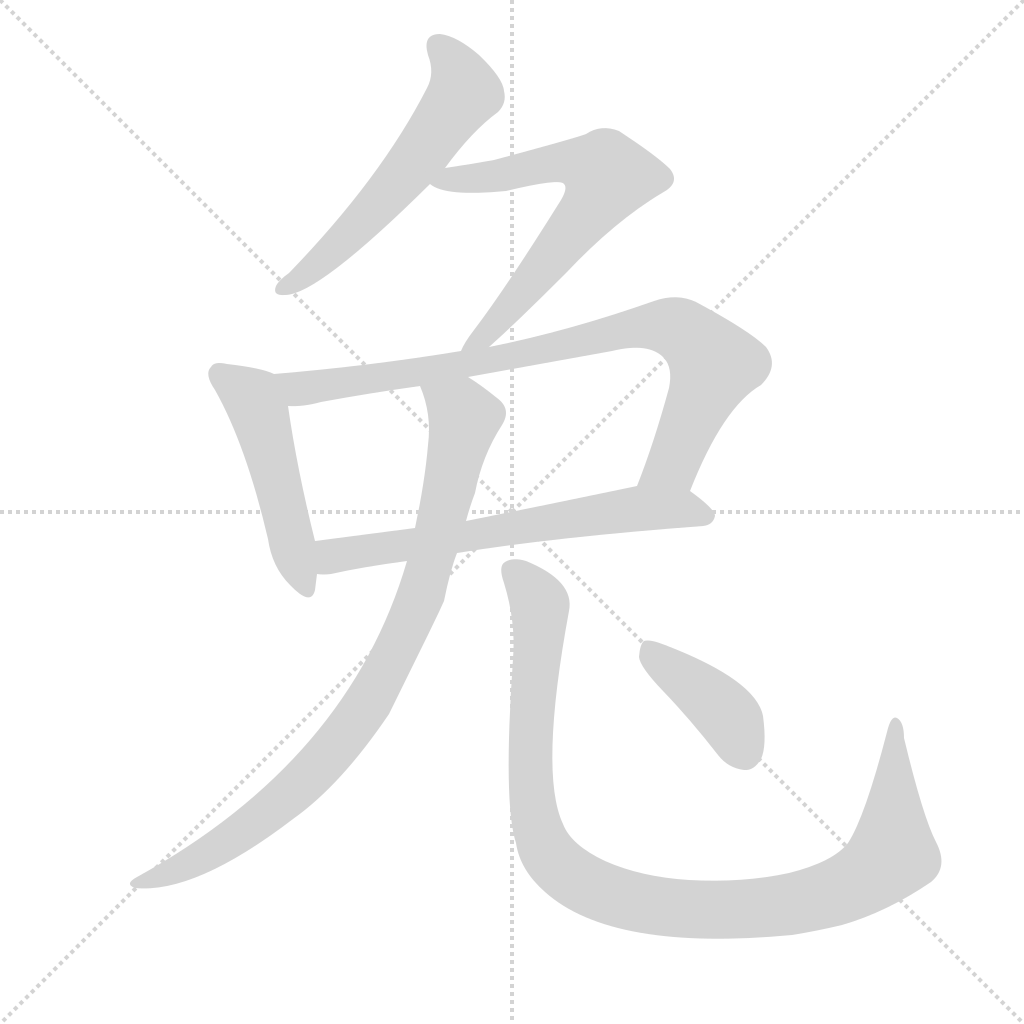
兔 (tù)
Kangxi Dictionary stroke count: 8
Page 125, Entry 06
Pronounced tù (falling tone) according to Tang Yun (tang gù qiè) and Jiyun (jùn), Yunhui (yùn huì), and Zhengyun (zhèng yùn) (tǔ gù qiè).
Definition from Shuowen Jiezi (Shuowen Jiezi): A type of animal. The character depicts its appearance with its tail behind when crouching.
In the "Book of Rites (Liji)," the rabbit is referred to as "míng shì" (clear sight).
Yunhui (Yunhui) quotes Ouyang's explanation: The character 兔 is formed by adding a dot to the character 免. The common incorrect writing 兎 is wrong. Lu Dian states: 兔 is indeed "tǔ" (spit). It is the essence of the bright moon, and it conceives by looking at the moon, hence it is called "míng shì" (clear sight). Generally, chewing animals have nine orifices and are viviparous, but the rabbit has only eight orifices, and gives birth to its young from its mouth after five months of gestation.
Wang Chong's "Discourse on the Balance of the Heavens (Lunheng)" records: Rabbits conceive by licking their fur, and when they give birth, the young emerge from their mouths.
Also written as 菟 (tú) in Zhengyun (Zhengyun).
"Han Shu (Hanshu), Biography of Jia Yi" contains the phrase "bó chù tú" (to capture and raise rabbits).
"Biography of Yan Yannian" contains the phrase "Hán lú qǔ tú" (Han Lu captures rabbits).