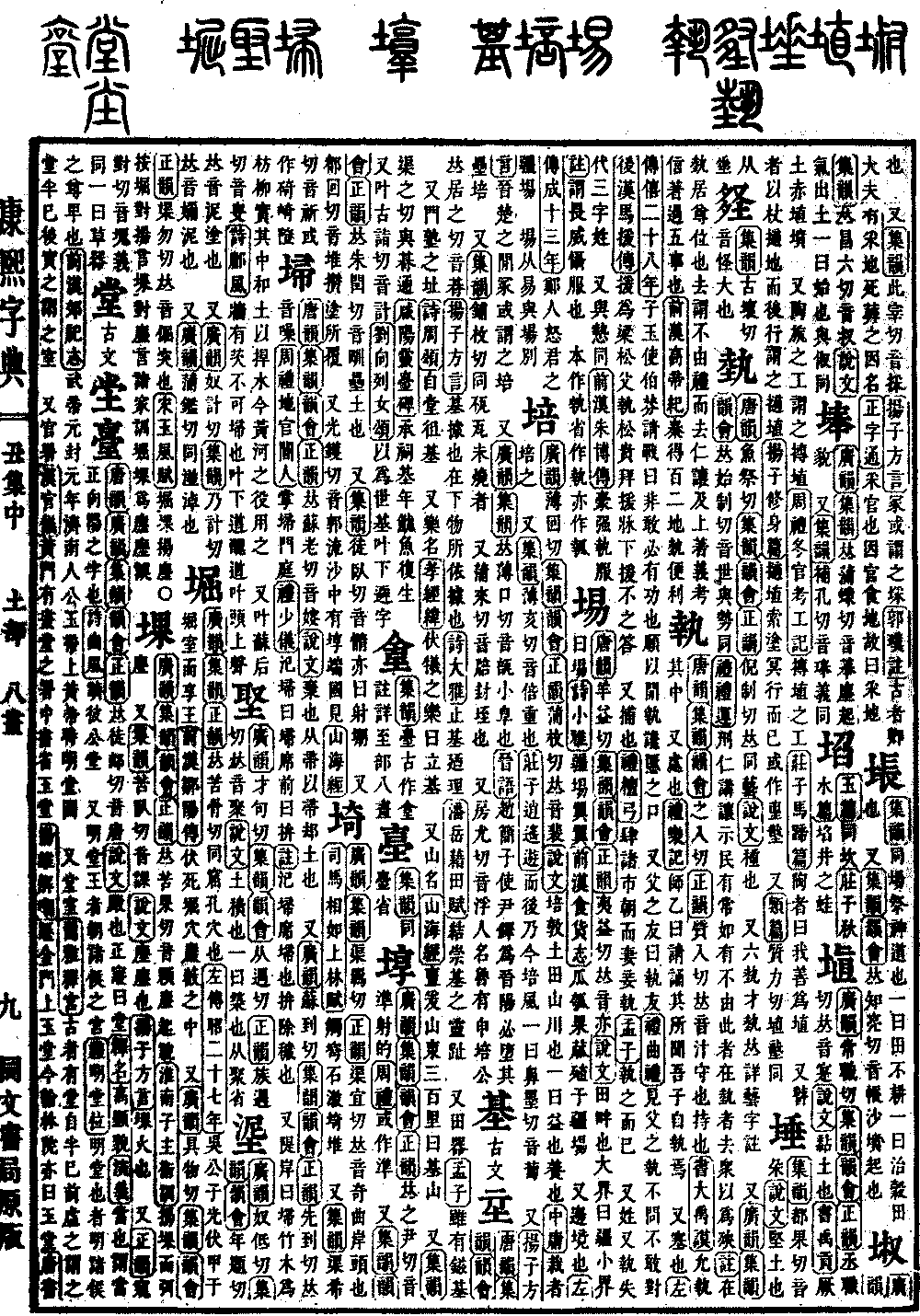
Chou Collection, Middle Volume
Radical: Earth (tǔ)
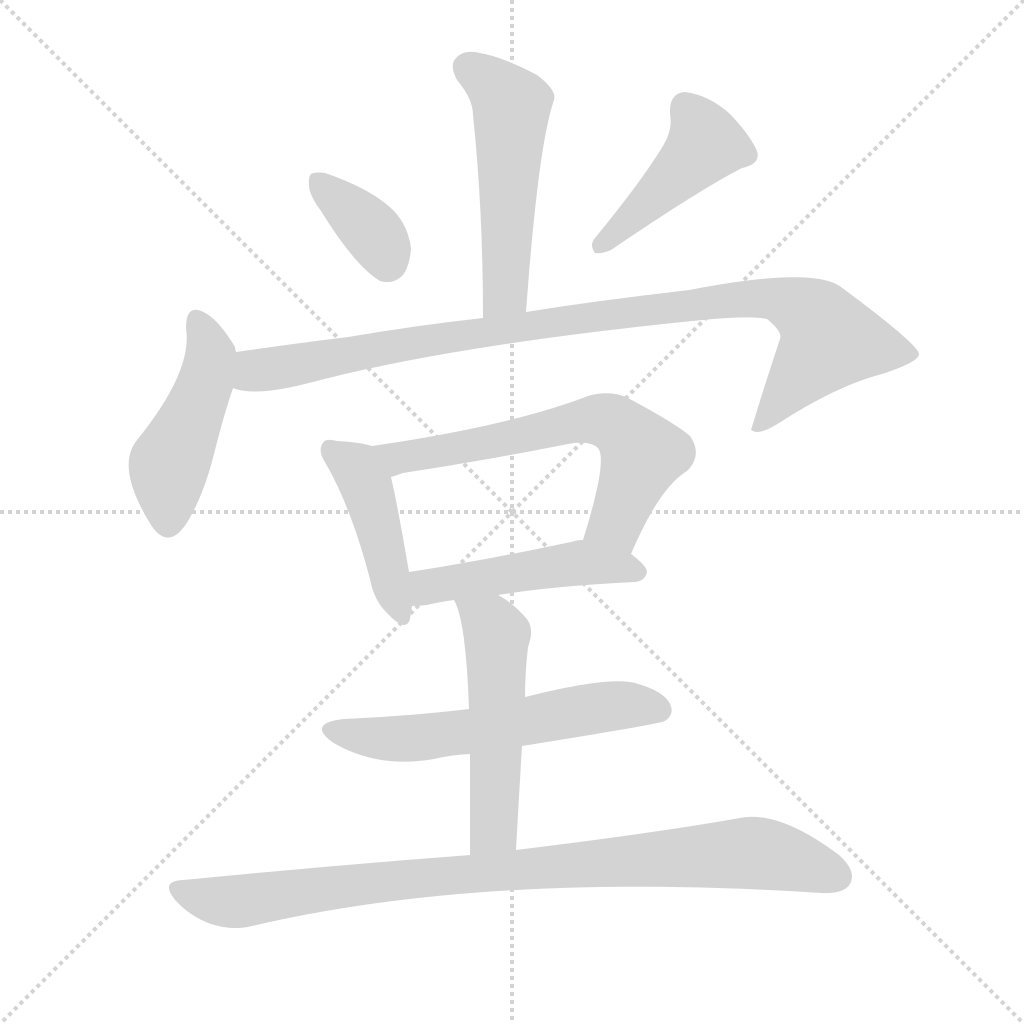
Tang. Kangxi Dictionary strokes: 11. Page 231, Entry 23.
Archaic form: Tang.
Pronounced tang.
Shuowen Jiezi (Explanation of Writing): A main hall. The central chamber is called a hall.
Shiming (Explanations of Names): Appearing high and prominent.
Yanyi (Romance): Meaning appropriate; it refers to a building that faces the sun directly.
Book of Odes (Shijing): Climbing up to that public hall.
Also refers to Mingtang, the palace where a king holds court for feudal lords.
Book of Rites (Liji): The Mingtang is the place where the status of feudal lords is clarified.
History of the Former Han (Qianhan Shu), Treatise on Suburban Sacrifices (Jiaosi Zhi): In the first year of the Yuanfeng era of Emperor Wu, the man Gongyu Dai from Jinan presented a diagram of the Mingtang from the time of the Yellow Emperor.
Also refers to a hall and chamber.
Erya (Approaching Elegance), Explanations of Palaces: In ancient times, buildings had halls; the space from the midpoint forward was left open, called a hall, and the space from the midpoint backward was enclosed, called a chamber.
Also refers to government offices.
Hanguan Yi (Ceremonials of Han Officials): The Yellow Gate had the Office of the Painted Hall, and the Secretariat had the Jade Hall.
Yang Xiong, Refuting Ridicule (Jiechao): Passing through the Golden Gate, ascending the Jade Hall. Today, the Hanlin Academy is also called the Jade Hall.
Old Book of Tang (Tang Shu), Treatise on Officials: Initially, the three departments discussed affairs at the Politics Hall of the Secretariat, but later Pei Yan moved it to the Secretariat.
Also, the Ministry of Revenue has an Examination Hall, where the annual accounts of the empire are settled.
Wujun Guozhi (Records of the Wu Commandery): The commandery governor's hall was the former residence of Lord Chunshen. It caught fire repeatedly, but once it was coated with orpiment, the fires stopped; therefore, the commandery government seat is called the Yellow Hall.
Lu's Spring and Autumn Annals (Lüshi Chunqiu): When Fu Zijian played the zither, the district of Shanfu was governed well; therefore, the district government seat is called the Zither Hall.
Also, tangtang means grand or upright.
Analects (Lunyu): How grand is Zhang.
Huainanzi, Summary of Military Strategy (Binglüe Xun): A grand, upright battle formation.
Also, people laughing together is called hongtang.
Yinhualu (Record of Conversations): The Censorate had the Terrace, Palace, and Investigative bureaus. One person was in charge of miscellaneous affairs, known as the Miscellaneous Head. In the public hall where they ate together, laughter was prohibited. When one could not help but laugh, the Miscellaneous Head laughed, and all three halls laughed; thus, it is called hongtang.
Also, a Buddhist hall is called a Wild Goose Hall.
Shishi Yaolan (Essentials of Buddhism): When building a hall for the Buddha at Vaishali, the shape resembled the character for wild goose, hence the name.
Refers to rituals by shamans.
Rites of Zhou (Zhouli), Offices of Spring: The male shaman performs the winter hall ritual, offering sacrifices to spirits without measure.
Commentary: At the end of the year, offerings are set in the hall to send off all ghosts.
Also a place name.
Book of Odes (Shijing): Gazing toward Chu and Tang.
Commentary: Chu is Chuqiu. Tang is a city beside the hill.
Also, a wide, flat place on a mountain is called a hall.
Book of Odes (Shijing): What is on Mount Zhongnan? There are ridges and halls.
Also a surname.
Hanshi Waizhuan (Outer Commentary to the Han School Odes): Tangyiruo knocked on the door of Confucius.
Also a double surname. The Han Confucian scholar Gaotang Sheng; during the Zhenguan era of the Tang Dynasty, an imperial decree allowed him to be honored with sacrificial offerings.
Also pronounced tong.
Qu Yuan, Nine Songs (Jiuge): Houses with fish-scale tiles and dragon halls, palace gates of purple cowries and pearl chambers.