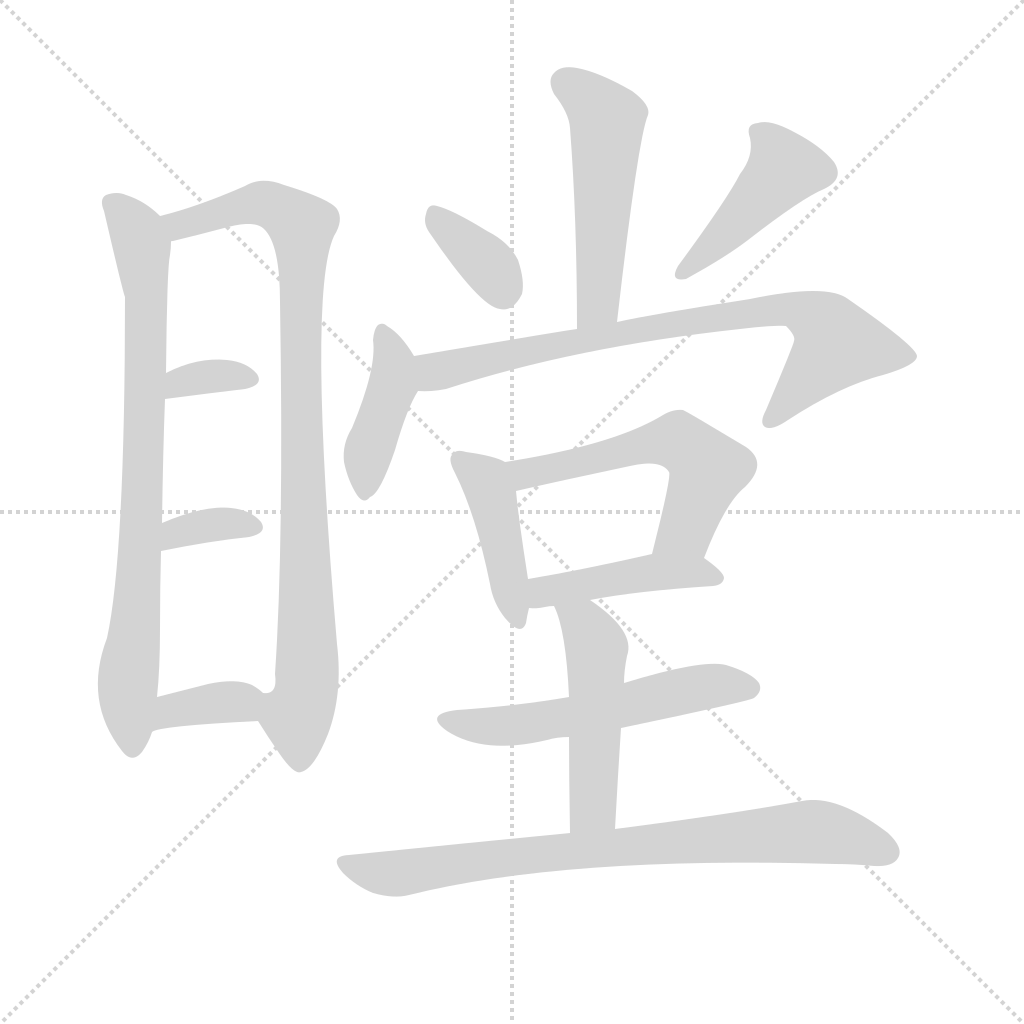
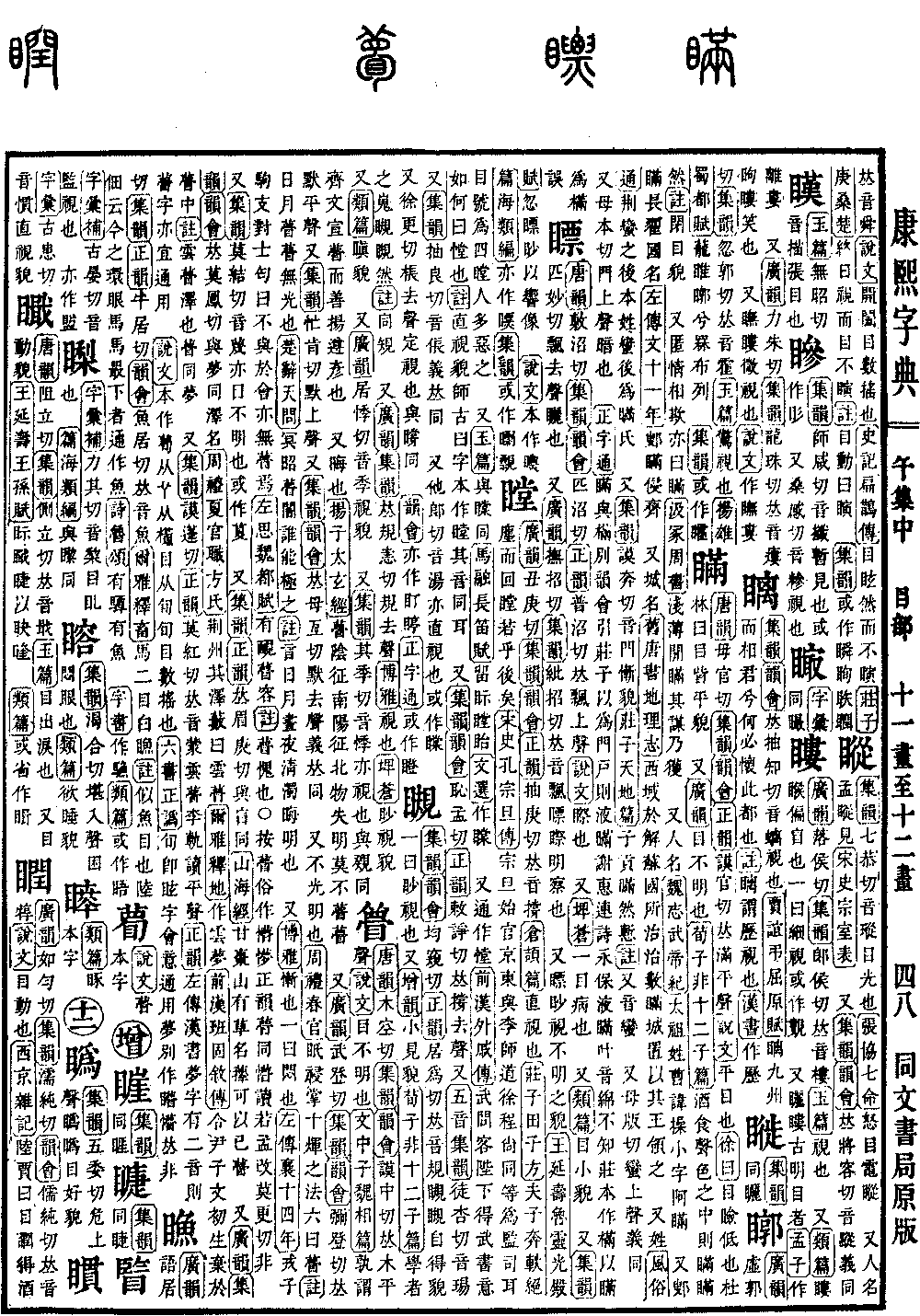
Wu Collection, Middle Volume. Radical: Eye (mù). Kangxi stroke count: 16. Page 816, Entry 11.
Broad Rhymes (Guangyun): Pronounced cheng. Collected Rhymes (Jiyun), Rhyme Meetings (Yunhui), and Orthodox Rhymes (Zhengyun): Pronounced cheng. To stare directly. Zhuangzi (Zhuangzi): The Master gallops away, leaving the dust behind, while Yan Hui stares in frustration as if he is behind. History of Song (Songshi), Biography of Kong Zongdan: When Zongdan first took office in Jingdong, he and others like Li Shidao and Xu Chengshang served as the eyes and ears of the oversight department, and were collectively known as the Four Stares, a title much loathed by the people.
Also, the Jade Chapters (Yupian) equates this to the same character. In Ma Rong’s Rhapsody on the Long Flute (Changdifu): Staring intently and wide-eyed. In Selections of Refined Literature (Wenxuan), it is written as such. It is also interchangeably written as the variant form (dang). In History of the Former Han (Qianhan), Biography of Empress Consorts: Emperor Wu asked the guest, what did you think when the Emperor received Wu’s letter? He replied, it was a blank stare. Commentary: The appearance of staring directly. Shigu said: The original character was written as cheng, and the pronunciation is the same.
Also, Collected Rhymes (Jiyun) and Rhyme Meetings (Yunhui): Pronounced cheng (falling tone). Also, Five Sound Collected Rhymes (Wuyin Jiyun): Pronounced chang. Also, Collected Rhymes (Jiyun): Pronounced chang. The meaning is the same. Also: Pronounced tang. It also means to stare directly. Sometimes written as the variant form. Also: Pronounced cheng (falling tone). A fixed stare. It is the same as the variant form. Rhyme Meetings (Yunhui): Also written as the variant form (ding). Orthodox Character Mastery (Zhengzitong): Sometimes written as the variant form (deng).