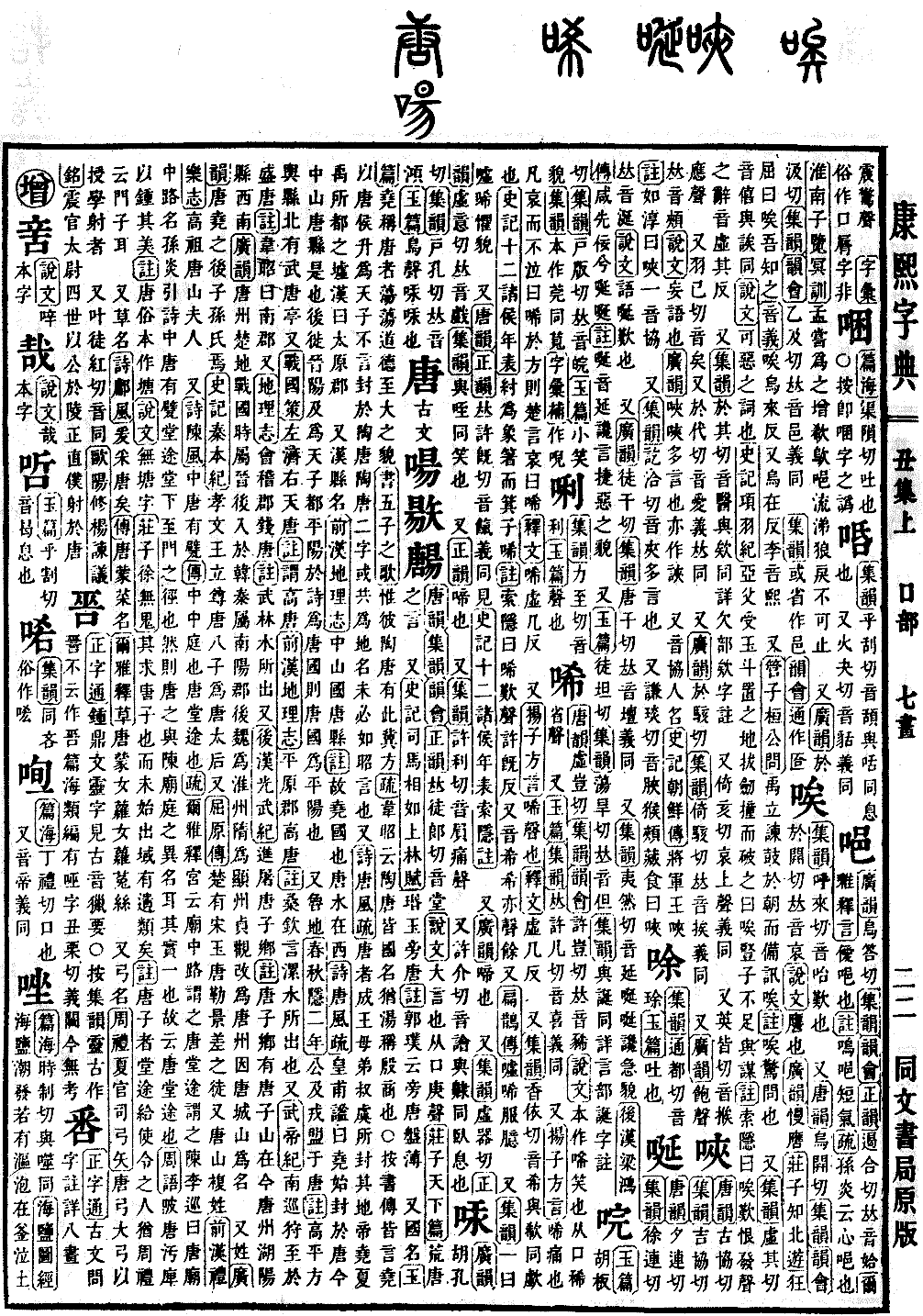
Chou Collection, Upper Volume
Radical: Mouth (kǒu)
Kangxi stroke count: 10
Page 192, Entry 12
Ancient form: Táng
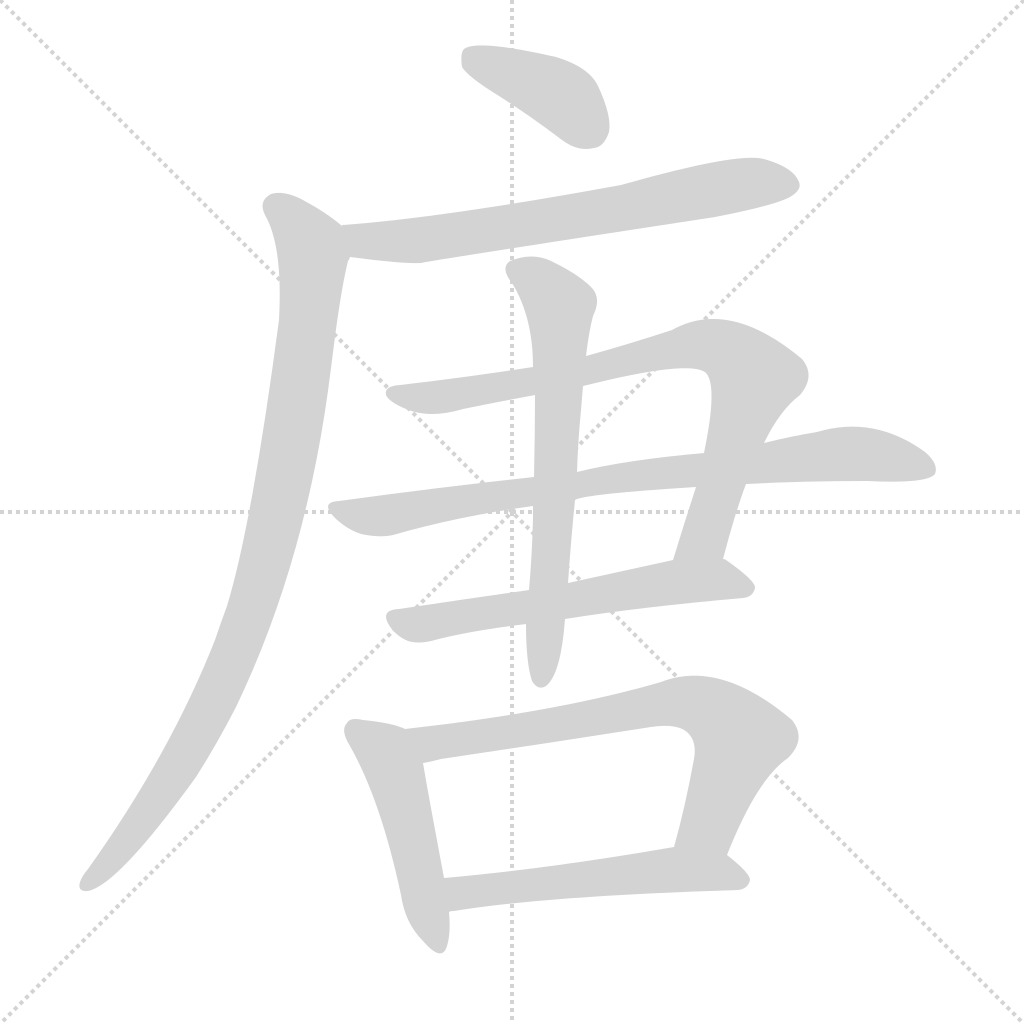
Pronounced táng.
Shuowen Jiezi (Explanation of Writing and Analysis of Characters): To speak loudly. Composed of Mouth (kǒu) and the phonetic component Gēng.
Zhuangzi, Chapter: Under Heaven (Tianxia pian): Extravagant and hyperbolic words.
Records of the Grand Historian (Shiji), Sima Xiangru, Shanglin Fu: A scattering of precious jade. Commentary by Guo Pu: Pángtáng means to be expansive and extensive.
A name of a state. Yu Pian (Jade Chapters): Emperor Yao was called Táng, meaning vast and overflowing, describing a character whose morality was reaching the greatest heights.
Book of Documents (Shujing), Song of the Five Sons: In those lands of Taotáng, this territory of Jì existed. Commentary by Wei Zhao: Táo and Táng are both names of states, similar to how King Tang was called Yīn Shāng. Note: The commentaries on the Book of Documents all state that Emperor Yao ascended to the position of Son of Heaven from being the Marquis of Táng, and do not mention his enfeoffment in Táo Táng. The two characters Táo and Táng might together form a single place name, and it is not necessarily as Wei Zhao stated.
Book of Odes (Shijing), Tang Feng Shu: Táng refers to the place enfeoffed to Shūyú, the younger brother of King Chéng. It was the ruined capital of Emperor Yáo and Yǔ the Great. In the Han Dynasty, it was called Tàiyuán Commandery.
A name of a Han dynasty county. History of the Former Han (Qian Hanshu), Geography Treatise: Táng County in the Zhōngshān State. Commentary: It was the former state of Yáo; the Táng River is to the west.
History of the Former Han (Qian Hanshu), Geography Treatise, Commentary by Huángfǔ Mì: Yáo was first enfeoffed in Táng, which is present-day Táng County in Zhōngshān. Later he moved to Jìnyáng, and when he became Son of Heaven, he established his capital at Píngyáng. In the Book of Odes, it is referred to as the State of Táng, meaning the State of Táng is Píngyáng.
A place in the State of Lǔ. Spring and Autumn Annals (Chunqiu), Duke Yin, 2nd Year: The Duke and the Rong tribe formed an alliance at Táng. Commentary: To the north of Fāngyú County in Gāopíng there is a Wǔtáng Pavilion.
Strategies of the Warring States (Zhanguo Ce): To the left is Jì and to the right is Tiāntáng. Commentary: This refers to Gāotáng.
History of the Former Han (Qian Hanshu), Geography Treatise: Gāotáng in Píngyuán Commandery. Commentary: Sāng Qīn says this is where the Lù River originates.
Biography of Emperor Wu: On his southern inspection tour, he arrived at Shèngtáng. Commentary: Wei Zhao states it is in Nán Commandery.
Geography Treatise: Qiántáng in Kuàijī Commandery. Commentary: Where the Wǔlín River originates.
Book of the Later Han (Hou Hanshu), Biography of Emperor Guangwu: Advanced to slaughter at Tángzǐ Township. Commentary: Tángzǐ Township has Tángzǐ Mountain, which is southwest of Húyáng County in Táng Prefecture today.
Guang Yun (Extensive Rhymes): Táng Prefecture was land of the State of Chǔ. During the Warring States period, it belonged to the State of Jìn, later entered the State of Hán, in the Qín Dynasty it belonged to Nányáng Commandery, in the Northern Wei it became Huái Prefecture, and in the Suí Dynasty it became Xiǎn Prefecture. During the Zhēnguān era, it was renamed Táng Prefecture, named after Tángchéng Mountain.
A surname. Guang Yun (Extensive Rhymes): Descendants of Yáo of Táng took this as their surname.
Records of the Grand Historian (Shiji), Qín Annals: When Emperor Xiàowén took the throne, he honored Táng Bāzǐ as Empress Dowager Táng.
Biography of Qu Yuan: Chǔ had people like Sòng Yù, Táng Lè, and Jǐng Chā.
Tángshān, a compound surname. History of the Former Han (Qian Hanshu), Treatise on Rites and Music: Lady Tángshān of the Gaozu Emperor.
Book of Odes (Shijing), Feng: In the middle of Táng there are tiles. Commentary: Zhōng refers to the central courtyard. Táng refers to the path leading to the hall. Commentary: Erya, Interpretation of Dwellings says: The path within the temple is called Táng; the path to the hall is called [omitted]. Lǐ Xún said: Táng is the name of the path within the temple. Sǔn Yán quotes the Book of Odes regarding the tiles in the middle of the Táng. The path to the hall is the path from under the hall to the gate. Therefore, Táng and the path to the hall are different names for the same temple courtyard; they are actually the same thing. Thus it is said: Táng is the path to the hall.
Discourses of the States (Zhou Yu): Embanking the Táng and the muddy lowlands to collect its beauty. Commentary: In common editions, Táng is written as Táng (pond).
Shuowen Jiezi (Explanation of Writing and Analysis of Characters): There is no character for pond.
Zhuangzi, Xu Wugui: Looking for a Táng servant, yet never having left the domain, there remains a surviving type. Commentary: A Táng servant refers to someone who provides service on the path to the hall, similar to what the Rites of Zhou calls a gate servant.
A name of a plant. Book of Odes (Shijing), Yong Feng: Gathering the Táng. Commentary: Táng is the name of the dodder plant.
Erya, Interpretation of Grasses: Tángméng is the Nǚluó (dodder). Nǚluó is the dodder.
A name of a bow. Rites of Zhou (Zhouli), Summer Official, Director of Bows and Arrows: The Táng bow and the Great bow were given to those learning archery.
Also pronounced tóng.
Ouyang Xiu, Inscription for Yang the Censor: The esteemed Grand Marshal, four generations serving the public. In Yùlíng, upright and honest, he served as Deputy Director in Táng.