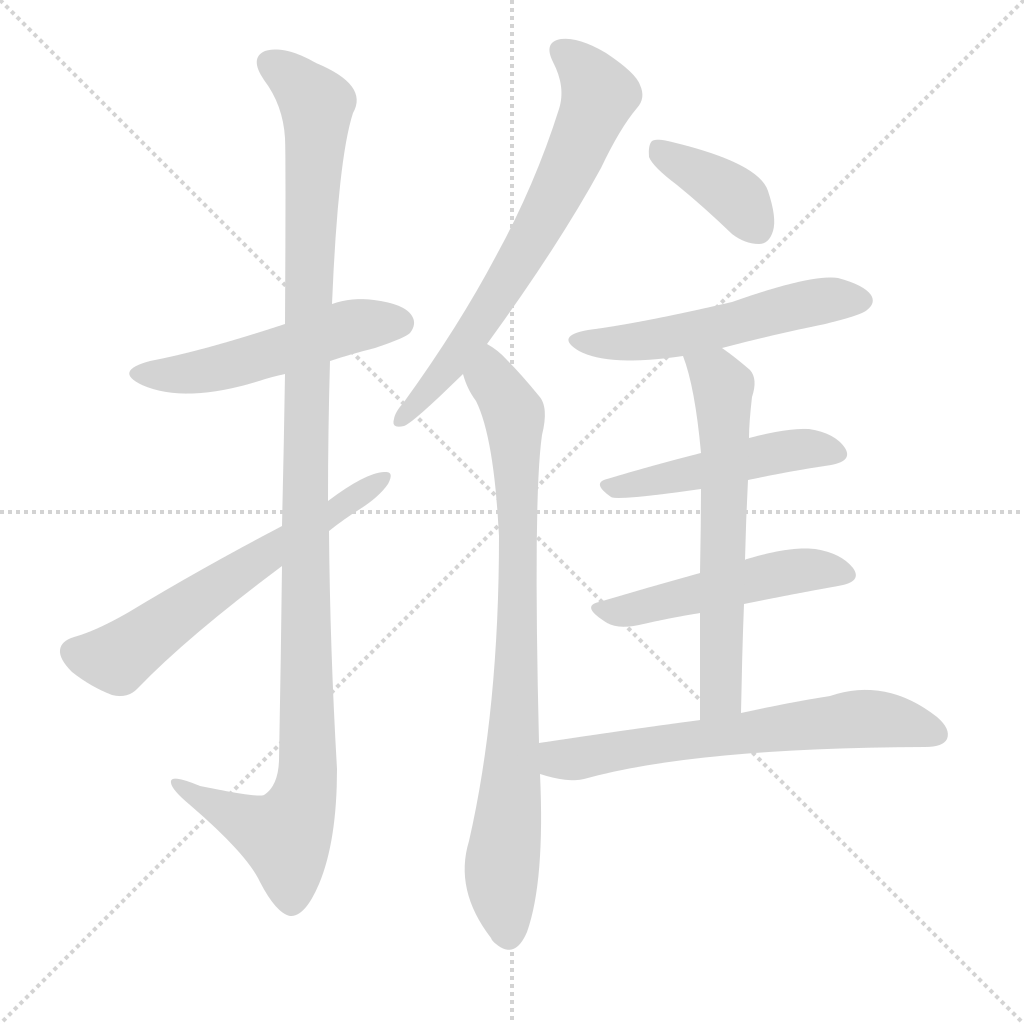
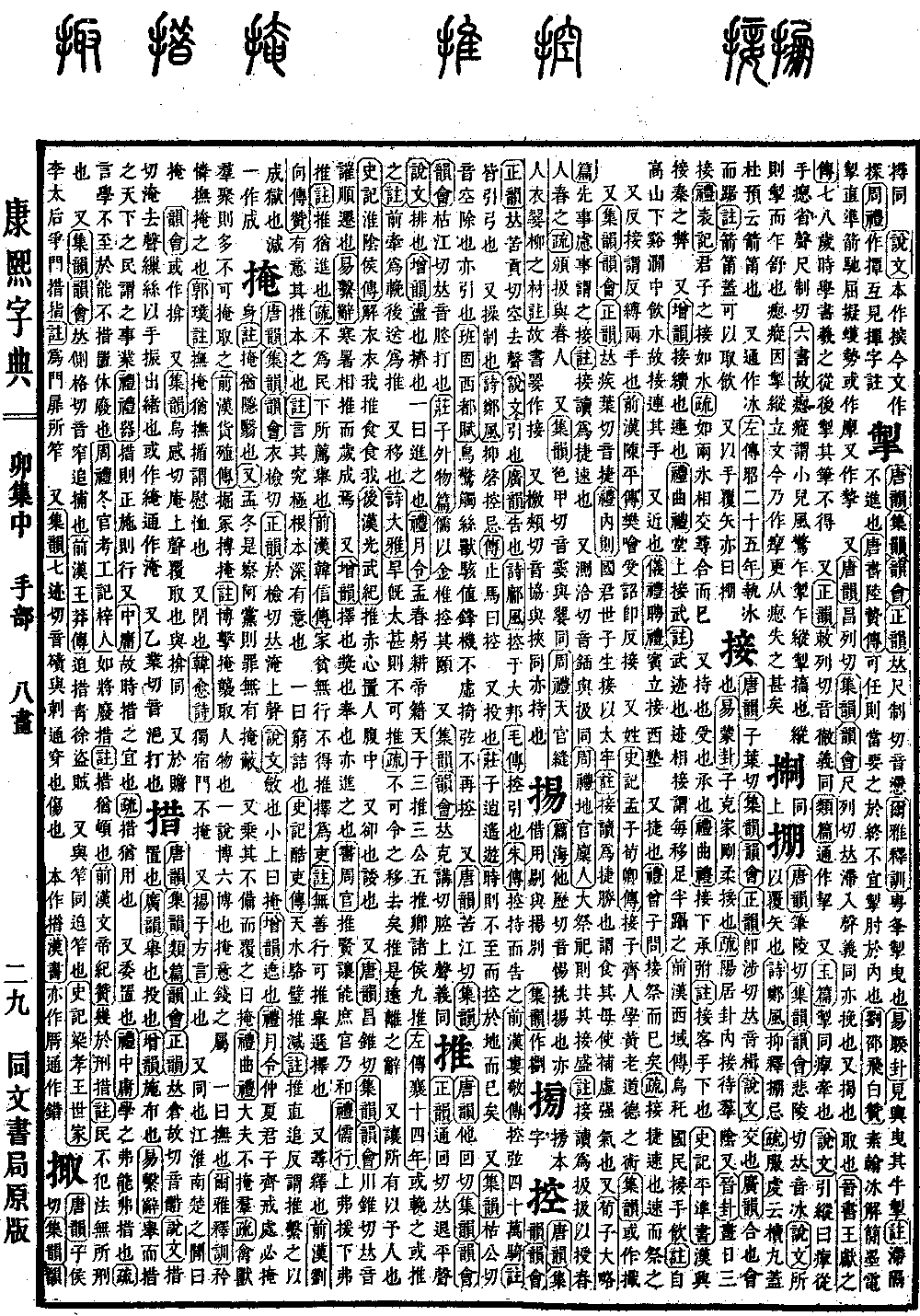
Mao Collection, Middle Volume. Radical: Hand (shǒu). Kangxi strokes: 12. Page 439, Entry 08.
Tang Yun dictionary pronunciation: tui (level tone). Jiyun, Yunhui, and Zhengyun dictionaries pronunciation: tui (level tone). Shuo Wen Jie Zi dictionary: to push away. Zeng Yun dictionary: to shake, to squeeze. Also signifies to move forward. Book of Rites (Liji), Monthly Ordinances (Yueling): In the first month of spring, the Emperor personally plows the imperial fields; the Son of Heaven pushes the plow three times, the Three Excellencies five times, and the ministers and dukes nine times. Zuo Zhuan (Zuozhuan), 14th Year of Duke Xiang: Some pulled it, others pushed it. Commentary: Pulling from the front is to drag, pushing from behind is to push. Also signifies to move. Book of Odes (Shijing), Greater Odes (Daya): When the drought is excessive, one cannot move it. Subcommentary: It means it cannot be made to move away. To push is a term for moving far away. Also signifies to yield all one possesses to another. Records of the Grand Historian (Shiji), Biography of Marquis of Huaiyin: He took off his own clothes to dress me, and offered his own food for me to eat. History of the Later Han (Hou Hanshu), Annals of Emperor Guangwu: To place one's sincere heart into the belly of another. Also signifies to reject or to blame others.
Also pronounced: cui (level tone). To progress or change. Book of Changes (Yijing), Appended Statements (Xici): The cold and heat push one another, and thus the year is completed. Also Zeng Yun dictionary: to select, to reward, to offer. Also signifies to advance. Book of Documents (Shujing), Zhou Offices (Zhouguan): To advance the worthy and yield to the capable, then the various officials will be in harmony. Book of Rites (Liji), Conduct of the Scholars (Ruxing): Above, one is not supported; below, one is not advanced. Commentary: To advance implies to recommend. Subcommentary: It means not being recommended or selected by those below. History of the Former Han (Qian Hanshu), Biography of Han Xin: His family was poor and he had no reputation, so he could not be advanced or selected to serve as an official. Commentary: There were no virtuous deeds for which he could be recommended or selected. Also signifies to investigate or examine. History of the Former Han (Qian Hanshu), Biography of Liu Xiang: There is an intention to trace it to its source. Commentary: It speaks of investigating the ultimate root, which requires deep intention. One source says it means to interrogate strictly. Records of the Grand Historian (Shiji), Biographies of Harsh Officials: Luo Bi of Tianshui investigated and reduced the charges. Commentary: To investigate, also pronounced as zhui, refers to investigating and detaining to complete a legal case. The character for reduce is sometimes written as a variant form.