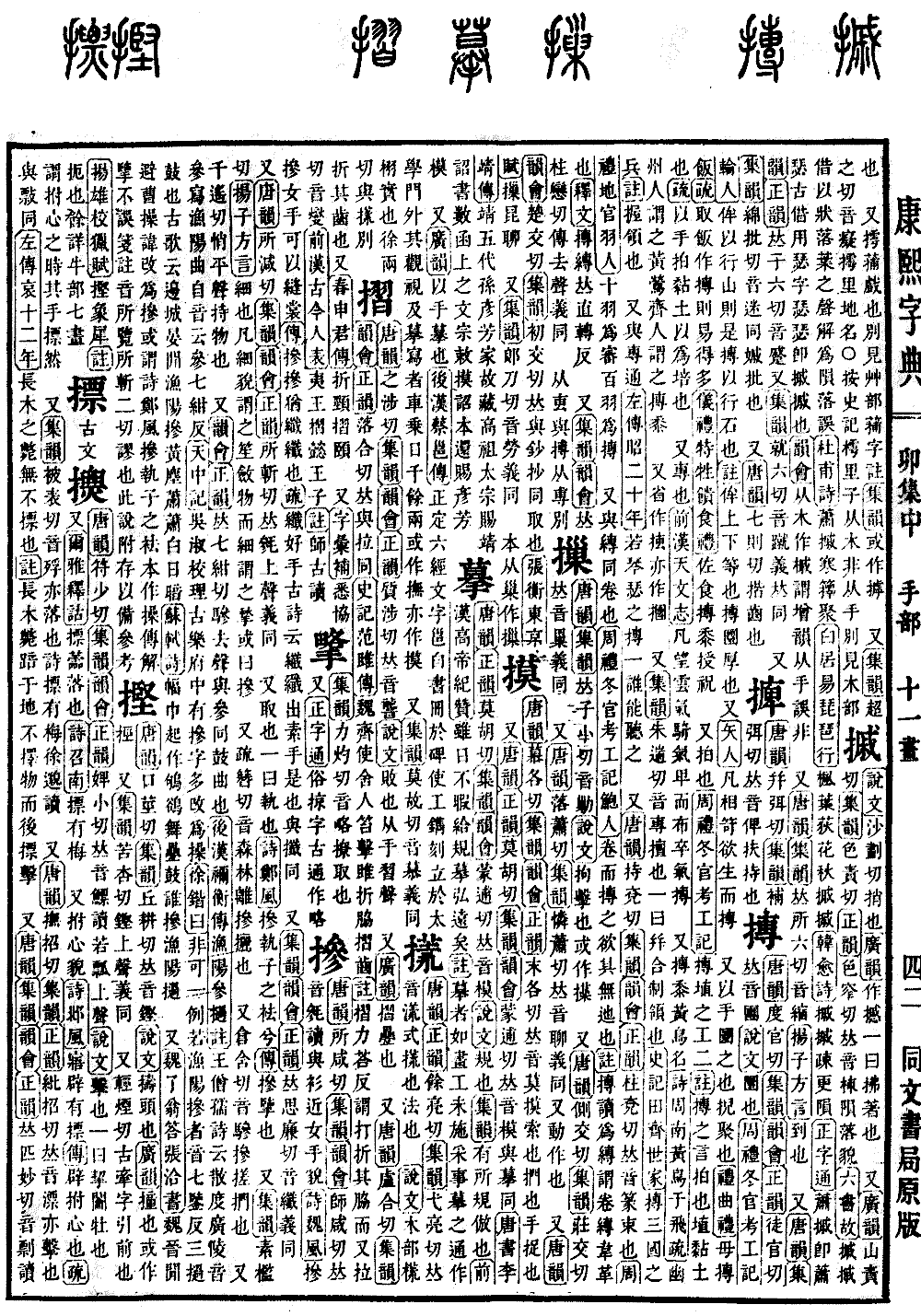
Mao Collection, Middle Volume
Radical: Hand (shǒu)
Kangxi Strokes: 15
Page 452, Entry 03
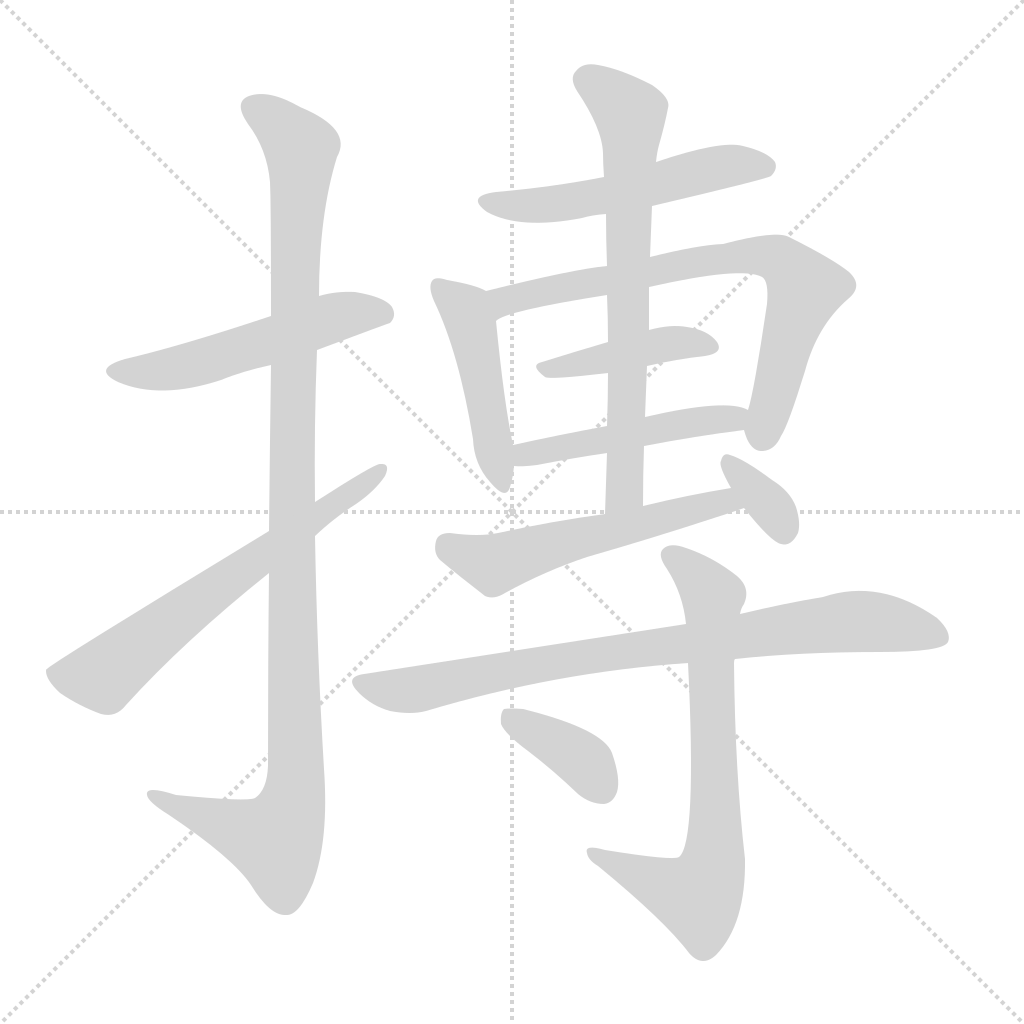
Pronounced tuan.
In the Shuowen Jiezi (Dictionary of Graphic Components), it means to be circular.
In the Rites of Zhou (Zhouli), section Winter Officials, Artisans' Record (Kaogongji), it says that if they are matched to travel through mountains, then they are rounded to travel through stones. The commentary notes that to be matched means the upper and lower parts are equal, and to be rounded means to be circular and thick.
In the Arrow Maker section, it says one should desire the shaft to be fresh and circular.
It also means to round something with one's hands. It means to press and gather.
In the Book of Rites (Liji), section Summary of Propriety (Quli), it says do not gather rice into a ball. The commentary explains that taking rice and pressing it into a ball makes it easier to obtain a larger amount.
In the Book of Etiquette and Ceremonial (Yili), section Special Animal Offering Rites, it states the assistant server gathers the millet into a ball and hands it to the priest.
It also means to pat or beat. In the Rites of Zhou, section Winter Officials, Artisans' Record, it mentions the two craftsmen who pat and mold clay. The commentary explains that to pat is to strike. Moldable clay is sticky earth. The sub-commentary explains this as using the hands to pat sticky earth into a mound.
It also means to concentrate or monopolize. In the History of the Former Han (Qianhan shu), Treatise on Astronomy, it says that when observing cloud vapors, the cavalry vapors spread out, and the foot soldier vapors gather.
Tuan-shu is the name of a bird. In the Book of Odes (Shijing), section Odes of Zhou and the South, Yellow Bird (Huangniao), the commentary states that the people of Youzhou call it the yellow oriole, and the people of Qi call it the Tuan-shu.
It is sometimes written in a simplified form. It is also written in a variant form.
Pronounced zhuan. It means to usurp or to monopolize. Another source states it means to combine and control the lead. In the Records of the Grand Historian (Shiji), House of Tian-Qi, it says to monopolize the armies of three states. The commentary notes this means to hold the reins of power.
It is also interchangeable with the character for monopolize (zhuan). In the Zuo Tradition (Zuozhuan), year 20 of Duke Zhao, it says if the zither and flute are monopolized by one person, who can listen to it.
Pronounced zhuan (falling tone). It means to bind or bundle.
In the Rites of Zhou, section Earth Officials, Feather Officials, it says ten feathers make a shen, and one hundred feathers make a tuan.
It is also synonymous with the character for bind (zhuan). It means to roll.
In the Rites of Zhou, section Winter Officials, Artisans' Record, Tallow Maker, it says to roll and bind it, desiring it not to be skewed. The commentary notes that this is read as bind, referring to the rolling and binding of leather. The explanatory text notes that for the character meaning to bind, the pronunciation is zhuan.
Pronounced zhuan (falling tone). The meaning is the same. It is composed with the component zhuan, which is distinguished from the character for fight (bo) which uses the component fu.