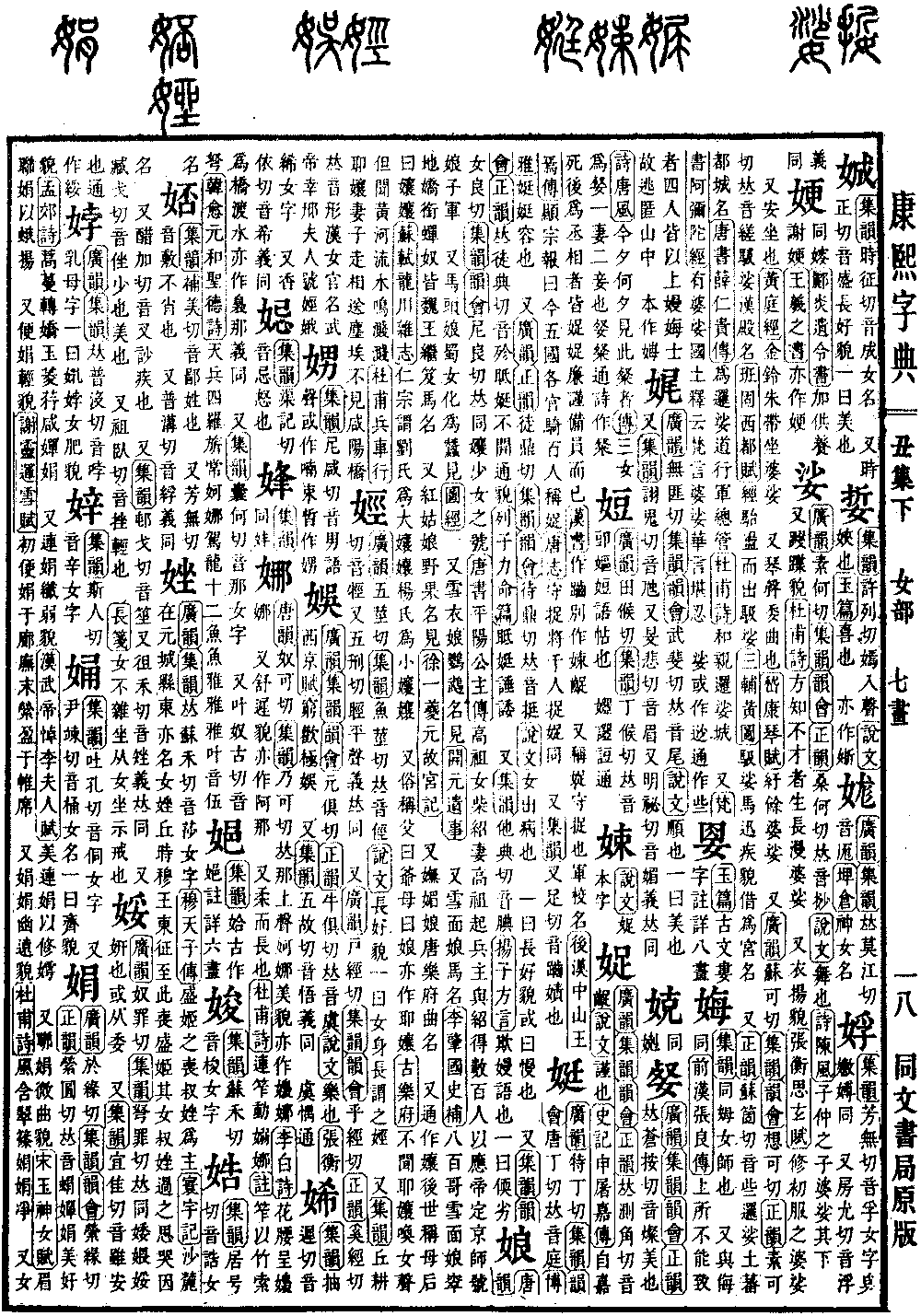
Chou Collection, Lower Volume
Radical: Woman (nǚ)
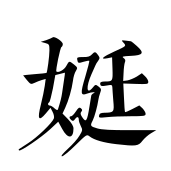
Entry: Ting
Kangxi Stroke Count: 10
Page 262, Entry 15
Pronounced ting. Broad Records of Rhymes (Guangyun): In the Dictionary of Collected Rhymes (Jiyun) and the Dictionary of Rhymes (Yunhui), it is noted as having a similar sound to ting. As recorded in the Encyclopedia of Etymology (Boya), the reduplicated form describes a person's appearance.
Also pronounced ting. As recorded in the Broad Records of Rhymes (Guangyun) and the Orthodox Dictionary of Rhymes (Zhengyun): In the Dictionary of Collected Rhymes (Jiyun) and the Dictionary of Rhymes (Yunhui), it is noted as having a similar sound to ting. According to the Analytical Dictionary of Characters (Shuowen), it refers to a woman's illness during childbirth. Another source defines it as a long and beautiful appearance. Others define it as slowness or negligence.
Also pronounced tian. As recorded in the Dictionary of Collected Rhymes (Jiyun), the Dictionary of Rhymes (Yunhui), and the Orthodox Dictionary of Rhymes (Zhengyun): Refers to a state of being closed off or not open, as in the expression shi-ting. From the Book of Master Lie (Liezi), section on Strength and Fate (Liming pian): Describing a state of being blocked and confused.
Also pronounced tian. As recorded in the Dictionary of Collected Rhymes (Jiyun): According to the Regional Dialects (Fangyan) by Master Yang, it refers to deceitful or rude speech. Another source defines it as being weak or inferior.