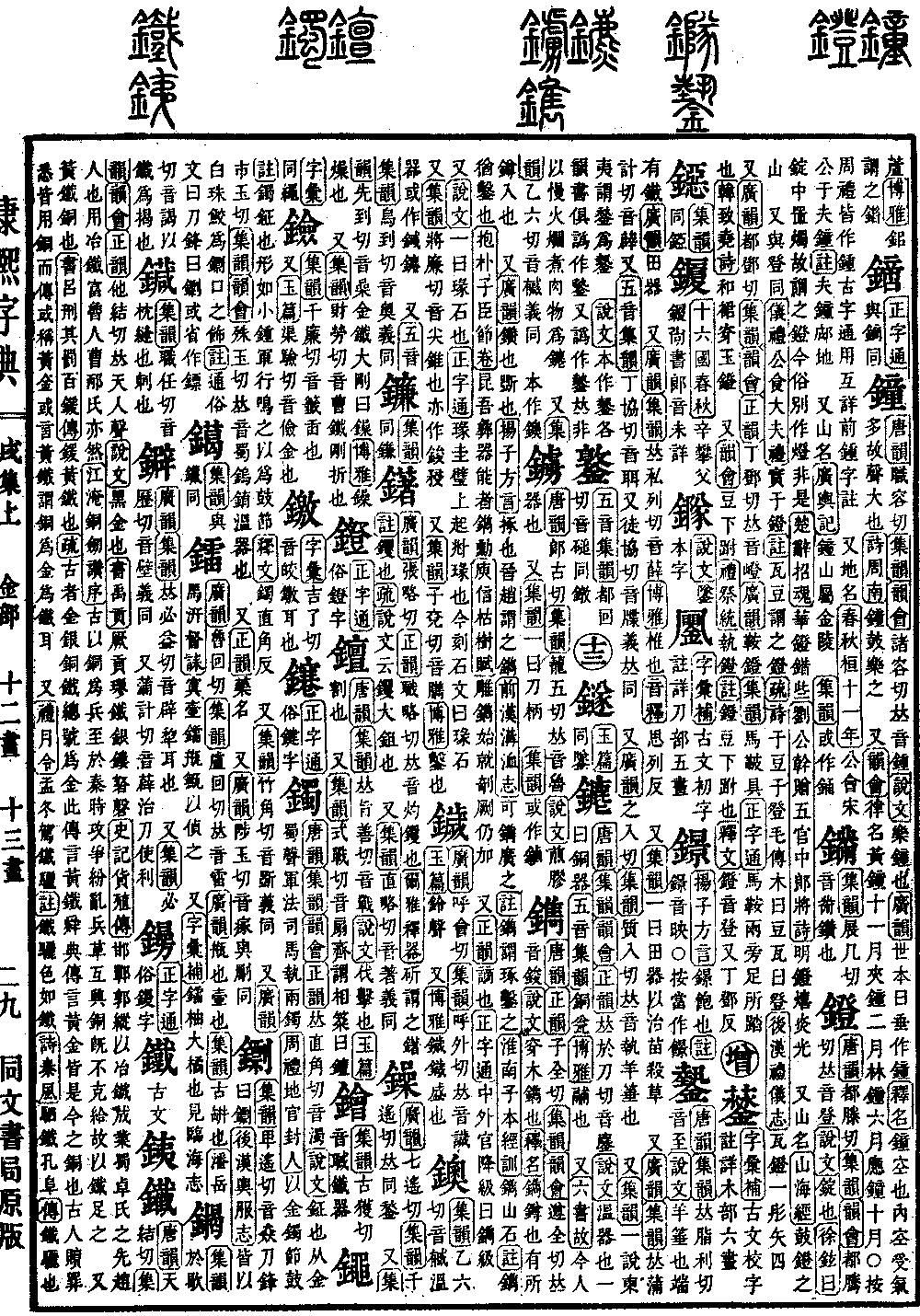
Xu Collection, Upper Volume
Radical: Metal (jīn)
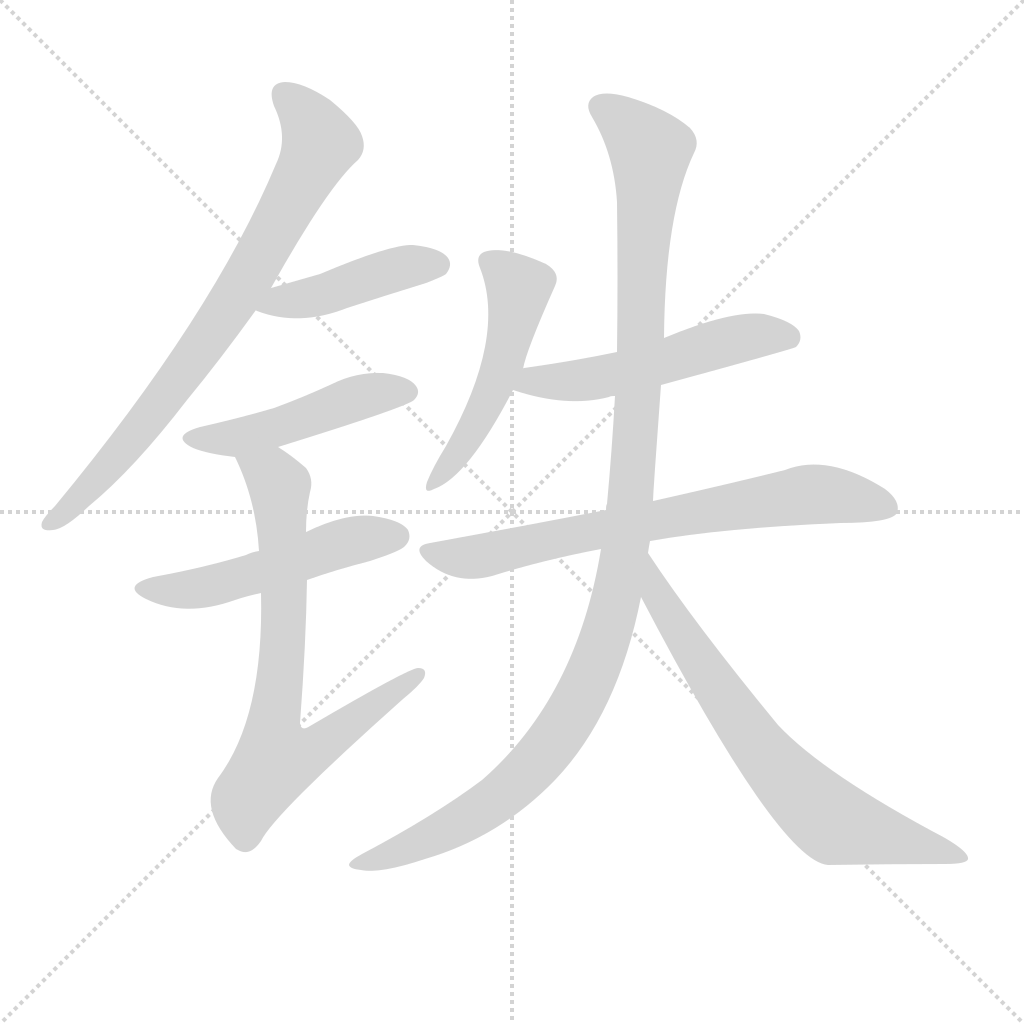
Iron
Kangxi strokes: 21
Page 1323, Entry 18
Ancient script: Tie. Pronounced tie.
Shuowen Jiezi (Shuowen): Black metal.
Classic of History (Shujing), Tribute of Yu (Yugong): Its tribute included fine jade, iron, silver, and refined iron for arrowheads and musical stones.
Records of the Grand Historian (Shiji), Biographies of the Money-makers (Huozhi Zhuan): Guo Zong of Handan built his fortune through iron smelting. The ancestors of the Zhuo family of Shu were people of Zhao who became wealthy through iron smelting. The Cao and Bing families were the same.
Jiang Yan, Preface to Praise of the Bronze Sword: In ancient times, bronze was used for weaponry. By the time of the Qin dynasty, conflict and warfare were frequent; bronze was insufficient, so iron was used to supplement it.
Also, yellow iron refers to copper.
Classic of History (Shujing), Marquis of Lu: A fine of one hundred huan. Commentary: Huan is yellow iron.
Sub-commentary: In ancient times, gold, silver, copper, and iron were collectively referred to as metal. The commentary here mentions yellow iron, while the commentary on the Canon of Shun mentions yellow gold; both refer to what is now called copper. In ancient times, crimes were redeemed with copper, and commentaries sometimes called this yellow gold or yellow iron, using the terms gold or iron to denote copper.
Also, Book of Rites (Liji), Monthly Ordinances (Yueling): In the first month of winter, drive the iron-colored black horses.
Commentary: Iron-colored black horses are those with a color like iron.
Book of Odes (Shijing), Odes of Qin (Qinfeng): The four iron-colored horses are very large.
Commentary: They are iron-colored black horses.
Sub-commentary: Iron refers to their black color, which resembles iron. Note: Current collected commentaries write this as tie.
Also a place name.
Spring and Autumn Annals (Chunqiu), Second Year of Duke Ai: Battle at Tie.
Commentary: Tie is a place name in the State of Wei, located south of Qicheng.
Also a river name.
Classic of Mountains and Seas (Shanhaijing): The Bietie River originates there.
Also a beast name.
Classic of Divine Marvels (Shenyingjing): There is a beast in the south named Nietie, similar in size to a water buffalo, black as lacquer in color. It eats iron and drinks water; its excrement can be used to forge weapons as sharp as steel.
Also a book title.
History of the Former Han (Qianhan Shu), Treatise on Literature and Arts (Yiwenzhi): Discourses on Salt and Iron (Yantielun), sixty chapters.
Also a surname.
Zhengzitong: In the Song dynasty, there was Tie Nanzhong; in the Ming dynasty, there was Tie Xuan.
Also, a compound surname. Helian Bobo changed the surnames of his collateral relatives to Tiefa, wishing his clan to be as strong and sharp as iron, capable of conquering enemies.
Also, pronounced die. Sharp iron.