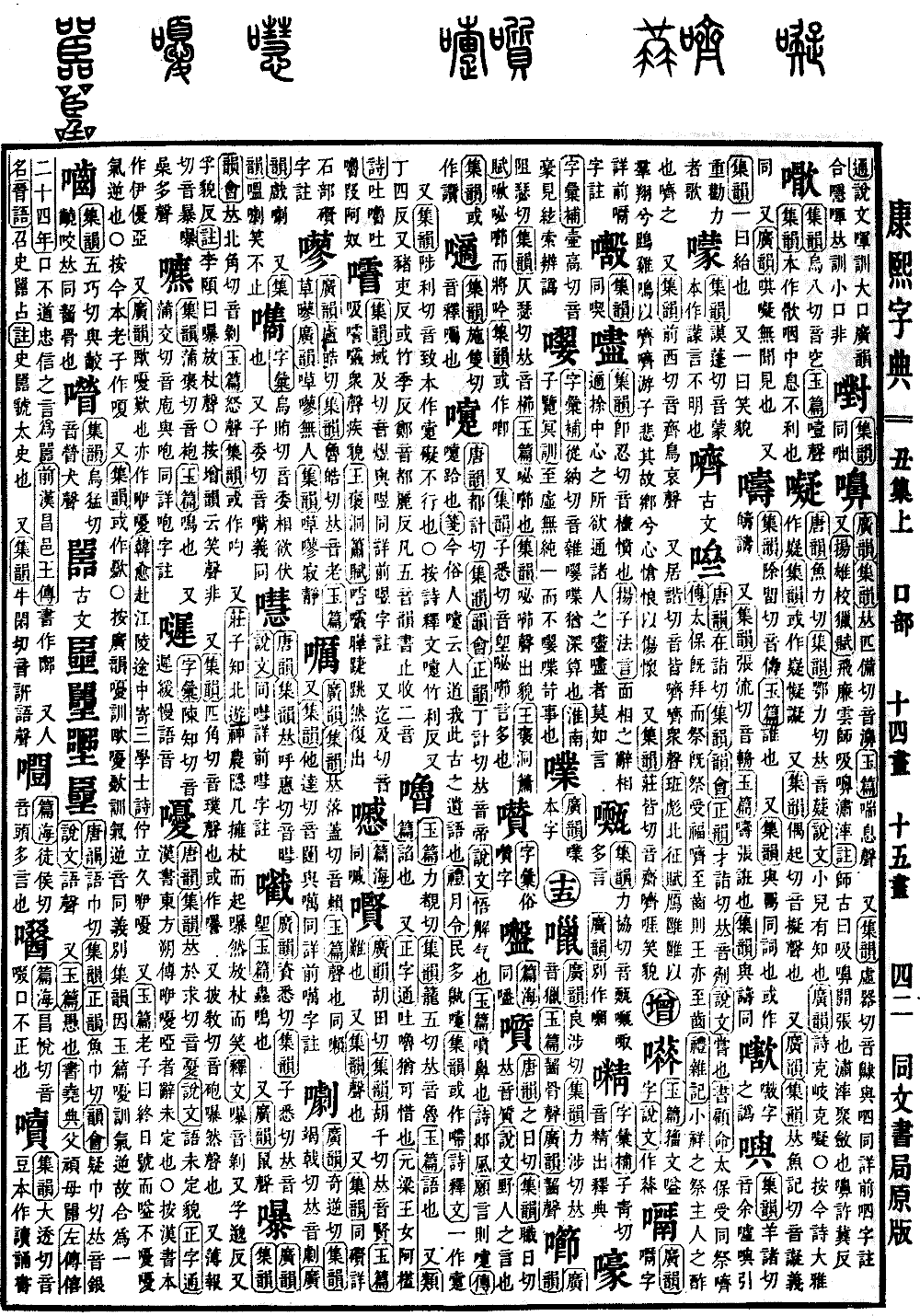
Chou Collection, Upper Volume
Radical: Mouth (kǒu)
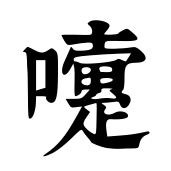
Character: 嚔
Kangxi strokes: 18
Page 212, Entry 26
Pronounced di.
According to the Explaining Graphs and Analyzing Characters (Shuowen Jiezi), it refers to the breath released during a moment of sudden realization or relief. According to the Jade Chapters (Yupian), it refers to the expelling of air from the nose, commonly known as sneezing.
In the Book of Odes (Shijing), Beifeng section: "When I think of him, I sneeze." The Commentary states: Sneeze refers to speech being obstructed or interrupted. The Supplementing Notes state: The current popular belief that sneezing means someone is talking about you is a tradition handed down from ancient times.
In the Book of Rites (Liji), Monthly Ordinances section: "The common people suffer from nasal congestion and sneezing."
The Collected Rhymes (Jiyun) notes it is sometimes written in a variant form. In the Explanatory Text for the Book of Odes (Shijing Shiwen), it is also written as a variant form (zhì).
Additionally, according to the Collected Rhymes (Jiyun), it is pronounced zhi. The original form of this character is (zhì), referring to being obstructed and unable to move forward.
Note: In the explanatory text of the Book of Odes (Shijing), the character for sneeze has five different pronunciations: zhuli, dingsi, zhuli, zhuji, and the pronunciation provided by Zheng Xuan is duli. The rhyme dictionaries only record two of these pronunciations. The character for nasal congestion (qiú) was originally written with the radical for round.