Zi Collection, Middle Volume
Radical: Person (ren)
Kangxi strokes: 23
Page 98, entry 13
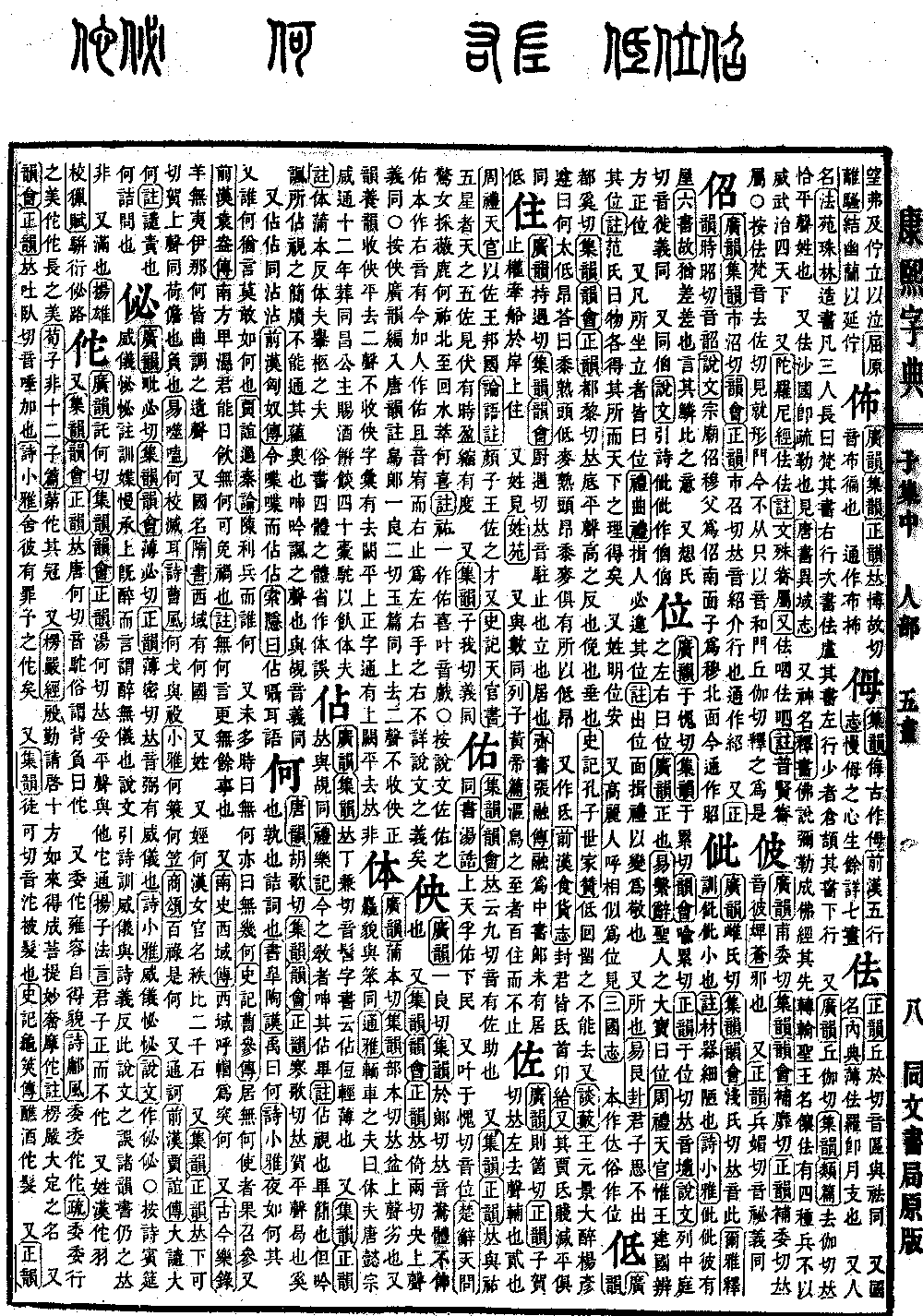
Pronounced puben in Guangyun (Guangyun) and buben in Jiyun (Jiyun), with a pingshang tone.
Means "inferior" or "weak."
Also refers to a "coarse appearance."
Same as ben.
The Tongya (Tongya) states: "The attendants of a funeral carriage are called tifu."
During the burial of Princess Tongchang in the twelfth year of Xiantong (871 CE) of Emperor Yizong of Tang, forty camels laden with wine, cakes, and snacks were bestowed to feed the tifu.
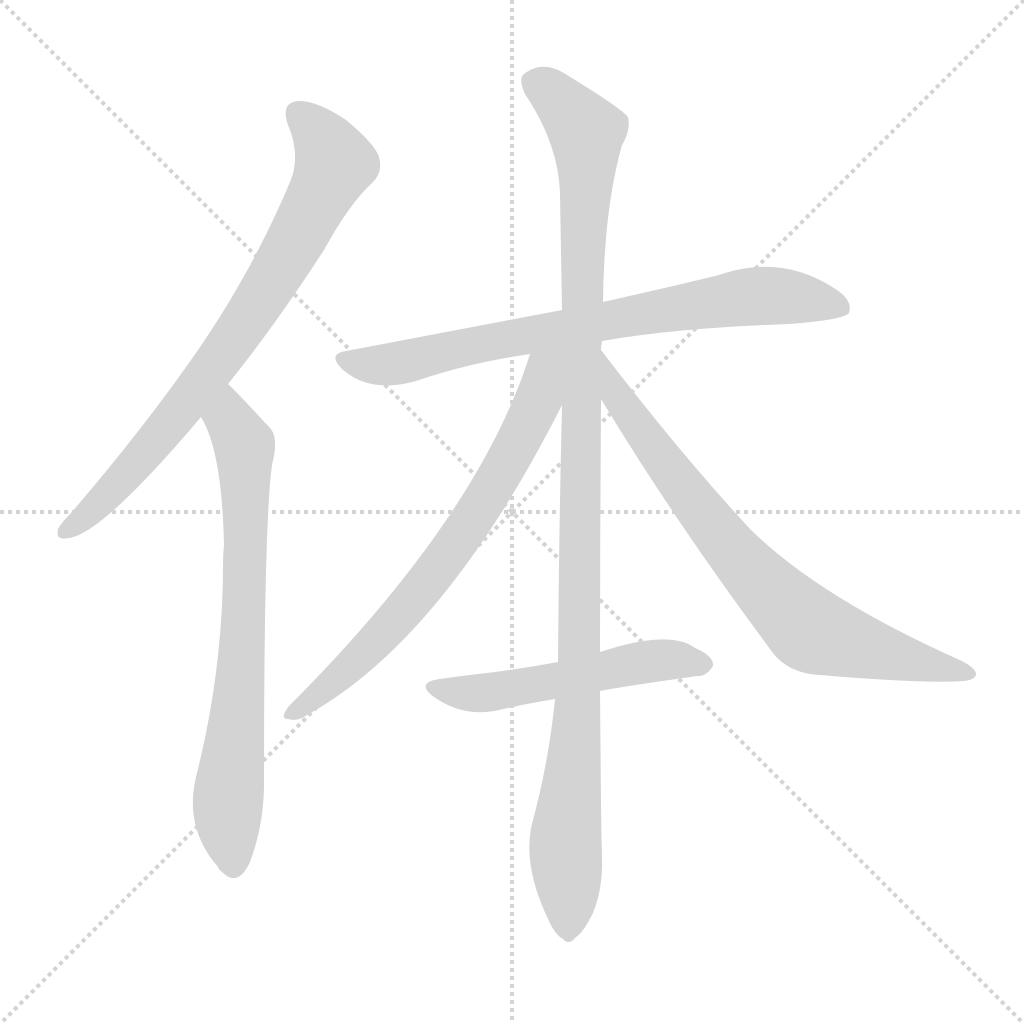
Note: The character 体 (ti) is pronounced puben. Tifu refers to the bearers of the coffin. The character 體 (ti), as found in common writing, for instance in the phrase 四體 (siti), is sometimes erroneously simplified to 体 (ti).
The character 體 (ti)
Pronounced tali in Tangyun (Tangyun) and Zhengyun (Zhengyun), and tuli in Jiyun and Yunhui (Yunhui), with a ti shang tone.
The Shuowen Jiezi (Shuowen) states: "It encompasses all twelve categories."
The Explanations of Names (Shiming) states: "Ti means 'order.' It refers to the sequential arrangement of bones, flesh, hair, blood, inside, outside, large, and small."
The Guangyun states: "Also means 'four limbs.'"
The Book of Rites (Liji), Doctrine of the Mean states: "Movement of the four limbs."
The Book of Changes (Yijing), Commentary on the Words of the Text states: "The gentleman embodies benevolence, enough to lead others."
Commentary: To embody means to encompass the Way of benevolence.
The Book of Documents (Shangshu), Bi's Decree states: "Words should value essential principles."
Note: For words, rationality and reality are essential.
The Book of Odes (Shijing), Odes of Wey states: "You consulted the tortoise shell and yarrow stalks, and the divination showed no inauspicious words."
Commentary: Ti refers to the form of the hexagram in divination.
The Book of Odes, Major Odes states: "They were just budding, just forming, their leaves luxuriant."
Commentary: Ti means to form a shape.
The Rites of Zhou (Zhouli), Offices of Heaven states: "To organize the state and administer the land."
Note: Ti is like 'to divide' or 'to differentiate.'
The Rites of Zhou, Offices of Heaven, Inner Kitchen states: "To distinguish meats by their cuts."
Note: 'Cuts' refers to parts like the spine, ribs, arms, and shanks.
The Book of Rites, Heir Apparent Wenwang states: "In the outer court, officials linked with those of different surnames."
Note: Ti is like 'to connect' or 'to link.'
The Book of Rites, Record of Learning states: "To approach the worthy and relate to the distant."
Note: Ti is like 'to be intimate with' or 'to treat as kin.'
The Book of Rites, Doctrine of the Mean states: "To embody things without omission."
Note: It is like 'to give birth' or 'to generate.'
The Book of Rites, Doctrine of the Mean states: "To embrace all officials."
Note: It is like 'to receive' or 'to accept.'
The Zuo Commentary (Zuozhuan), Duke Zhao, 20th Year states: "Sound is also like taste, one qi, two forms."
Commentary: That which moves the body in music is only dance. Dance has two forms: civil and martial.
Commonly written as 軆 (ti) in Guangyun.
Written as 躰 (ti) in Jiyun.
Commonly written as 体 (ti) in Zengyun (Zengyun), but this is incorrect.