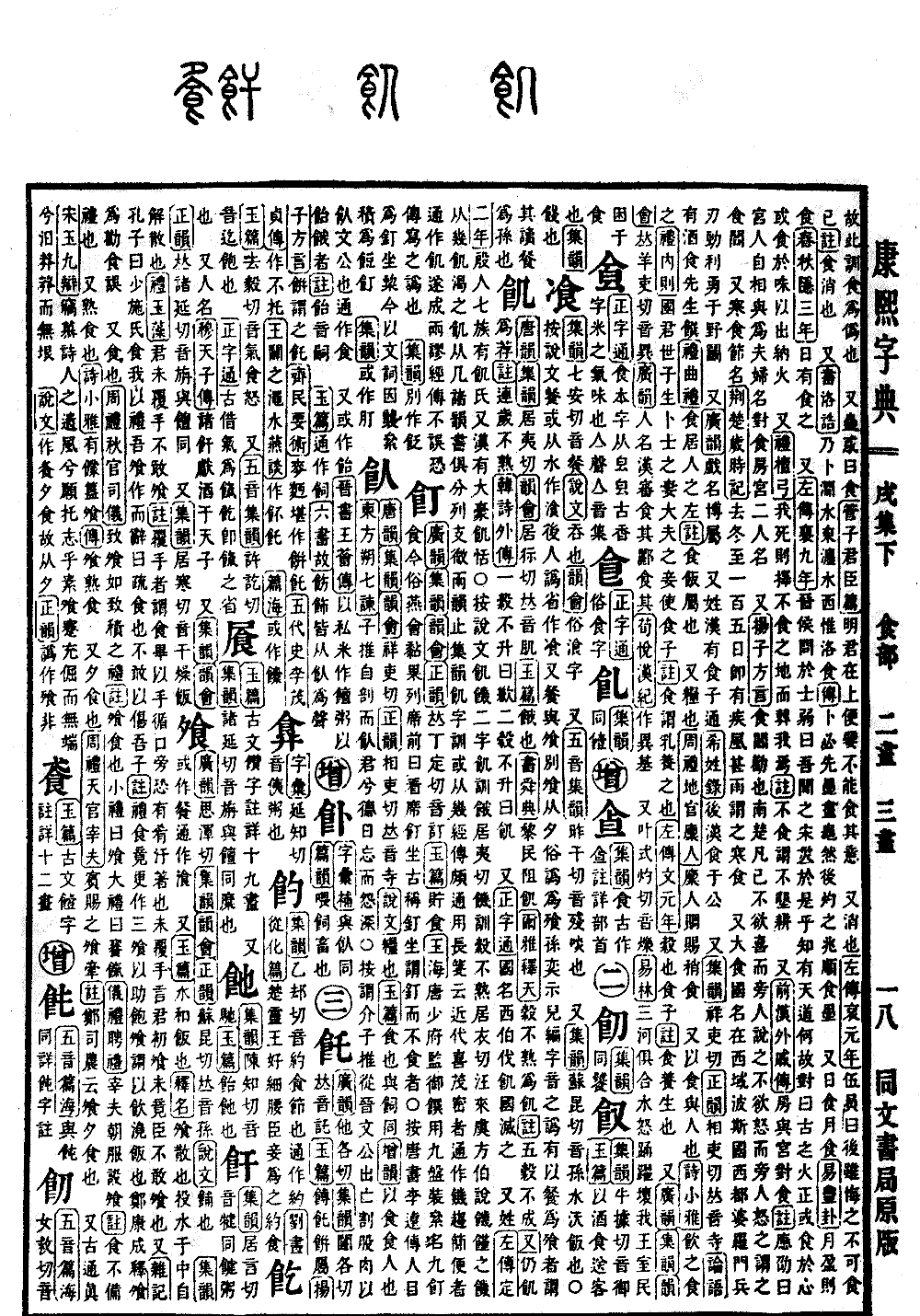
Xu Collection, Lower Volume
Radical: Food (shí)
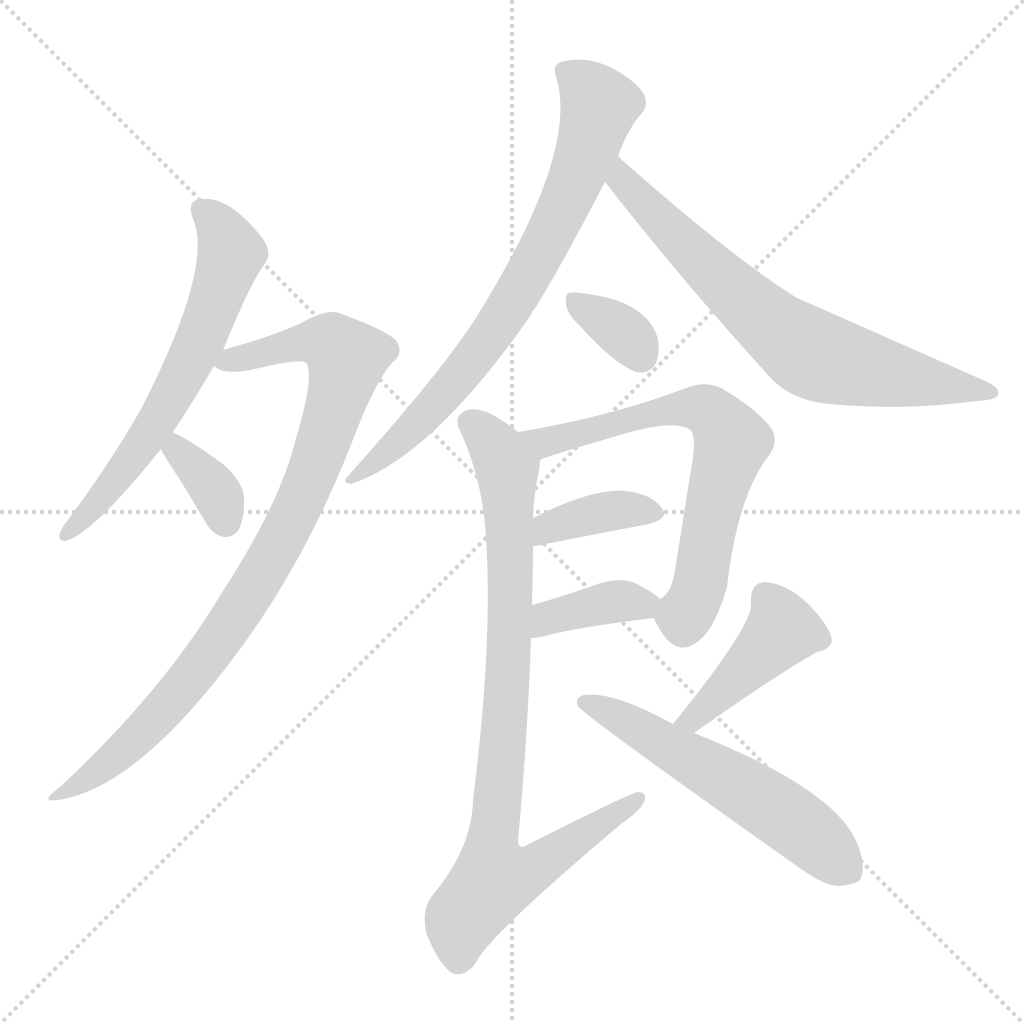
飧
Kangxi strokes: 12
Page 1416, Entry 19
Pronounced sūn
According to the Analytical Dictionary of Characters (Shuowen Jiezi), it refers to an afternoon meal. The Collected Rhymes (Jiyun) notes it is sometimes written as a variant form (cān), and often interchangeable with another variant form (cān).
According to the Jade Chapters (Yupian), it is rice mixed with water.
According to Explanations of Names (Shiming), it means to scatter; one adds water to it, and it disperses.
In the Book of Rites (Liji), it is written: Before the ruler has wiped his hands, one does not dare to eat. The commentary notes that wiping the hands refers to passing the hand around the mouth after eating, fearing that food particles might remain. Not daring to eat while the ruler has not wiped his hands means the ruler has not finished his meal, and the subject does not dare to begin eating.
In the Record of Miscellaneous Matters (Zaji), Confucius said: The Shao-shi clan entertained me with ritual; I ate, then rose and declined, saying: This is simple food, I dare not trouble you further. The commentary explains that according to the ritual, when the meal is finished, one offers three additional portions of food to help satisfy the guest. Here, the term refers to pouring a drink over the rice. Zheng Kangcheng’s interpretation of this as urging someone to eat is incorrect.
It also means to eat.
In the Rites of Zhou (Zhouli), under the Ministry of Autumn, Office of the Master of Ceremonies, it mentions offering a meal (sun), which follows the ritual of presenting provisions. The commentary states that the term refers to food. A minor ritual is called a sun; a major ritual is called a yong-xi (a feast of cooked grain and live animals).
In the Book of Etiquette and Ceremonial (Yili), under the Rites of Hosting Envoys, the steward wears court robes to prepare the meal. The commentary notes that this refers to food that does not meet the full ceremonial requirements.
It also means cooked food.
In the Book of Odes (Shijing), it is written: There are heaped bowls of cooked food. The commentary explains that it refers to cooked food.
It also refers to an evening meal.
In the Rites of Zhou (Zhouli), under the Ministry of Heaven, Office of the Prime Minister, it mentions the ruler gifting the guest with a meal and livestock. The commentary by Zheng Sinong says it refers to an evening meal.
In ancient texts, it is also interchangeable with the character (zhēn).
In the Nine Arguments (Jiubian) by Song Yu: I secretly admire the legacy of the poets, wishing to entrust my aspirations to a meal of plain food. Distressed and frustrated without direction, wandering in the vast and boundless void.
The Analytical Dictionary of Characters (Shuowen Jiezi) writes the character as consisting of evening and food, as it refers to an evening meal. The Correct Rhymes (Zhengyun) incorrectly writes it as a variant form (sūn), which is wrong.