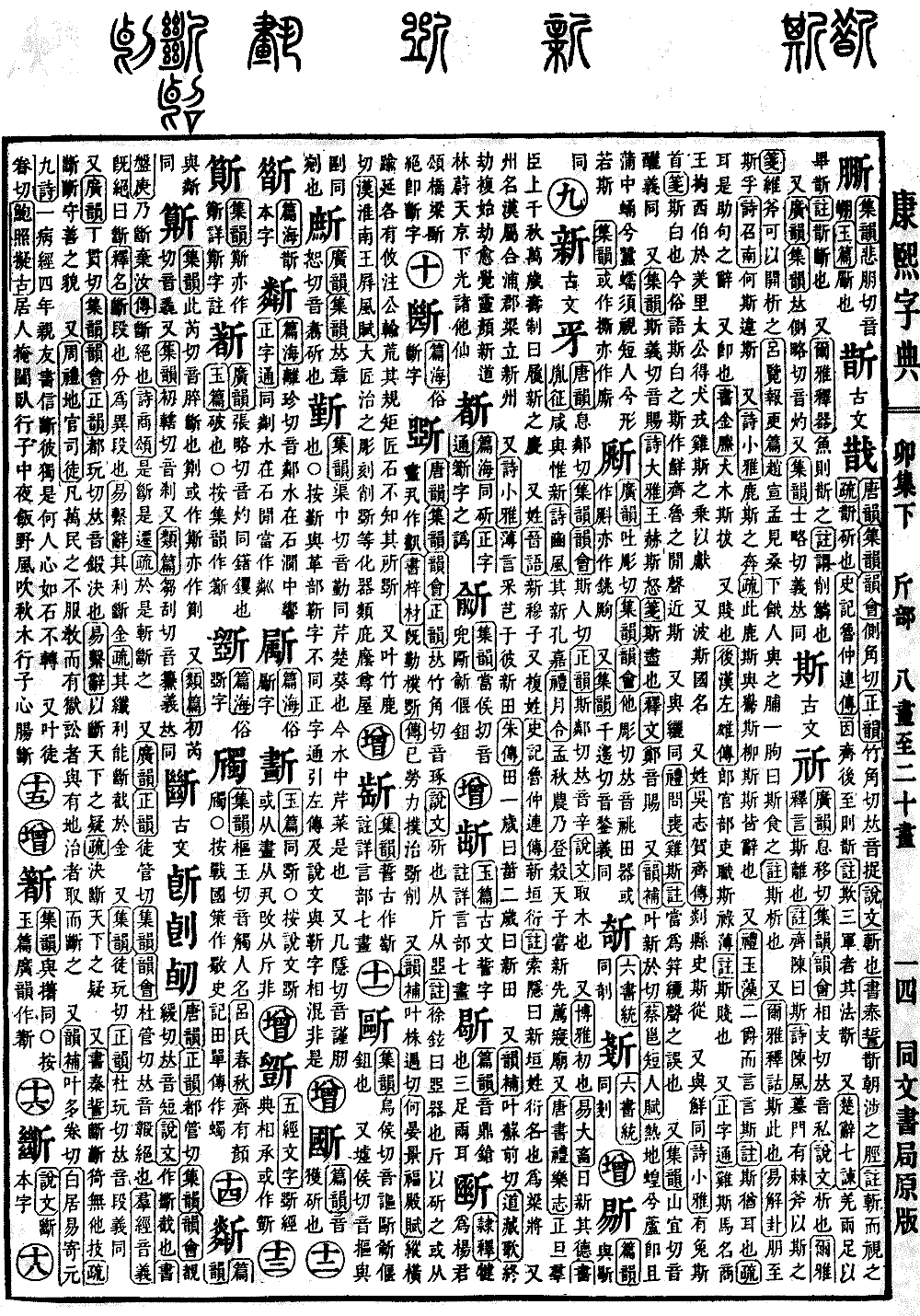
Mao Collection, Lower Volume
Radical: Axe (jīn)
Kangxi Dictionary strokes: 12
Page 480, Entry 04
Ancient literary records:
Guangyun: Pronounced si.
Jiyun, Yunhui: Pronounced si.
The pronunciation is the same as the character for private (si).
Shuowen Jiezi explains it as to split or to dissect.
Erya, Shiyan states: Si means to separate.
Commentary: In the dialect of the Qi region, it is called si.
Book of Odes (Shijing): Records that there are thorns before the tomb gate, which one uses an axe to split.
Jian (Annotations by Zheng Xuan): Only an axe can split them.
Lu Lan (Lüshi Chunqiu), Ba Geng chapter: Records that Zhao Xuanmeng saw a starving man under a mulberry tree and gave him a piece of dried meat, saying, Split it and eat it.
Commentary: Si means to dissect.
Also, Erya, Shigu states: Si means this.
Book of Changes (Yijing), Xie hexagram: When friends arrive, then one is convinced.
Book of Odes (Shijing), Zhaonan: Why at this time break the agreement.
Also, Book of Odes (Shijing), Xiaoya: The deer running in such a way.
Sub-commentary: Here, deer si, si liu, and si are all modal particles.
Also, Book of Rites (Liji), Yuzao: Drinking two cups of wine and speaking incessantly.
Commentary: Si is like the character for ear (er).
Sub-commentary: Ear is a function word that assists a sentence.
It also has the meaning of then or just.
Book of Documents (Shangshu), Jinteng: The great tree was then uprooted.
It also has the meaning of humble or lowly.
History of the Later Han (Hou Hanshu), Biography of Zuo Xiong: The Langguan and various departmental officials had low positions and meager salaries.
Commentary: Si means lowly.
Also, Zhengzitong records: Jisi is the name of a horse. When the King of Shang imprisoned Xibo at Youli, Taigong obtained the Jisi horse of the Quanrong to present to him.
There is also Boshi (Persia), which is the name of a country.
There is also a surname.
Records of the Three Kingdoms (Wuzhi), Biography of He Qi: Records an official named Si Cong from Shan County.
Also interchangeable with the character for fresh (xian).
Book of Odes (Shijing), Xiaoya: The hare has a white head.
Jian: Si means white. In common parlance today, the si in si bai is written as xian. The dialect in the Qi and Lu regions has a pronunciation close to si.
Also interchangeable with the character for hair band (li).
Book of Rites (Liji), Wensang: Records jisi.
Commentary: It should be written as ji, as it is an error in the pronunciation of the character li.
Also, Jiyun: Pronounced li. The meaning is the same.
Also, Jiyun: Pronounced ci.
Book of Odes (Shijing), Daya: The king was awesomely angry.
Jian: Si means to exhaust or all.
Shiwen: Zheng Xuan gives the pronunciation as ci.
Also, Yunbu: Rhymes with xin yu.
Cai Yong, Duanren Fu: The locusts of the hot earth are like clams, the pupae in the rushes are like silkworms creeping, look at that dwarf, his body is like this.
Jiyun: Sometimes written as si (to tear) or as si (servant).