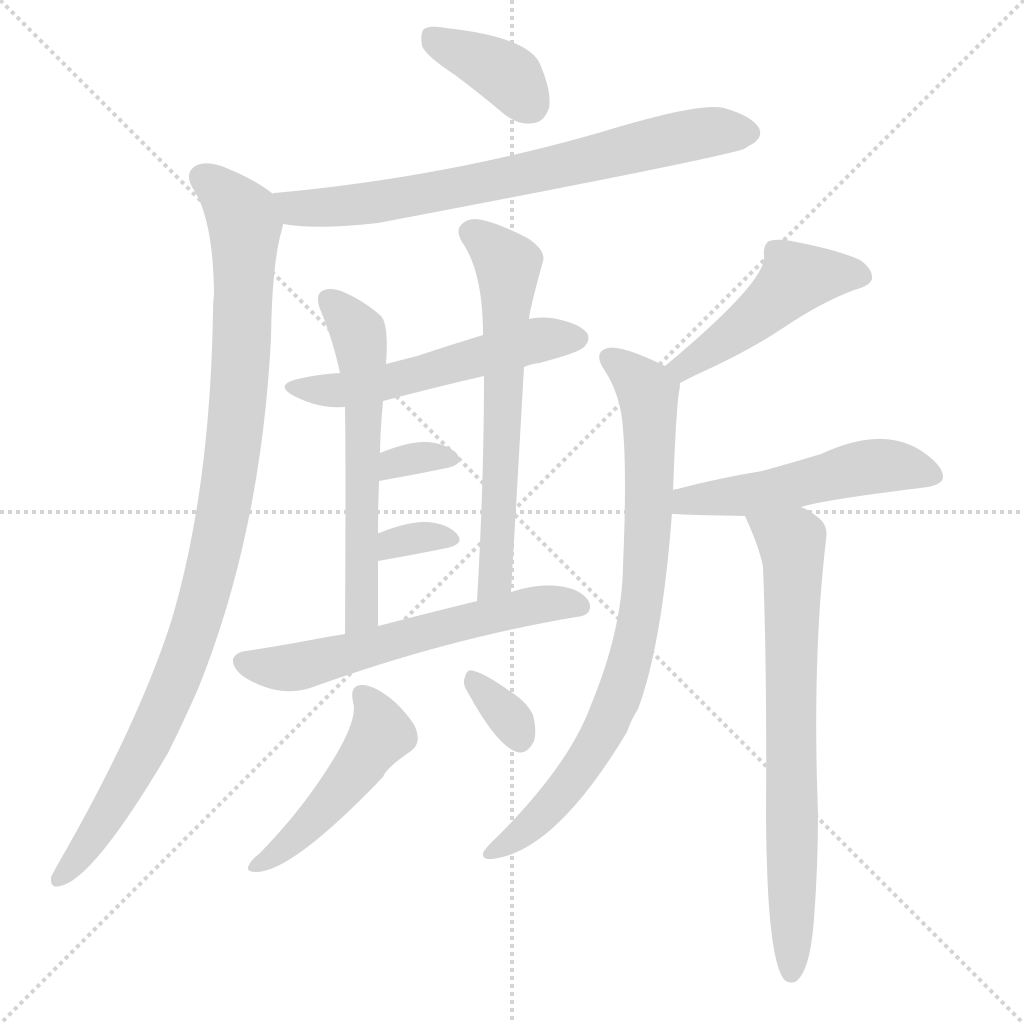
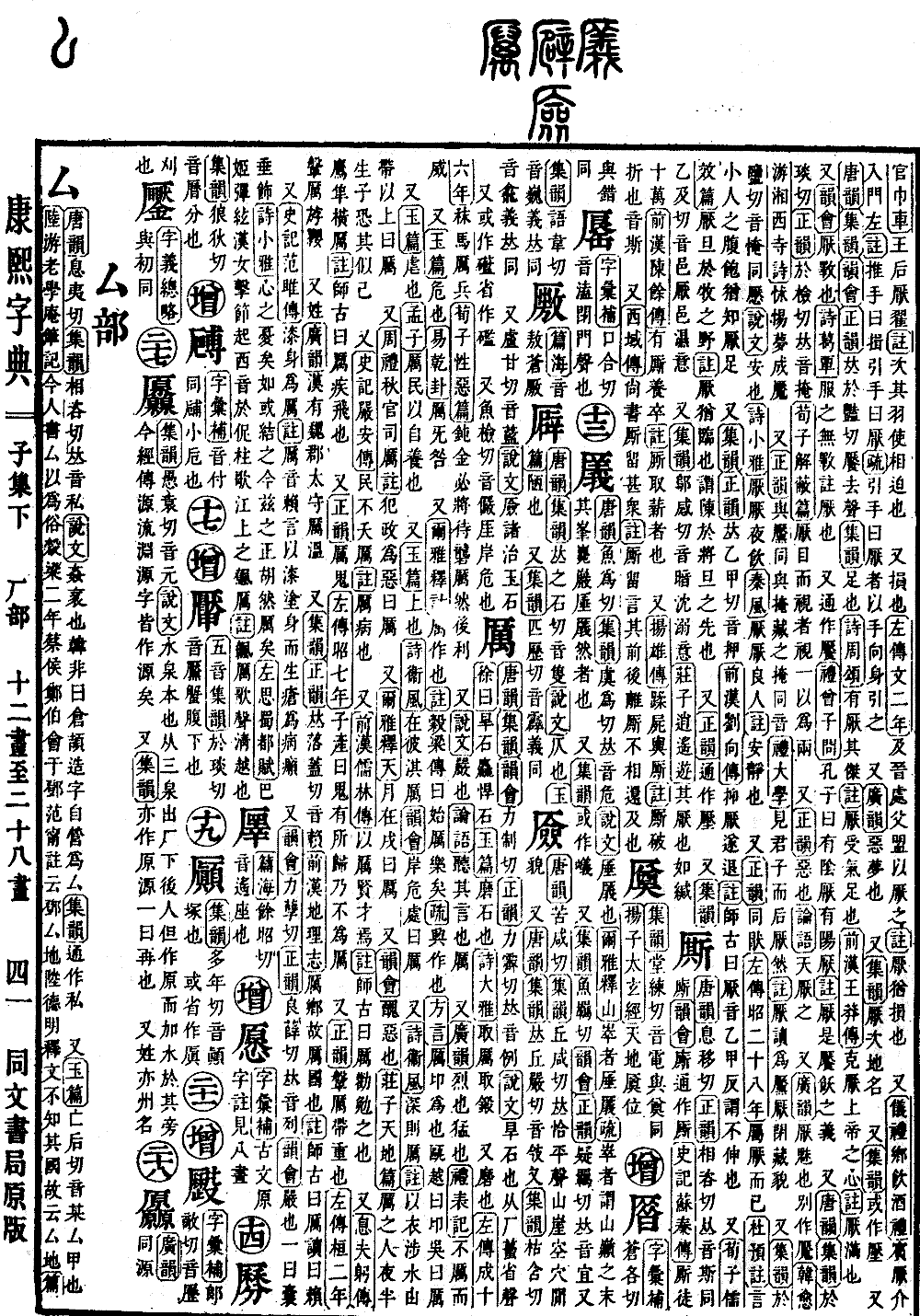
Yin Collection, Lower Volume
Radical: Wide (guǎng)
Kangxi Strokes: 15
Page 163, Entry 06
Pronounced si.
In the Jade Chapter (Yupian), it means to employ or low-status.
In the Tang Rhymes (Tangyun), it means to provide for or nurture.
In the Collected Rhymes (Jiyun), it refers to one who splits firewood and tends to horses.
In the Commentary on the Spring and Autumn Annals (Gongyang Zhuan), for the twelfth year of Duke Xuan: Servants and laborers act as guards. The commentary notes that those who gather mugwort to create defenses are called si.
In the Dialects (Fangyan) by Yang Xiong: Official bondservants and female servants are called shen. The commentary notes that female servants, women who provide service, are also called shen.
Also, according to the Rhyme Collection (Yunhui), it is also written as a variant form (si).
In the Records of the Grand Historian (Shiji), biography of Su Qin: A hundred thousand servants and followers.
In the biography of Zhang Er: Servant soldiers.
Also, in the Orthodox Rhymes (Zhengyun), it is interchangeable with si (to filter or strain).
In the Book of Tang (Tangshu), biography of Gao Jian: Attached to the old channels and filtered streams flowing out from the side.
Also, it is interchangeable with si (to tear).
In the Collected Rhymes (Jiyun), it is noted that si (to tear) is also written as a variant form (si).
In the Jade Chapter (Yupian), it is also written as a variant form (si).