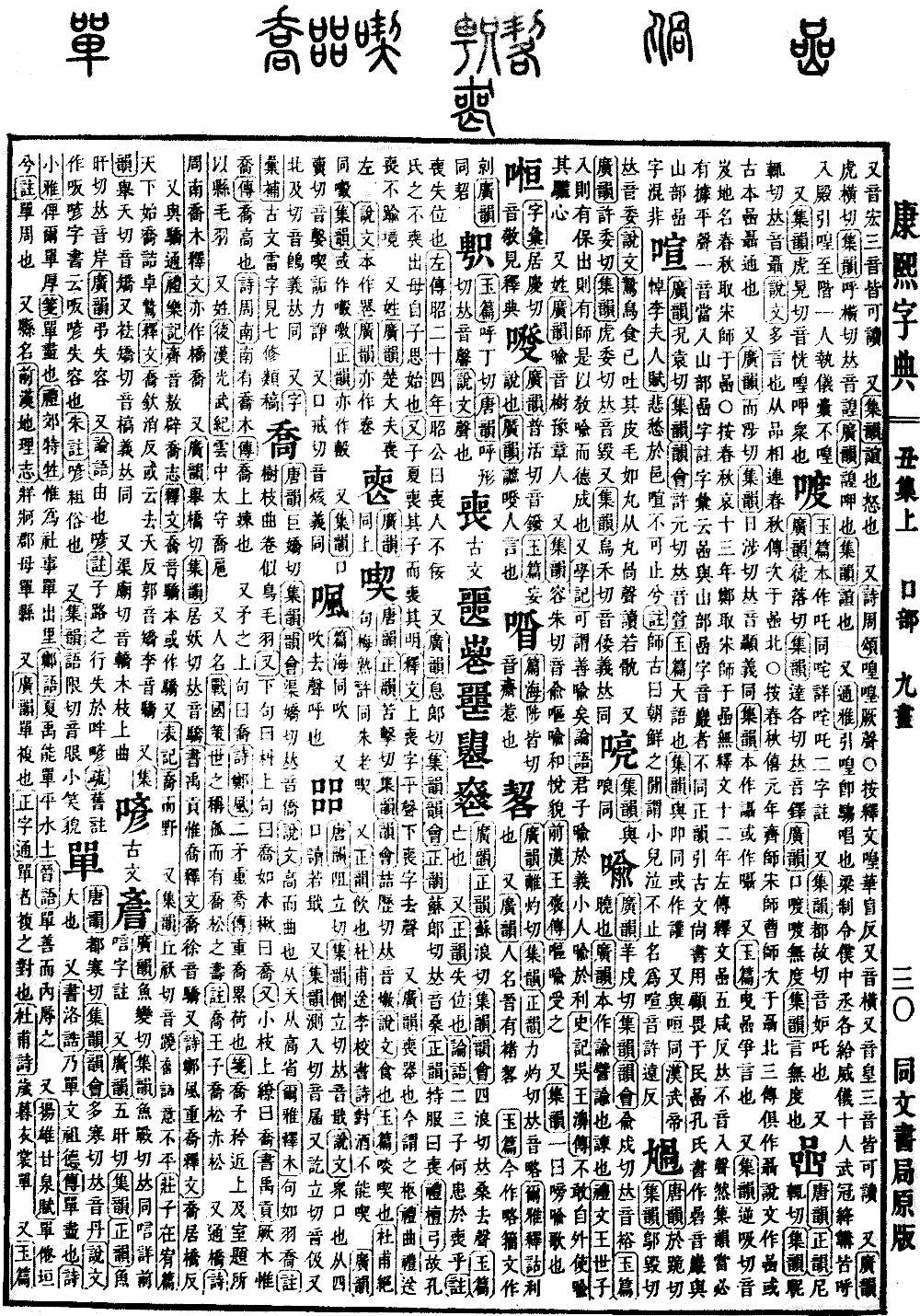
Chou Collection, Upper Volume
Radical: Mouth (kǒu)
Character: sāng
Kangxi Stroke Count: 12
Page 200, Entry 12
Ancient script.
Pronounced sàng (falling tone).
According to the Broad Rhymes (Guangyun) and Standard Rhymes (Zhengyun), it is pronounced sàng (falling tone). According to the Collected Rhymes (Jiyun) and Rhyme Compendium (Yunhui), it is also pronounced sàng (falling tone).
According to the Jade Chapters (Yupian), it means to perish or lose.
According to the Standard Rhymes (Zhengyun), it refers to the loss of a position or status.
In the Analects (Lunyu): Why should the two or three of you be troubled by the loss of status?
Annotation: Loss of status.
In the Zuo Commentary (Zuo Zhuan), twenty-fourth year of Duke Zhao: Duke Zhao said, I, a person who has lost his state, am not talented.
Also pronounced sāng (level tone).
According to the Broad Rhymes (Guangyun), it is pronounced sāng (level tone). According to the Collected Rhymes (Jiyun), Rhyme Compendium (Yunhui), and Standard Rhymes (Zhengyun), it is also pronounced sāng (level tone).
According to the Standard Rhymes (Zhengyun), to observe mourning is called sang.
In the Book of Rites (Liji), Tan Gong chapter: Therefore, the practice of the Kong family not mourning a mother who has been divorced began with Zisi.
Also: Zixia mourned his son, and lost his eyesight.
Explanation of Text: The first occurrence of the character is pronounced in the level tone; the second occurrence is pronounced in the falling tone.
Also, according to the Broad Rhymes (Guangyun), it refers to a vessel or container; today it is called a coffin.
In the Book of Rites (Liji), Qu Li chapter: Sending off a funeral should not cross the border.
Also a surname.
According to the Broad Rhymes (Guangyun), there was a Chu state official named Sang Zuo.
According to the Explaining Graphs and Analyzing Characters (Shuowen), it was originally written in a certain form.
According to the Broad Rhymes (Guangyun), it is also written in a variant form.