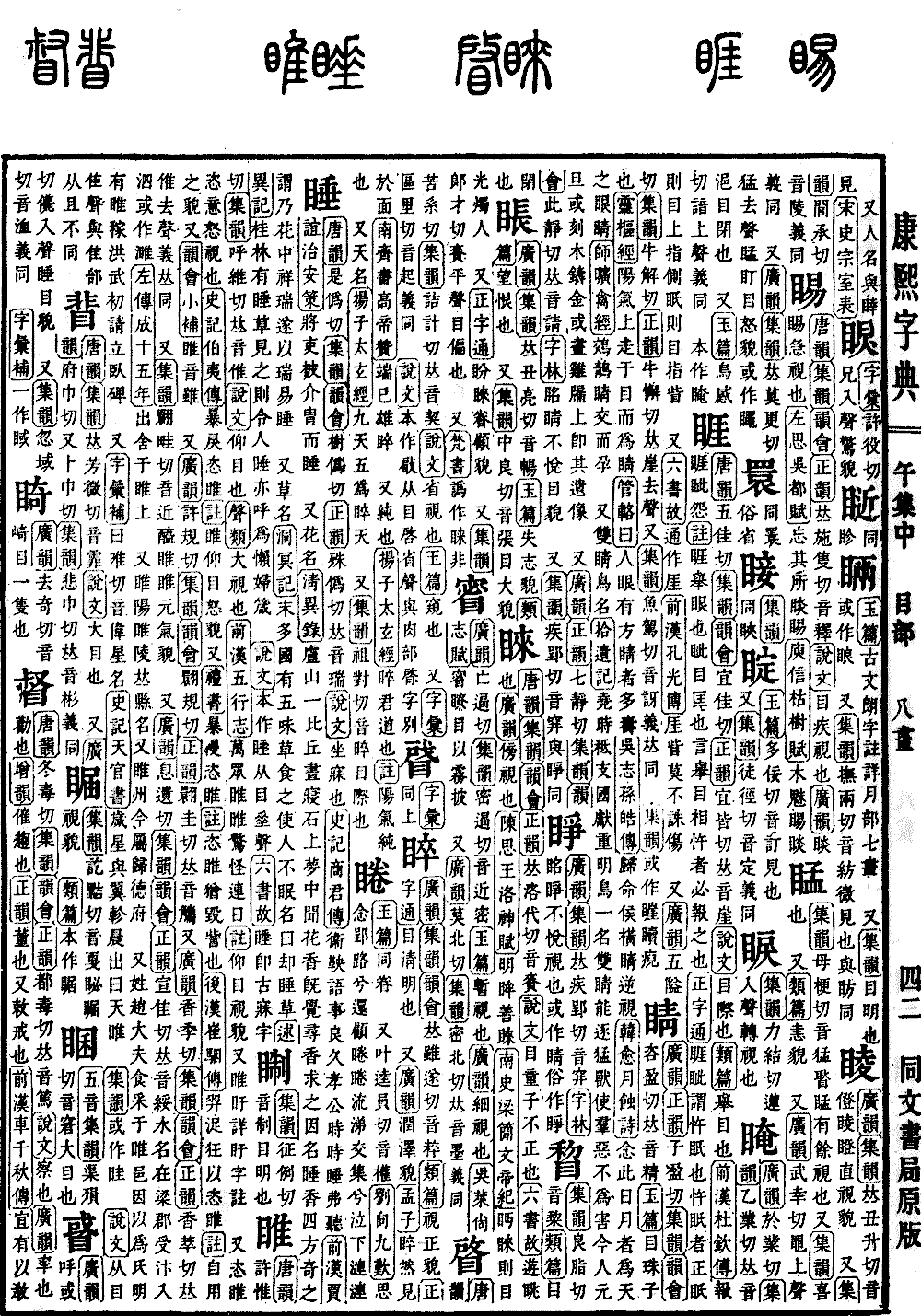
Wu Collection, Middle Volume
Radical: Eye (mù)
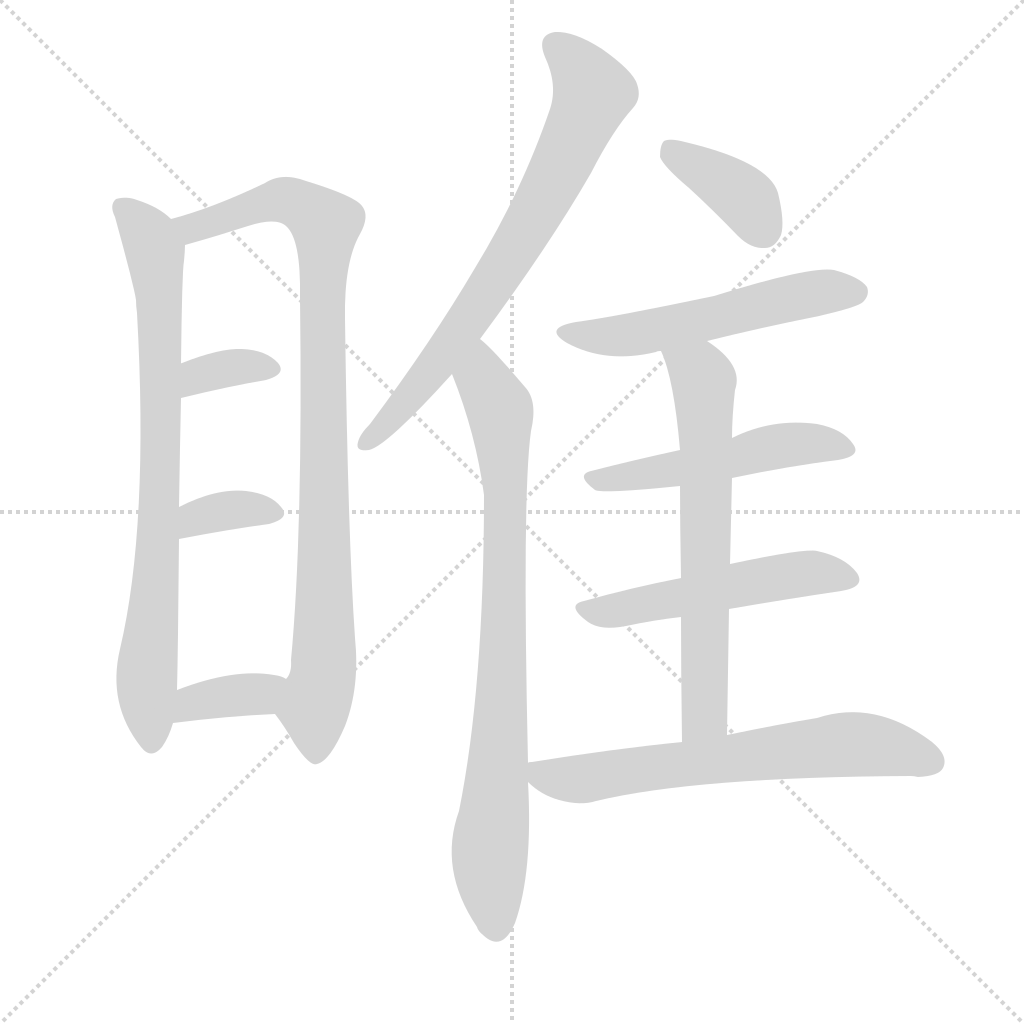
睢
Kangxi stroke count: 13
Page 810, Entry 25
Pronounced sui.
Shuowen Jiezi explains: To look upward.
Sheng Lei explains: To stare with wide-open eyes.
Book of Han (Hanshu), Records of the Five Elements: Ten thousand people looked upward in alarm, surprised and strange for days.
Commentary: Describes the appearance of a crowd of people looking up.
Also, sui xu, see the entry for the character xu for detailed commentary.
Also, zi sui, referring to looking with an angry, unrestrained, and arbitrary expression.
Records of the Grand Historian (Shiji), Biography of Bo Yi: Violent, angry, and unrestrained.
Commentary: Sui describes the appearance of looking up with an angry expression.
Also, Book of Rites (Liji) records: Violent, arrogant, and unrestrained.
Commentary: Zi sui, similar to slandering and accusing.
Book of the Later Han (Hou Hanshu), Biography of Cui Yin: Yi and Zhuo were wild, arrogant, and unrestrained.
Commentary: Describes the appearance of being self-righteous and arbitrary.
Also, Yunhui Xiaobu records: Sui is pronounced the same as sui.
Also, pronounced sui.
Also, pronounced sui (departing tone).
The above pronunciations and meanings are the same.
Also, Ji Yun records: Pronounced xi. Sui sui describes the appearance of primordial energy (the original natural force).
Also, pronounced sui.
A river name. Located in Liang Commandery, it joins the Bian River and flows into the Si River. Sometimes written as a variant form (sui).
Zuo Tradition (Zuozhuan), 15th Year of Duke Cheng: Camped out at the Sui River.
Also, Suiyang and Suiling, which are county names. There is also Suizhou, which now belongs to Guide Prefecture.
Also a surname. A grandee of the Zhao state held the fief of Sui, and thus it was adopted as a surname. During the early Hongwu era of the Ming dynasty, there was a person named Sui Jia who petitioned for the establishment of a horizontal stone tablet.
Also, Zi Hui Bu records: Pronounced wei.
Name of a star or constellation. Records of the Grand Historian (Shiji), Treatise on the Celestial Offices: When the Year Star appears with the Wing and Chariot constellations in the morning, it is called Heavenly Sui.
Ji Yun records: Sometimes written as a variant form (sui).
Shuowen Jiezi: The character is formed from the radical for eye and the phonetic element zhui. It is distinct from characters in the zhui radical that use the component qie.