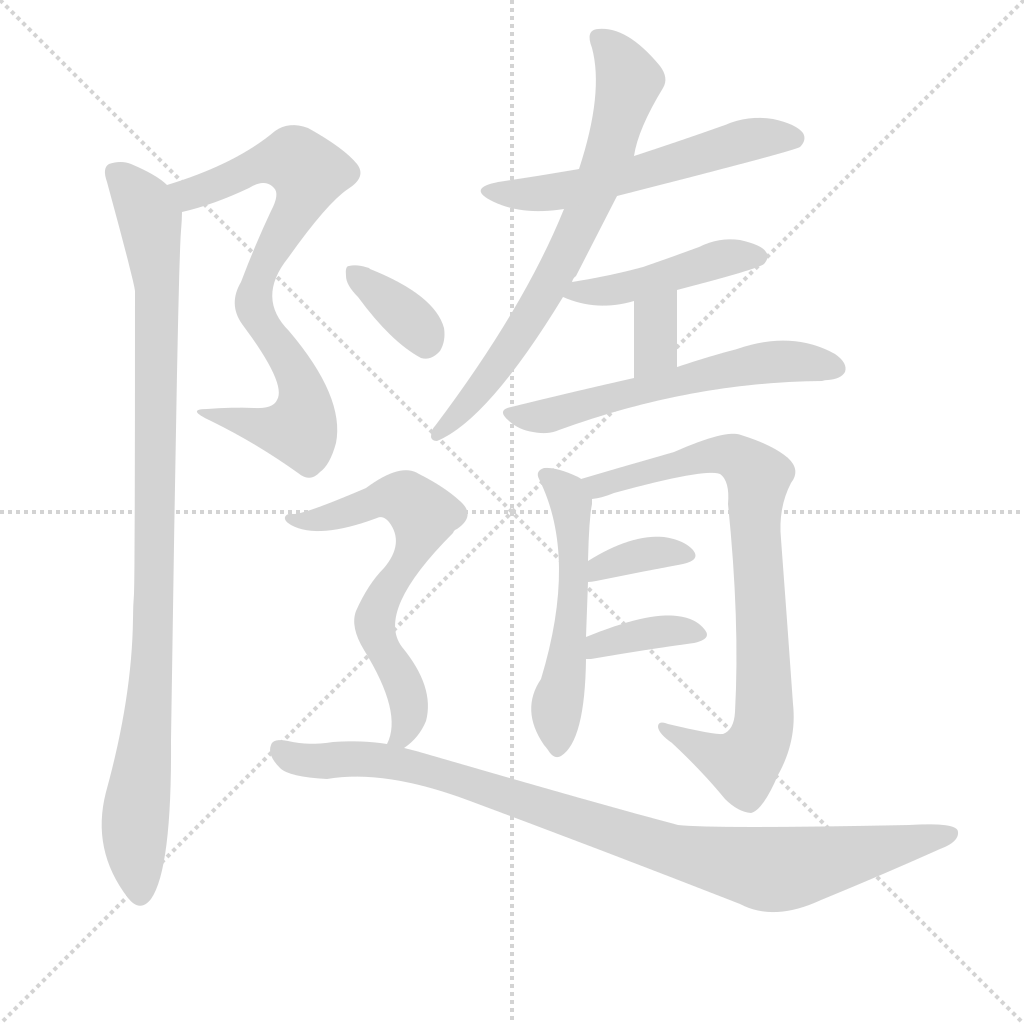
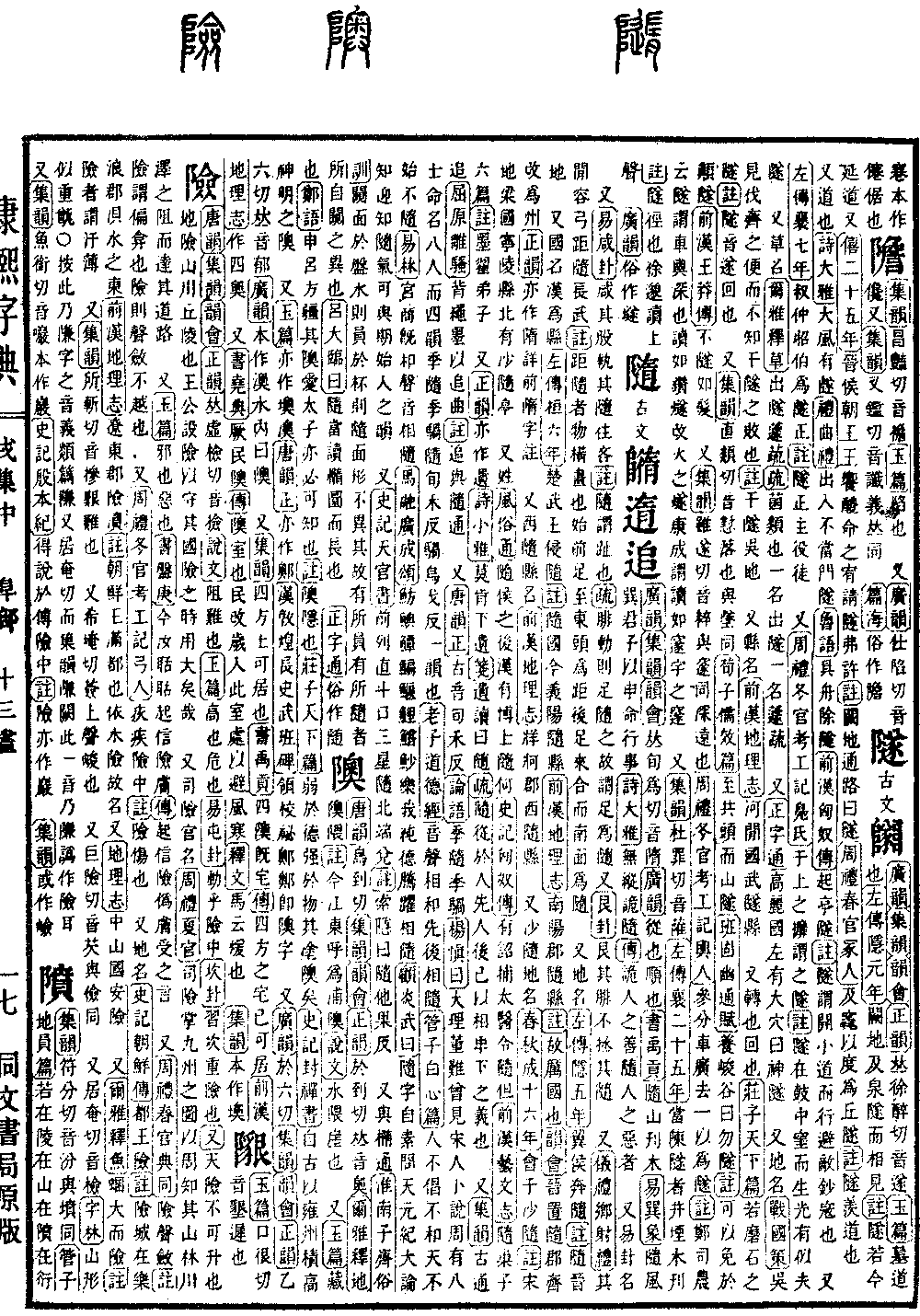
Xu Collection, Middle Volume
Radical: Mound (fù)
Kangxi Strokes: 21; Page Number: 1361, entry 04
Anciently written as zhuì (a variant form of suí) or zhuī (to pursue).
According to Guangyun (Guǎngyùn), Jiyun (Jíyùn), and Yunhui (Yùnhuì), it is pronounced 'xún wéi qiè', sounding the same as suí.
Guangyun defines it as to follow, to obey.
In the Book of Documents (Shàngshū), 'Yu's Tribute' states: 'follow the mountains and cut trees' (to mark a path according to the mountain terrain).
In the Book of Changes (Yìjīng), the 'Image' commentary says: 'Wind follows wind (as in the Xun hexagram), the noble person thereby issues commands and carries out affairs' (implying adaptability and execution).
In the Book of Odes (Shijing), 'Greater Odes' states: 'Do not indulge guǐ suí' (treacherous and compliant individuals). The commentary explains: guǐ refers to a person's capriciousness; suí refers to a person's evil deeds.
It is also the name of a hexagram in the Book of Changes.
Also, in the Book of Changes, the 'Xian' hexagram says: 'Sensitive in the thigh, to insist on following results in regret' (meaning, if one is moved in the thigh, but insists on going along with others, there will be regret). The commentary states: suí refers to the toes. The sub-commentary adds: When the lower leg moves, the foot follows, hence the foot is called suí.
Also, in the 'Gen' hexagram: 'Restraining the calf, unable to lift the foot to follow' (meaning, hindering one's own progress).
Also, in the Book of Rites (Yílǐ), 'Village Archery Ceremony' states: 'The space between them accommodates a bow, and the jù suí measures one wǔ long.' The commentary explains: jù suí refers to objects drawn horizontally. The front foot reaching the east end first is jù; the hind foot following to meet, facing south, is suí.
It is also a place name. In the Zuo Commentary (Zuǒzhuàn), 'Duke Yin, Year 5' records: 'Marquis Yi fled to Suí.' The commentary notes: Suí is a place name in the state of Jin.
It is also a state name. In the Han dynasty, it was established as a county. In the Zuo Commentary, 'Duke Huan, Year 6' records: 'King Wu of Chu invaded Suí.' The commentary states: The state of Suí is now Suí County in Yiyang. The Book of Han (Hànshū), 'Treatise on Geography' mentions Suí County in Nanyang Commandery. The commentary adds: Originally it was the state of Lì. Yunhui states: In the Jin dynasty, Suí Commandery was established; in Northern Qi, it was changed to a prefecture. Zhengyun (Zhèngyùn) also notes that it is written using the character suí (隋). For details, see the entry for the character suí (隋).
There is also 'Xisuí', a county name. The Book of Han, 'Treatise on Geography' mentions Xisuí County in Zangke Commandery.
There is also 'Shasuí', a place name. In the Spring and Autumn Annals (Chūnqiū), 'Duke Cheng, Year 16' records: 'An assembly was held at Shasuí.' The commentary states: Shasuí is a place name in the state of Song, and there is Shasuí Pavilion north of Ningling County in the state of Liang.
It is also a surname. According to Fengsu Tong (Fēngsú Tōng), descendants of Marquis Suí include Suí Hé, a scholar of the Han dynasty. The Records of the Grand Historian (Shǐjì), 'Account of the Xiongnu' states: 'An imperial edict was issued to arrest the Grand Physician Suí Dàn.' The Book of Han, 'Treatise on Literature' mentions 'Suí Cháozi' in six chapters. The commentary notes: Suí Cháozi was a disciple of Mò Dí.
Also, Zhengyun notes that it is sometimes written as yí (referring to the character '遺'). In the Book of Odes, 'Minor Odes' states: 'No one would condescend to yí' (meaning, would not be humble and compliant). The commentary clarifies: yí is read the same as suí. The sub-commentary explains: To follow others, putting others before oneself, embodies the meaning of humility and compliance.
Also, Jiyun states that in ancient times it was interchangeable with zhuī (referring to the character '追'). In Qu Yuan's 'Li Sao' (Lísāo), it says: 'Turning their backs on the measuring line, they zhuī (pursue) crookedness.' The commentary notes: zhuī is interchangeable with suí.
Also, Tangyun Zheng (Tángyùn Zhèng) notes that the ancient pronunciation was 'xún hé fǎn'. In the Analects (Lúnyǔ), it refers to 'Ji Suí, Ji Guā'. Yang Shèn comments: Dàlǐ Dǒng Nán once saw a Song dynasty novel which mentioned the eight scholars of the Zhou dynasty, named in rhyming pairs. For 'Ji Suí, Ji Guā', suí is read 'xún hé fǎn', and guā (referring to the character '騧', a bay horse) is read 'wū gē fǎn', both rhyming.
Laozi's Daodejing (Dàodéjīng) states: 'Sound and tone harmonize, front and back follow each other.'
In Guanzi (Guǎnzǐ), 'White Heart' chapter says: 'If people do not initiate, there is no harmony; if Heaven does not begin, there is no following.'
Yilin (Yìlín) states: 'When the gōng and shāng (two notes of the ancient Chinese musical scale) are harmonious, sounds follow each other.'
In Ma Rong's 'Guangcheng Song' (Guǎngchéng Sòng): 'The fāng, xù, xún, biān, yǎn, lǐ, cháng, shā (types of fish), delight in my pure virtue, leaping and following each other.'
Gu Yanwu (Gù Yánwǔ) states: The character suí began to be used in rhyme starting with the line from the 'Basic Questions' (Sùwèn), 'Great Treatise on the Cosmic Origin': 'Knowing how to welcome, knowing how to follow, the qi can be expected.'
Also, in the Records of the Grand Historian, 'Treatise on Astronomy' states: 'The three stars directly in front of the Dipper's mouth, pointed at the northern end.' The Suǒyǐn commentary says: In this context, suí is pronounced 'tā guǒ fǎn'.
It is also interchangeable with tuǒ (referring to the character '橢', meaning oval). In Huainanzi (Huáinánzǐ), 'Lessons on Uniform Customs' states: 'When viewing one's face in water in a plate, it appears round; in a cup, it appears suí (oval).' Lǚ Dàlín comments: In this context, suí should be read as tuǒ, meaning round and elongated.
Zhengzitong (Zhèngzìtōng) notes that the common form is this character suí itself.