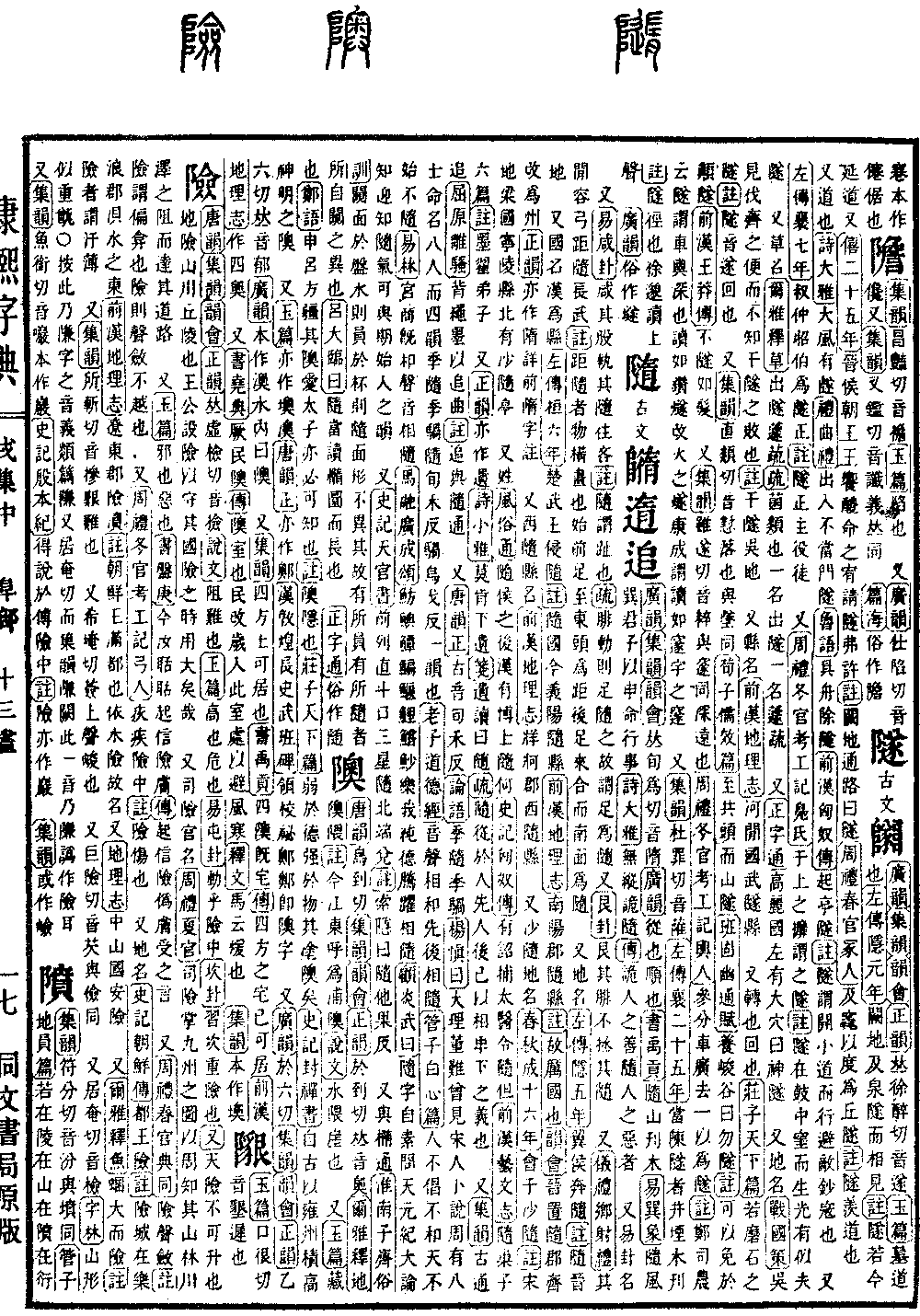
Xu Collection, Mound Radical, Middle Volume
Page 1361, Entry 01
Pronounced xún hé qiè, same as "suí"
Meaning: To follow, to obey.
Record: "Carving trees as markers along the mountain ridges" — Book of Documents (Shujing)
Explanation: "Following the wind, the superior man therefore clarifies his commands and promotes his affairs" — Book of Changes (Yijing)
Quote: "Do not indulge in treacherous following" — Book of Odes (Shijing), Greater Odes section
Commentary: "Treacherous" refers to people's fickleness. "Following" refers to blind obedience and conformity.
Also, a name of a hexagram in the Book of Changes (Yijing).
Quote: "When the thigh is moved, the toes will follow, and regret will ensue" — Book of Changes (Yijing), Xian hexagram
Note: Here, "following" refers to the toes.
Commentary: When the calf moves, the foot follows, hence the foot is called "following."
Quote: "Suppressing the movement of the calf, but not suppressing the toes that follow" — Book of Changes (Yijing), Gen hexagram
Record: "The distance between the middle and the bow is one wu, and the lengths of 'jù' and 'suí' are each one wu" — Rites and Ceremonies (Yili), Rural Archery Ceremony
Note: "Jù" and "suí" are forms of horizontal objects. "Jù" is when the front foot reaches the east end first, and "suí" is when the hind foot follows to meet it and faces south.
Also, a place name.
Record: "Marquis Yi fled to the land of Suí" — Zuo Zhuan (Zuozhuan), 5th year of Duke Yin
Note: Suí was a territory of the state of Jin.
Also, a state name. It was established as a county during the Han Dynasty.
Record: "King Wu of Chu invaded the state of Suí" — Zuo Zhuan (Zuozhuan), 6th year of Duke Huan
Note: The state of Suí is the present-day Suí County in Yiyang.
Record: "In Nanyang Commandery, there was Suí County" — Han Dynasty Geographical Records (Qian Hanshu, Dilizhi)
Note: This was originally the state of Lì.
Record: "During the Jin Dynasty, Suí Commandery was established, and during the Northern Qi Dynasty, it was changed to Suí Prefecture" — Yùn huì
Also see the commentary on the character "suí" earlier.
There is also Xī Suí, a county name.
Record: "In Zangke Commandery, there was Xī Suí County" — Han Dynasty Geographical Records (Qian Hanshu, Dilizhi)
There is also Shā Suí, a place name.
Record: "They met at Shā Suí" — Spring and Autumn Annals (Chunqiu), 16th year of Duke Cheng
Note: This was a territory of the state of Song. There is Shā Suí Pavilion north of Ningling County in the state of Liang.
Also, a surname.
Statement: "It is a descendant of Marquis Suí. During the Han Dynasty, there was a scholar named Suí Hé." — Fēngsú Tōng
Record: "An imperial decree was issued to arrest the imperial physician Suí Dàn." — Records of the Grand Historian (Shiji), Xiongnu Biography
Record: "There are six chapters of 'Suí Cháozi'" — Han Dynasty Treatises on Literature (Qian Hanshu, Yiwenzhi)
Note: This was a disciple of Mò Dī.
Also written as "yí".
Quote: "None were willing to yield and follow" — Book of Odes (Shijing), Lesser Odes section
Annotation: "Yí" is pronounced the same as "suí".
Commentary: Following others, putting others before oneself, is a meaning of humility and treating others with respect.
Also, it is interchangeable with "zhuī" in ancient texts.
Quote: "Abandoning the plumb line to follow the crooked" — Qu Yuan (Qū Yuán), Li Sao
Note: "Zhuī" is interchangeable with "suí".
Ancient pronunciation was "xún hé fǎn".
Mentioned: "Jì Suí, Jì Guā" — Analects (Lunyu)
Statement by Yáng Shèn: Dàlǐ Dǒng Nán once saw a Song Dynasty novel that stated that during the Zhou Dynasty, there were eight wise men, and these eight were named to form four rhyming pairs. "Jì Suí, Jì Guā," with "suí" pronounced "xún hé fǎn" and "guā" pronounced "wū gē fǎn," formed one rhyming pair.
Statement: "Sound responds to sound, and the preceding follows the succeeding" — Laozi (Lǎozǐ), Daodejing
Statement: "If people do not initiate, others will not respond; if heaven does not begin, others will not follow." — Guanzi (Guǎnzǐ), Baixin chapter
Statement: "The palace and commercial tones are already harmonious, and the sounds follow each other." — Yì Lín
Statement: "Fáng fish, shù fish, xí fish, biān fish, shèn fish, lǐ fish, shè fish, zhǎ fish. They delight in my pure virtue and leap in succession." — Mǎ Róng, Guǎngchéng Song
Statement by Gù Yánwǔ: The character "suí" began to be used in rhymes with the phrase "knowing to welcome and knowing to follow, so that the qi can be anticipated" from "Zhi yíng zhi suí, qì kě yǔ qī" in "Sù Wèn, Tiān Yuán Jì Dà Lùn."
Record: "The three stars in front aligned with the mouth of the Dipper, with the Suí (star) at the northern end, sharp in shape." — Records of the Grand Historian (Shiji), Treatise on Heavenly Offices (Tianguan Shu)
Note: Suǒyǐn says: Suí is pronounced "tā guǒ fǎn".
Also interchangeable with "tuǒ".
Statement: "Reflecting one's face in a plate of water appears round, while reflecting in a cup of water appears oval. The shape of the face does not change; the reason why it sometimes appears round and sometimes oval is due to the tool used for reflection." — Huainanzi (Huáinánzǐ), Qí Sú chapter
Statement by Lǚ Dàlín: Suí should be read as "tuǒ," referring to something round and long.
Variant form: The common variant form is written as "随".