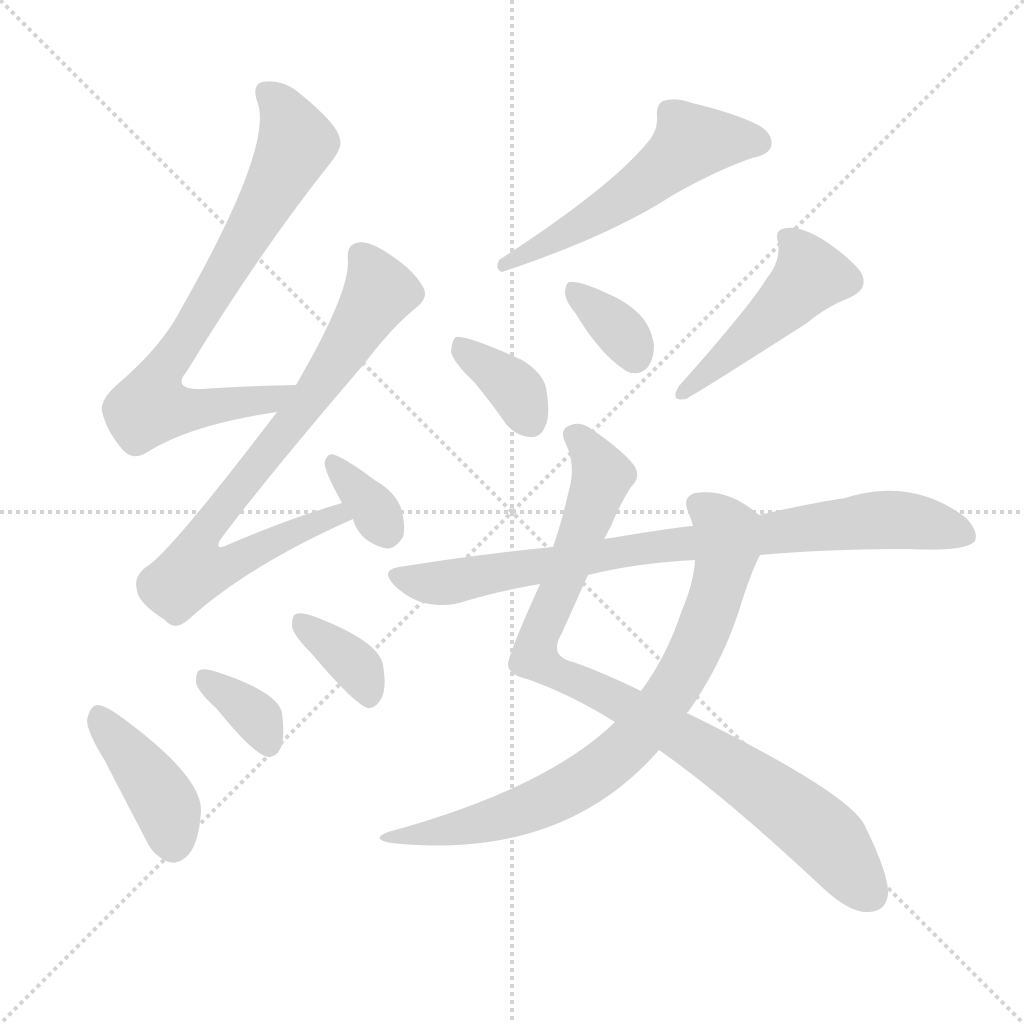
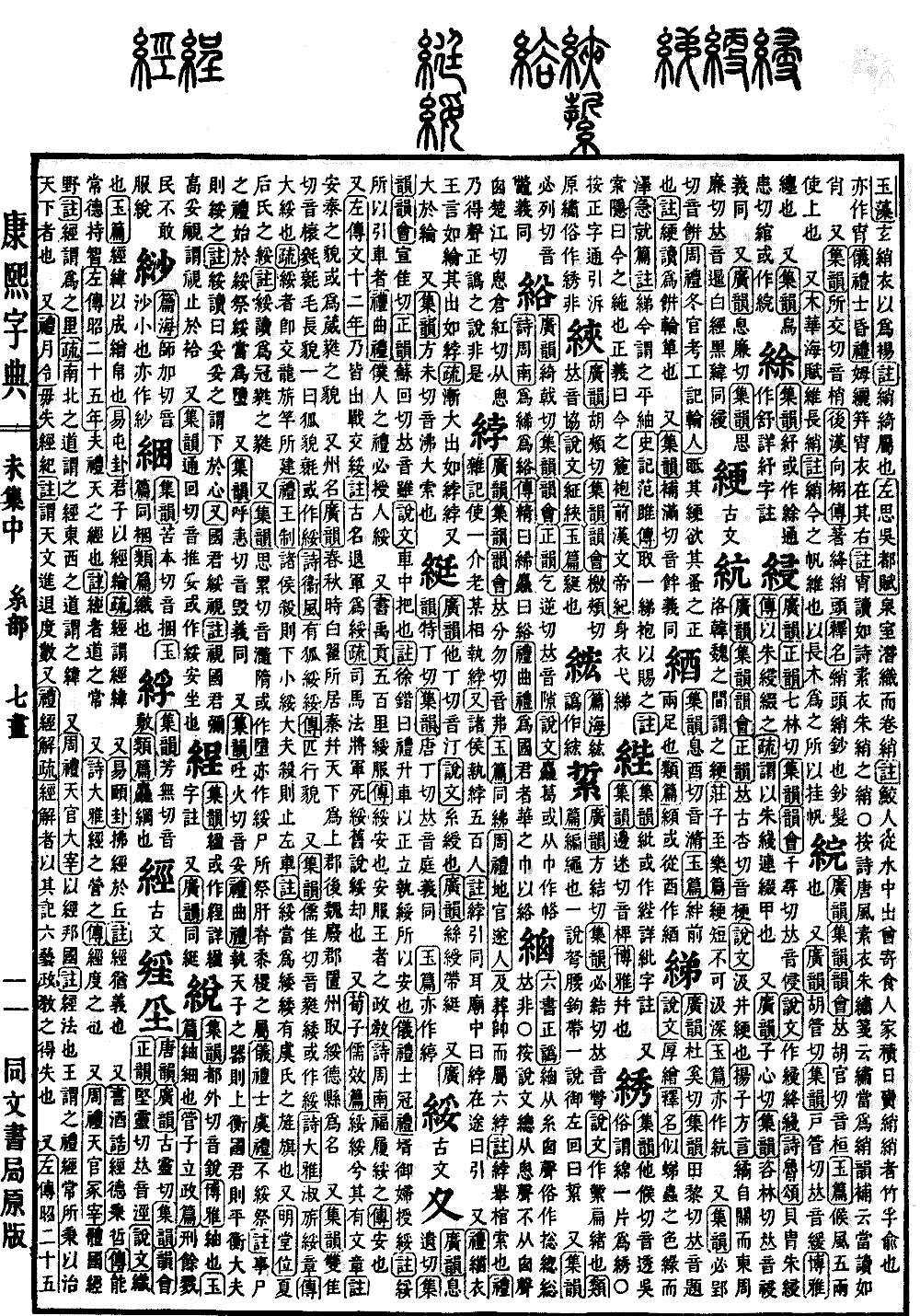
Wei Collection, Middle Volume. Radical: Silk (mì). Kangxi Strokes: 13. Page 925, Entry 17. Ancient form is written as 夊. Pronounced sui. According to the Shuowen Jiezi (Shuowen), it refers to the strap inside a carriage. The commentary by Xu Kai states: In the Book of Rites (Liji), when boarding a carriage, one must stand upright and hold the strap, which provides stability. In the Book of Etiquette and Ceremonial (Yili), it is said: The bridegroom drives the bride's carriage and offers her the strap. The commentary states: The strap is that by which one pulls oneself into the carriage. In the Book of Rites (Liji), it is said: The etiquette of a charioteer is to always offer the strap to others. Also, in the Book of Documents (Shujing), it says: Five hundred li of peaceful submission. The commentary states: To stabilize, meaning to settle and submit to the administration and teachings of the king. In the Book of Odes (Shijing), it says: Blessings and prosperity settle him. The commentary states: To stabilize. Also, in the Zuo Tradition (Zuo Zhuan), it mentions: They all went out to battle and withdrew (sui). The commentary states: In ancient times, retreating the army was called sui. The sub-commentary states: In the Sima Fa, it says a general who dies while retreating is called sui. Ancient explanations suggest that sui means to retreat. Also, in the Xunzi, it says: Elegant and orderly, it possesses refined patterns. The commentary states: An appearance of peace and tranquility, or perhaps the appearance of being luxuriant and drooping. Also, it is the name of a prefecture. According to the Guangyun, it was the location occupied by the White Di during the Spring and Autumn period. Qin unified the world and made it Shang Commandery. Later, the Northern Wei abolished the commandery and established a prefecture, taking the name from Suide County. Also, pronounced cui. It describes long hair, or alternatively, the appearance of a fox. Also written as a variant form (sui). In the Book of Odes (Shijing), it says: A fox moving in a pair. The commentary states: The appearance of walking in a pair. Also, pronounced rui. Often written as a variant form (sui). In the Book of Odes (Shijing), it says: Fine banners with drooping ornaments. The commentary states: A large drooping ornament. The sub-commentary states: The sui is that which is established on the pole of the dragon-patterned banner. In the Book of Rites (Liji), it says: When a feudal lord kills, he lowers the small drooping ornament; when a high official kills, he stops the secondary carriage. The commentary states: The character for sui should be written as rui, which refers to the flags and banners of the Yu clan. Also, in the Mingtang Wei, it mentions: The drooping ornaments of the Xia dynasty. The commentary states: Read as the rui in the phrase for drooping cap-strings. Also, pronounced sui. Often written as a variant form (duo). Also written as (sui). Refers to the offerings of liver, spine, millet, and panicled millet dedicated to the deceased. In the Book of Etiquette and Ceremonial (Yili), it says: Do not offer the sacrificial food (sui). The commentary states: The rituals for serving the deceased begin with the sacrificial offering. Sui should be written as duo. Also, pronounced hui. The meaning is the same. Also, pronounced tuo. In the Book of Rites (Liji), it says: When holding the vessels of the Son of Heaven, one keeps them level with the top; for a regional ruler, one keeps them level with the chest; for a high official, one lowers them (sui). The commentary states: Sui is read as tuo, meaning to lower it toward the heart. Also: A regional ruler looks down (sui). The commentary states: Looking at a regional ruler from a higher position; looking down means the gaze stops at the collar. Also, pronounced tui. Often written as a variant form (sui), meaning to sit peacefully.