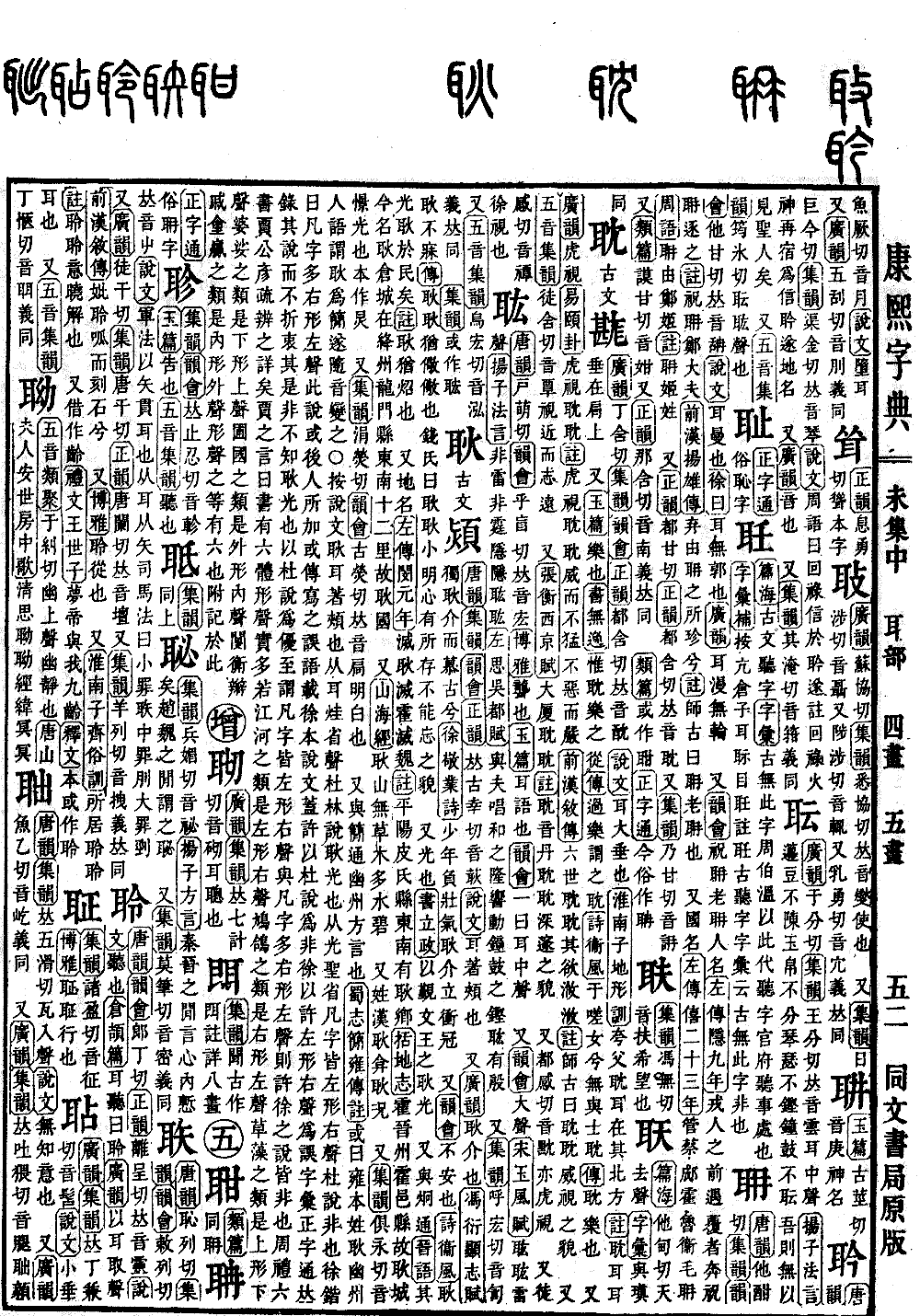
Wei Collection, Middle Volume. Radical: Ear (ěr). Seventeen strokes. Page 966, Entry 01.
Pronounced song. According to the Dialect (Fangyan) by Yang Xiong, to be deaf. To be born deaf is called song in the regions between the Chen, Chu, Jiang, and Huai rivers. The commentary explains this is because when one hears nothing, one is always pricking up the ears.
Also, to be tall. In the collected poems by Han Yu, it is written that the sword heart knows it has not yet perished, and poetic thoughts remain standing tall alone.
Also, according to the Dialect (Fangyan), to desire. This is said in the regions of Jing and Wu. From the region west of the pass, in the lands of Qin and Jin, to urge one another is called song.
Also, according to the Dialect (Fangyan), to be fearful. The commentary explains this as being alert and frightened. In the Zuo Tradition (Zuo Zhuan), it is written that when the grandees heard of this, there was none who was not afraid and trembling. In the Discourses of the States (Guoyu), it is written that formerly, King Wu Ding of the Shang dynasty was able to arouse his virtue. The commentary explains song as reverence.
Also, according to the Collected Rhymes (Jiyun), pronounced shuang, with the same meaning.