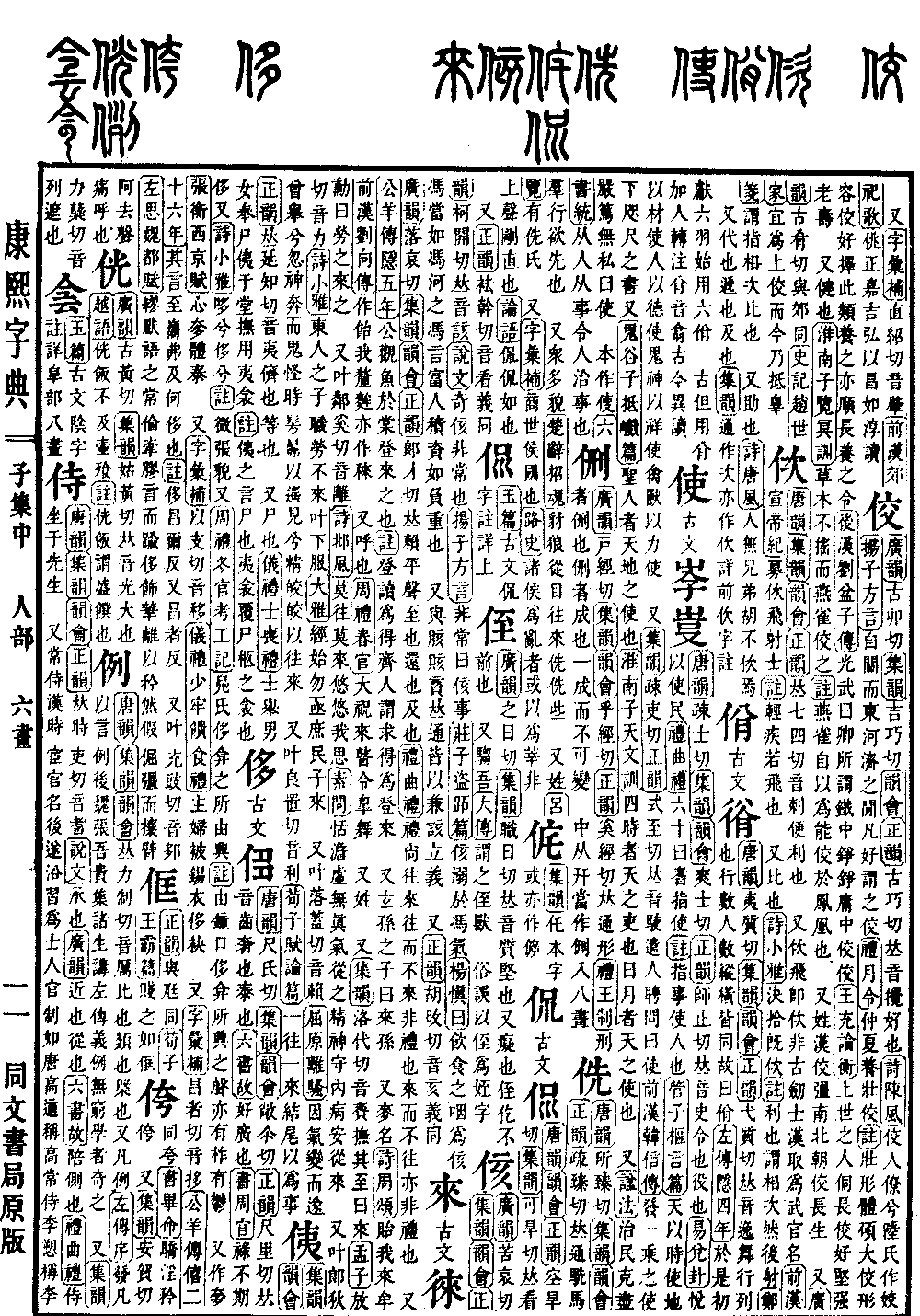
Zi Collection, Middle Volume
Radical: Person (rén)
Page 101, Entry 05
Ancient form. Pronounced shi (rising tone).
Meaning: To command, to dispatch.
Book of Odes (Shijing), Binfeng Preface: To please people in order to employ them.
Book of Rites (Liji), Quli: At sixty, one is called elderly and employs others to act. Note: To employ means to arrange affairs for others to execute.
Guanzi, Shuyan Chapter: Heaven employs through seasons, Earth employs through products, man employs through virtue, ghosts and spirits employ through auspicious or ominous signs, and birds and beasts employ through strength.
Also pronounced shi (falling tone).
To dispatch a person for the purpose of a diplomatic visit is called shi.
History of the Former Han (Qian Han Shu), Biography of Han Xin: Dispatched an envoy with one carriage to deliver a short letter.
Guiguzi, Dixi Chapter: The sage is the envoy of Heaven and Earth.
Huainanzi, Tianwen Xun: The four seasons are the officials of Heaven. The sun and moon are the envoys of Heaven.
Also, according to the System of Posthumous Titles (Shifa): To govern the common people with strictness, sincerity, and without selfishness is called shi.
The original character is written as.
Six Books Unified (Liushu Tong): Composed of the radical Person and the character for business. The meaning is to assign people to manage affairs.
Textual Research:
Book of Changes (Yijing), Dui Hexagram: To please people in order to employ them.
Note: Upon examination, the original text of the Dui Hexagram Image Commentary in the Book of Changes (Yijing) actually reads to please people in order to lead them, which is unrelated to the character shi. It has been verified that these four words only appear in the Binfeng Dongshan Preface of the Book of Odes (Shijing). Therefore, the characters Book of Changes (Yijing) Dui Hexagram have been changed to Binfeng Preface, and the character please has been corrected.