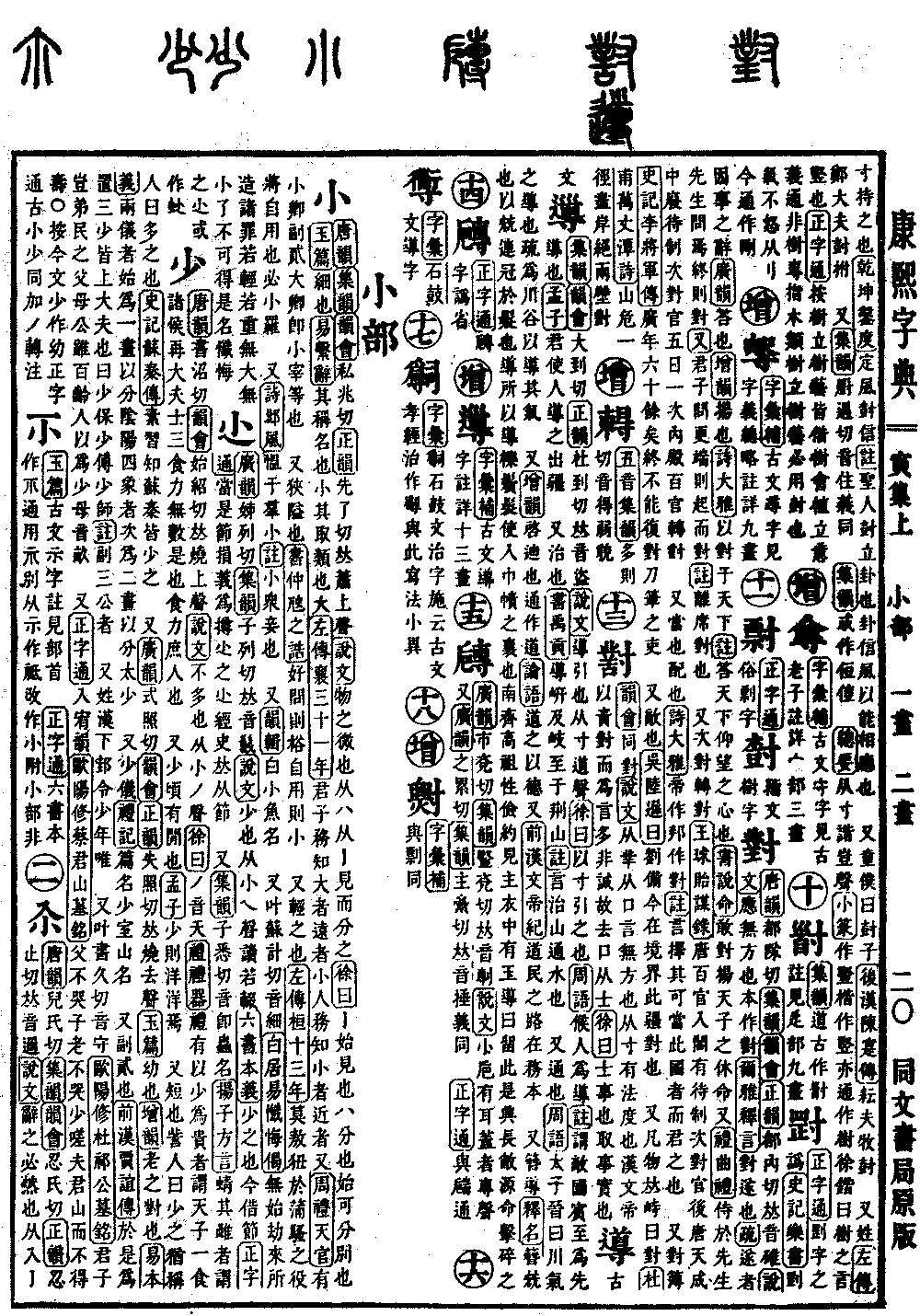
Yin Collection, Upper Volume
Radical: Small (xiǎo)
Kangxi Strokes: 4
Page 296, Entry 20
Pronounced shǎo.
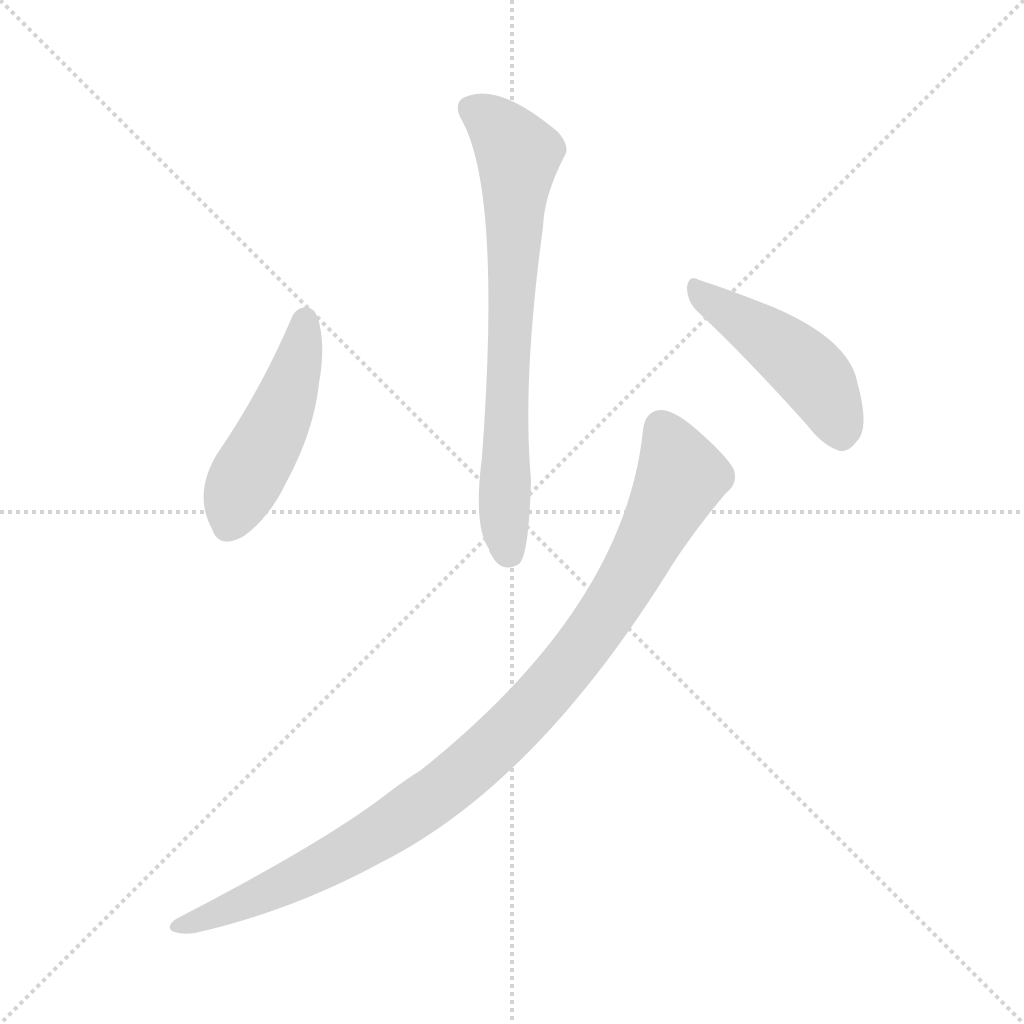
According to the Shuo Wen Jiezi (Explicating Graphs and Analyzing Characters), it means not many. It is composed of Small (xiǎo) with the sound of the stroke (piě). Xu says the stroke is pronounced yāo.
Book of Rites (Liji), section on Ritual Vessels: There are rituals where being few is considered noble, such as the Son of Heaven eating once, the feudal lords twice, and the ministers and scholars thrice, while the laborers have no set number. Laborers refers to the common people.
Also means a little while, meaning having leisure.
Mencius: When it is a little, it is vast.
Also means to belittle. To criticize someone is to treat them as small, just as praising someone is to treat them as great.
Records of the Grand Historian (Shiji), Biography of Su Qin: He was accustomed to knowing that everyone looked down on Su Qin.
Pronounced shào.
According to the Yu Pian (Jade Chapters), it means young.
According to the Zeng Yun (Expanded Rhymes), it is the opposite of old.
Book of Changes (Yijing), Original Meaning: The two forms are the beginning, representing one line to distinguish yin and yang. The four images are next, representing two lines to distinguish great and small.
Also refers to the Shao Yi, a chapter name in the Book of Rites (Liji).
Shao Shi is the name of a mountain.
Also refers to a deputy or assistant.
History of the Former Han (Qianhan Shu), Biography of Jia Yi: Thus, three shao positions were established, all being upper grandees. They were called Junior Guardian, Junior Tutor, and Junior Preceptor. The commentary notes these are deputies to the three excellencies.
Also a surname. The Prefect of Xiagui during the Han dynasty was named Shaonian Wei.
Also rhymes with shǒu.
Ouyang Xiu, Epitaph for Du Qigong: The gentleman is happy and easy, the parent of the people. Although the Duke reached one hundred years, people still thought him young. Mu is pronounced mǔ.
According to the Zheng Zi Tong (Correction of Characters), it enters the you rhyme.
Ouyang Xiu, Epitaph for Cai Junshan: The father does not weep for the son, the old do not weep for the young. Alas, Junshan, you did not attain a long life.
Note that in modern texts, shǎo is written as yòu. The Zheng Zi Tong states that in ancient times, small (xiǎo) and few (shǎo) were the same, with the addition of a stroke, representing a derivative character.