Xu Collection, Upper Volume
Radical: Gate (mén)
16 Kangxi strokes
Page 1336, Entry 18
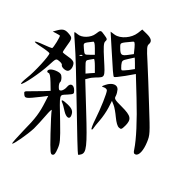
Zhengzitong states it is the same as the character for kill. It has three pronunciations: rising tone, departing tone, and entering tone. The Rites of Zhou: Artificers' Record (Kaogongji) states: People inspect ox horns; horns from cattle killed in autumn are thick, while horns from cattle killed in spring are thin. The commentary explains: This character is synonymous with kill, and is pronounced with an entering tone.
Furthermore, the Bowyer section states: When crafting the side bones of a bow, if they deform, it must affect the central joint. The commentary explains: The side bones are the side supports, and the term refers to the central joint. The side bones and the central joint function together; if the side supports deform, the central joint is also affected. Lu Deming in his Explanation of Classical Texts (Jingdian Shiwen) provides the pronunciation as se-jie (entering tone).
The Artificer section also states: For all construction of embankments, the width and height should be equal; from the base upwards, one-third of the way up it begins to taper, with larger embankments tapering more significantly. The commentary explains: This refers to cutting or reducing. The embankment base occupies one-third, and the upper two-thirds remain solid. For larger embankments, the tapering occurs beyond the base-third and within the upper two-thirds. By repeatedly tapering and trimming, the embankment becomes more solid.
When meaning to kill, it is pronounced with an entering tone. When meaning to diminish or to categorize, it is pronounced with a departing tone. It is not necessary to follow the Rites of Zhou (Zhouli) by using this specific character, as following the common convention of writing it as the character for terminate is also acceptable. The Dictionary of Standard Rhymes (Zhengyun) also notes in its commentary on the character for kill in the six-tai rhyme group that it may be written as the character for terminate. In the four-xia rhyme group, it is defined as to execute without a legal charge. It is incorrect to generalize that the character for kill is always written as these variants. The Rites of Zhou modifies the character for kill to this form, but this is overly pedantic. For further detailed explanations, see the commentary for the character for kill under the Weapon (shu) radical.