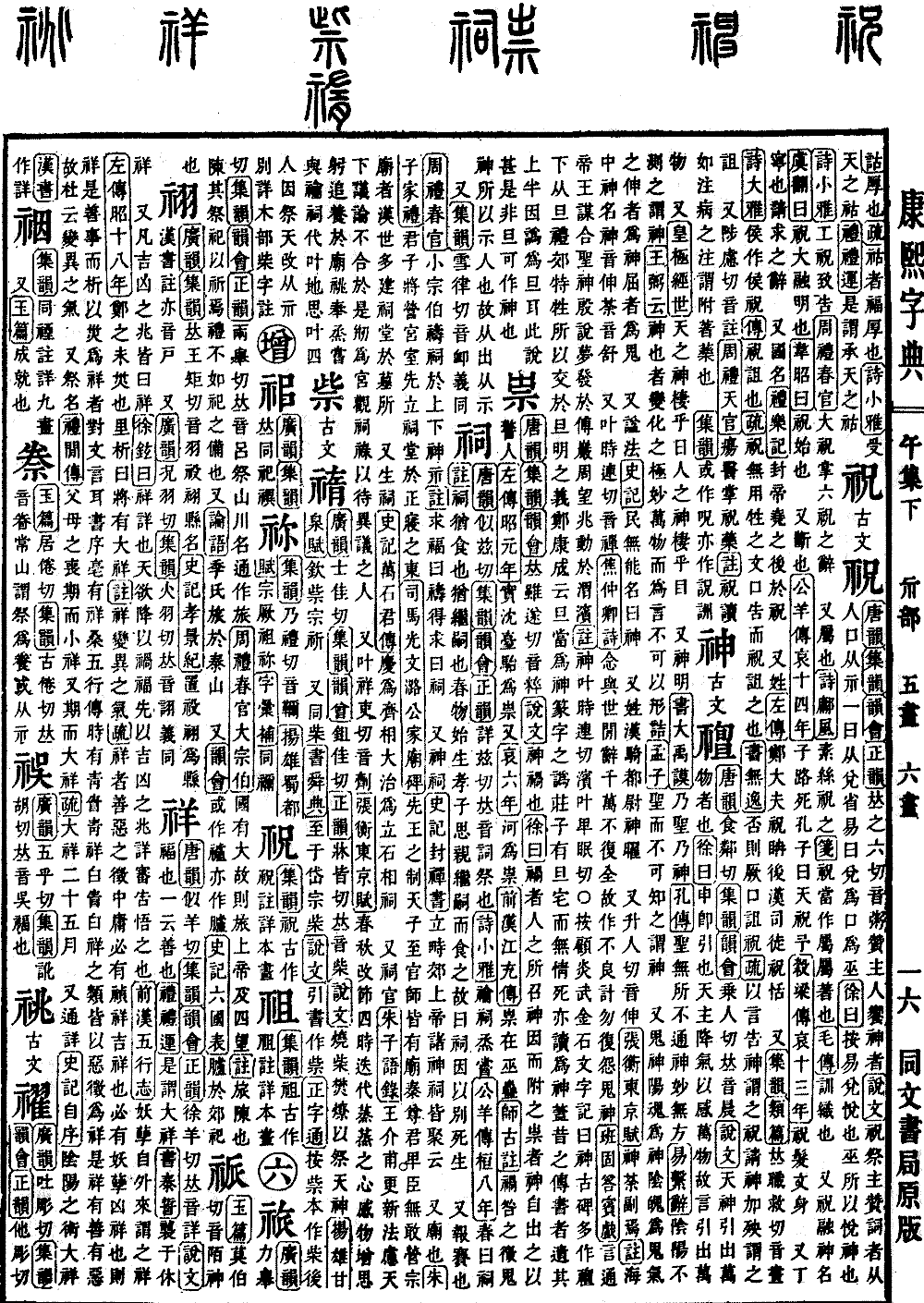
Wu Collection, Lower Volume
Radical: Spirit (shì)
Kangxi Strokes: 10
Page 842, Entry 03
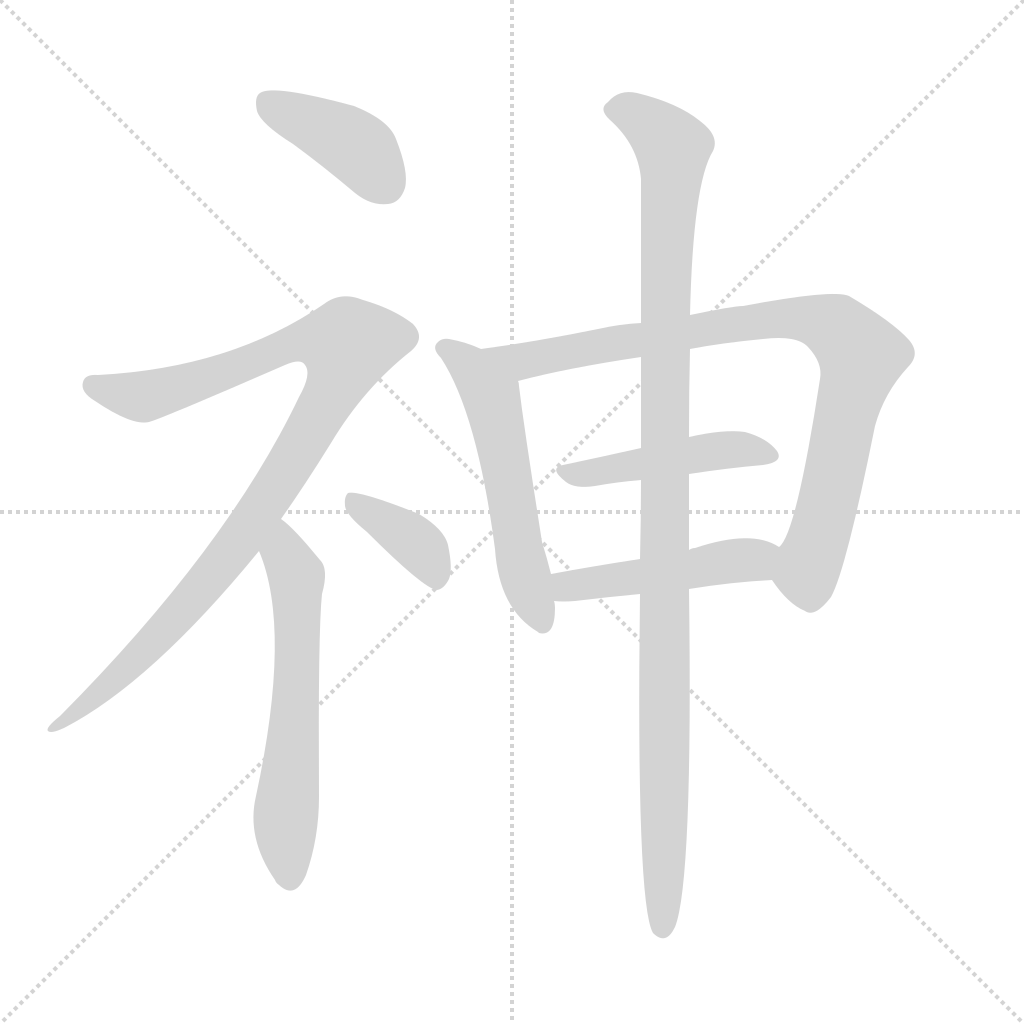
Ancient character. According to Tang Rhymes (Tangyun), pronounced chen (rising tone); according to Collected Rhymes (Jiyun) and Rhymes Dictionary (Yunhui), pronounced chen (rising tone).
According to Explaining Graphs and Analyzing Characters (Shuowen), it refers to heavenly spirits, those that bring forth the ten thousand things. Xu says: To extend means to pull forth; the Lord of Heaven descends energy to affect all things, hence it is said to bring forth all things.
Also, in the Book of Supreme World Ordering Principles (Huangji Jingshi), the spirit of Heaven resides in the sun, and the spirit of man resides in the eyes.
Also, divine intelligence. In the Book of Documents (Shujing), specifically the Great Plan of Yu (Da Yu Mo), it says: Possessing sagehood and possessing divine intelligence. Kong comments: Sagehood is that which is nowhere unpenetrated; divine intelligence is subtle and without bounds. In the Book of Changes (Yijing), within the Appended Remarks (Xici), it says: That which is unfathomable in the movement of yin and yang is called spirit. Wang Bi states: Spirit is the culmination of transformation, a term describing the subtle nature of all things, which cannot be examined through physical form. In Mencius, it says: To be a sage and yet be beyond knowledge is called spirit.
Also, ghosts and spirits. The yang soul is called spirit, the yin soul is called ghost. The energy that expands is spirit; that which contracts is ghost.
Also, posthumous titles. In the Records of the Grand Historian (Shiji), it states: That which the people cannot name is called spirit.
Also, a surname. The Han dynasty cavalry commandant Shen Yao.
Also, pronounced shen. In Zhang Heng's Eastern Capital Rhapsody (Dongjing fu), it mentions Shentu as a deputy. The commentary notes: The name of a spirit in the sea. Shen is pronounced shen, tu is pronounced shu.
Also, rhymes with chan. In the poem by Jiao Zhongqing: Reflecting on parting from the world, ten thousand times never to be whole. Therefore I make a bad plan, do not again blame the ghosts and spirits. In Ban Gu's Response to the Guest's Ridicule (Da bin xi): Words communicate with emperors and kings, strategies align with sages and spirits; Yin Yue dreamed and was discovered at Fu Yan, Zhou observed the omens and stirred at the Wei River. The commentary notes: Shen rhymes with chan, bin rhymes with mian.
Note: Gu Yanwu, in his Record of Stone and Metal Inscriptions (Jinshi wenzi ji), says that in ancient times, the character for spirit was often written with the character for morning at the bottom. The Book of Rites (Liji), in the section on the Suburban Sacrifice (Jiao te sheng), discusses the meaning of interacting with the bright morning light. Zheng Kangcheng says: Morning should be spirit; the seal script character is an error. In Zhuangzi, there is a reference to living in a morning dwelling without emotion and death, which is also read as spirit. Likely, those who transmitted the books in the past lost the upper half of the character, resulting in the error of writing it as morning. This explanation is quite correct; morning cannot serve as the character for spirit.