Si Collection, Middle Volume
Radical: Crossed Lines (yáo)
Kangxi Strokes: 11
Page 690, Entry 22
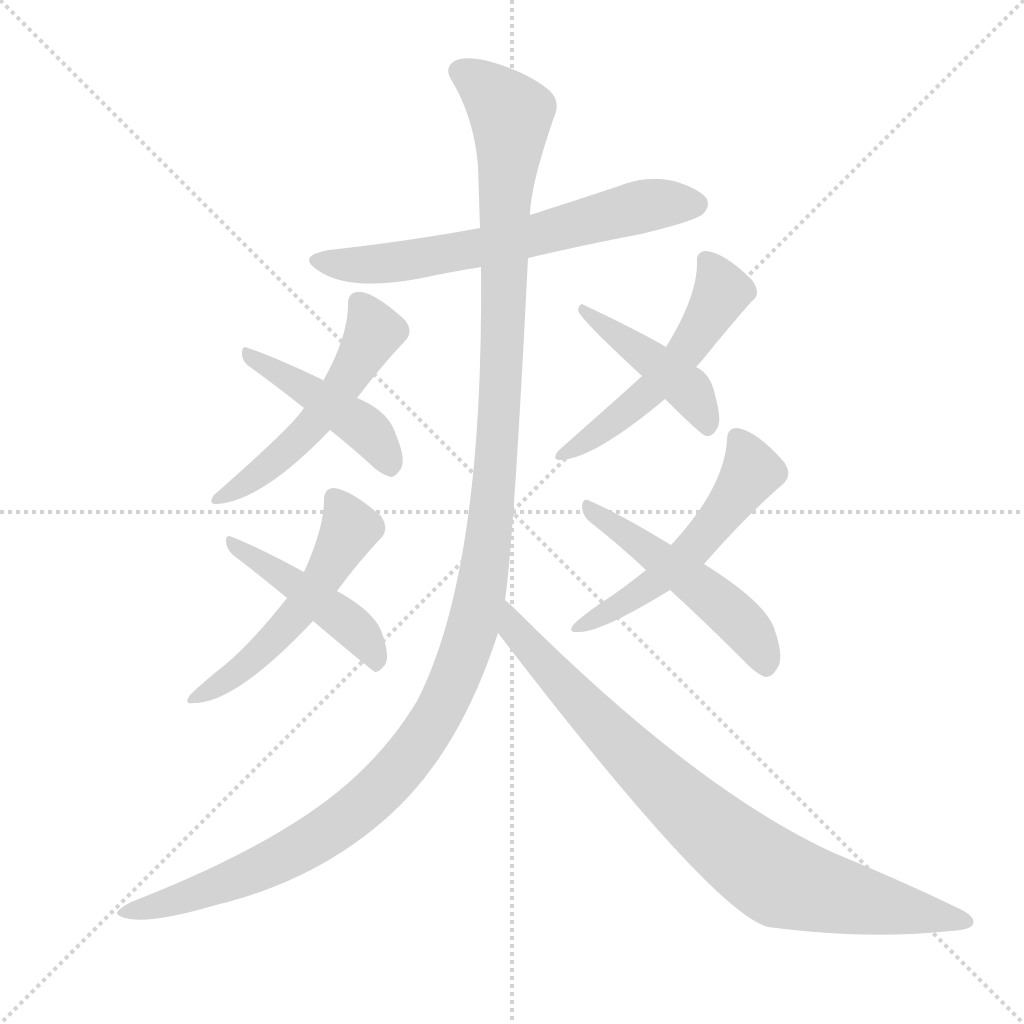
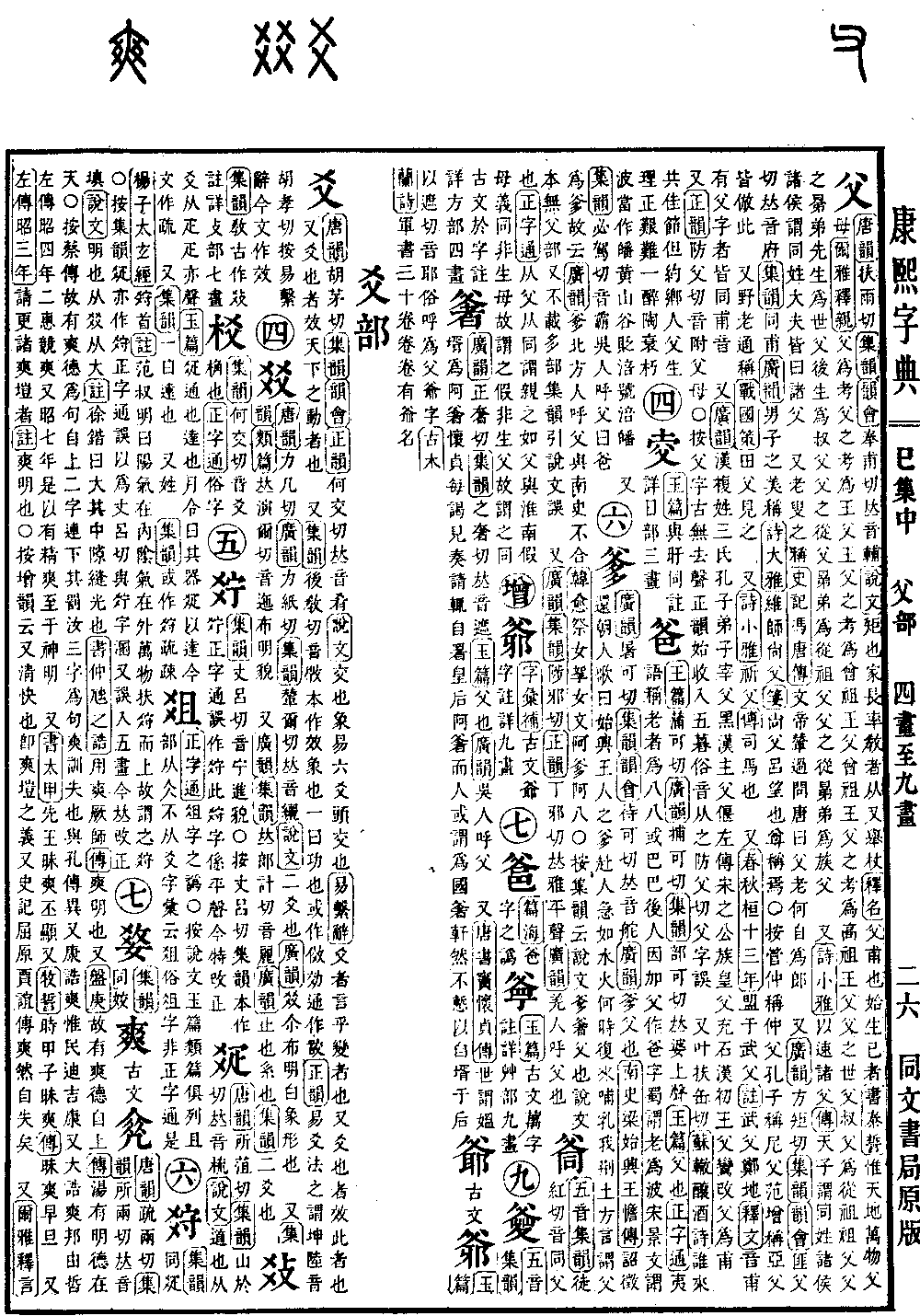
Ancient literature records: According to the Tang Rhyme (Tangyun), pronounced shuang (rising tone). According to the Collected Rhymes (Jiyun), pronounced shuang (rising tone). The pronunciation is the same as the character meaning high and bright. The Explaining Graphs and Analyzing Characters (Shuowen Jiezi) interprets it as bright. The character structure is composed of the symbol for crisscrossed lines and the character for great. Annotation: Xu Kai states: Great refers to the light that penetrates through the middle gap. Book of Documents (Shangshu), Zhong Hui's Announcement: Use this to clarify the army. Commentary: Shuang means to be manifest or clear. Also, Pan Geng: Therefore there is bright virtue from above. Commentary: Refers to the bright virtue of Shang Tang manifested to heaven. Note: Cai Chen's commentary interprets Therefore there is bright virtue as one clause. The two characters from above connect to the following text, forming a clause with the three characters describing the punishment. Here, shuang is interpreted as a mistake or error. This differs from Kong Anguo's commentary. Also, Kang Announcement: Clarify the people's path to auspicious peace. Also, Great Announcement: A clarified state relies on the wise. Zuo Commentary (Zuo Zhuan), Year 4 of Duke Zhao: Two favors competing in brilliance. Also, Year 7 of Duke Zhao: Therefore there is a refined clarity, reaching to the divine. Also, Book of Documents (Shangshu), Tai Jia: The former king in the early dawn was greatly manifest. Also, Oath of Mu: At the hour of jiazi in the early dawn. Commentary: Early dawn refers to the time of daybreak. Also, Zuo Commentary (Zuo Zhuan), Year 3 of Duke Zhao: Please relocate to a place that is bright and dry. Annotation: Shuang means bright and dry. Note: The Added Rhymes (Zengyun) states: There is also the meaning of clear and refreshing. This refers to the meaning of bright and dry. Also, Records of the Grand Historian (Shiji), Biography of Qu Yuan and Jia Sheng: Disconcerted and lost. Also, Erya, Interpreting Words: Shuang means error or deviation. Yangzi's Regional Expressions (Fangyan): Shuang means excessive. Book of Documents (Shangshu), Luo Announcement: In matters, one may commit an error or insult. Discourses of the States (Guoyu), Zhou Discourses: The Marquis of Jin deviated twice. Master Lie (Liezi), Yellow Emperor Chapter: Dimly, the five emotions become confused and disordered. Also, Yangzi's Regional Expressions (Fangyan): Shuang means valiant or fierce. In the regions of Qi and Jin, it is called shuang. Also, Broad Rhymes (Guangyun): Means rigid or fierce. Also means noble. It is also the name of a star. Xishuang is one of the seven stars of the Rabbit constellation (Mao constellation). Seen in Records of the Grand Historian (Shiji), Treatise on the Celestial Offices. Also, Zuo Commentary (Zuo Zhuan), Year 17 of Duke Zhao: The Shuangjiu clan were the Ministers of Justice. Annotation: Shuangjiu refers to a hawk. Also used as a person's name; Zuo Shuang appears in Strategies of the Warring States (Zhan Guo Ce). Also, Dictionary of Characters (Leipian): Pronounced shuang. The meaning is the same. Book of Odes (Shijing), Wei Airs: The waters of the Qi flow broadly, soaking the carriage curtains; the woman has not been mistaken, the man has changed his conduct. Also, Minor Odes (Xiaoya): His virtue is not mistaken, and he will be remembered for a long life. Note: In Zhu Xi's Collected Commentaries on the Odes (Shiji Zhuan), the character shuang is read with an altered pronunciation as sheng. In the Collected Rhymes (Jiyun), the character shuang was originally included under the rhyme group ten-yang. This pronunciation existed in ancient times and was not necessarily an altered rhyme. Also, Laozi, Classic of the Way and Virtue (Daodejing): The five flavors cause a person to have a dull palate; galloping and hunting cause a person's heart to go mad. Also, Songs of Chu (Chuci), Summoning the Soul: Dew-basted chicken and minced turtle, not spoiled. Annotation: Means spoiled or rotten. In the Chu region, people call spoiled soup shuang. Also, Zuo Commentary (Zuo Zhuan), Year 2 of Duke Ding: The Duke of Tang went to Chu and had two steeds with white-spotted coats. Explanation of Texts: Shuang is pronounced shuang. The horse is not called by the name susuang. The character shuang in some versions is written as frost. Jia Kui says: The horse's coat is like fine, frost-white silk. Ma Rong says: Susuang is a wild goose; the horse's appearance resembles it. Note: In the Broad Rhymes (Guangyun), rhyme group ten-yang, it is written as a horse radical with a frost phonetic, equivalent to a horse radical with a double-shuang phonetic. The character shuang is not included. Only the Dictionary of Characters (Leipian) entry for the horse-radical character notes that it is commonly written as shuang. Also, pronounced as sheng as an altered rhyme. History of the Later Han (Hou Hanshu), Biography of Ma Rong: Luxuriant and dense, towering and tall, gathering the spring breeze, holding moisture and spitting out glory. Annotation: Cansen-shuang describes the appearance of flourishing trees. The character shuang is read with an altered pronunciation as sheng.