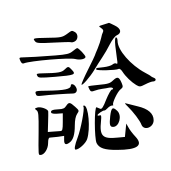
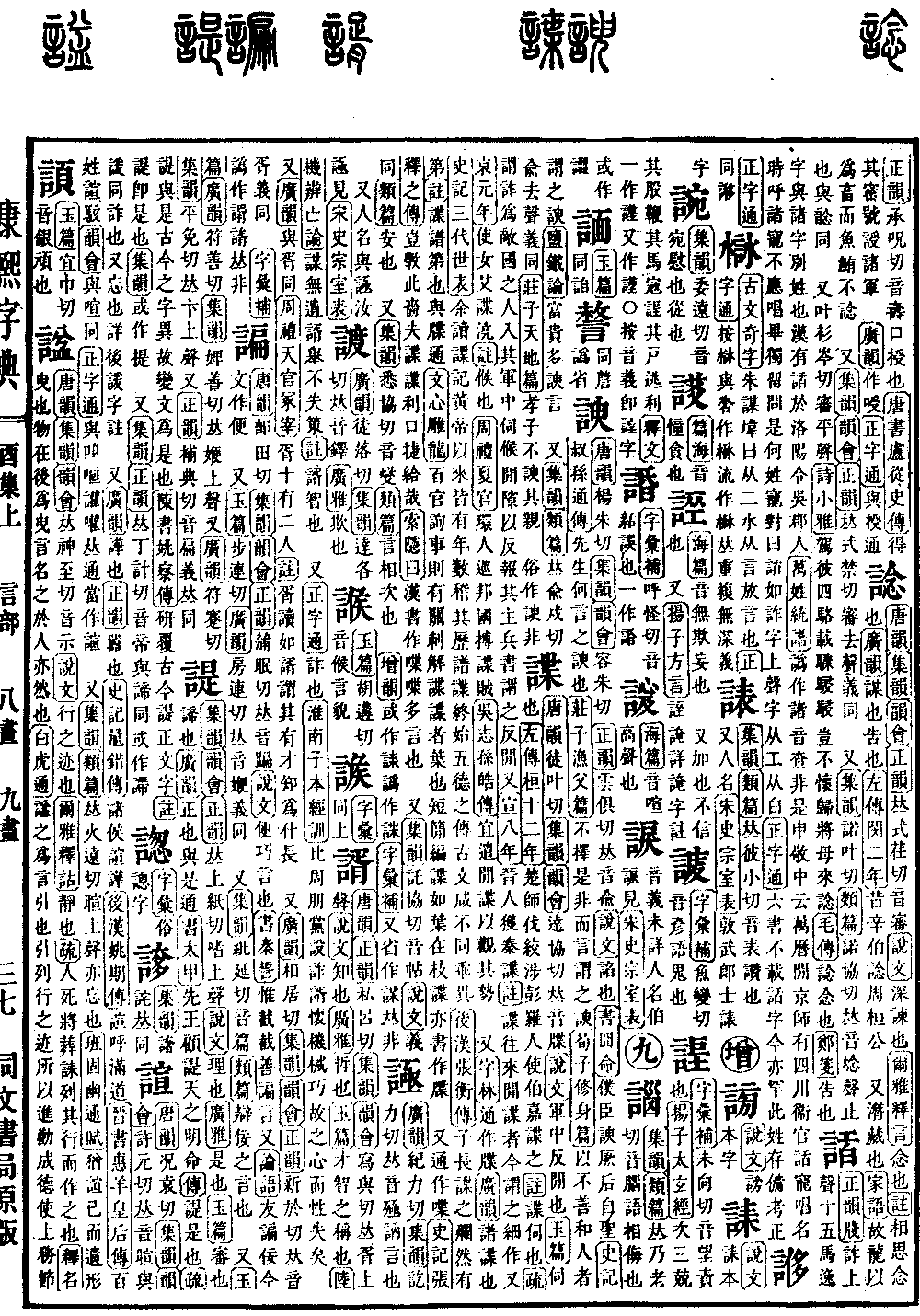
You Collection, Upper Volume
Radical: Speech (yán)
15 Kangxi strokes
Page 1169, Entry 01
Tang Rhymes (Tangyun), Collection Rhymes (Jiyun), Rhyme Meetings (Yunhui), and Correct Rhymes (Zhengyun) record the pronunciation as shen (third tone).
According to Explaining Graphs and Analyzing Characters (Shuowen), it means to remonstrate deeply.
According to the Approach to Elegance (Erya), in the section explaining terms, it means to think. The commentary notes it signifies mutual longing or thinking.
The Broad Rhymes (Guangyun) states it means to plan or to inform.
In the Zuo Tradition (Zuozhuan), Min Year 2, it is written: In the past, Xin Bo remonstrated with Duke Huan of Zhou.
It also means to hide or conceal. In the School Sayings (Jiayu), it is written: Therefore, when the dragon is considered a domestic animal, the fish and sturgeon do not hide.
According to Collection Rhymes (Jiyun), Rhyme Meetings (Yunhui), and Correct Rhymes (Zhengyun), it is also pronounced shen (fourth tone), with the same meaning.
According to Collection Rhymes (Jiyun), it is pronounced nian. It means the cessation of sound, and is written as a variant form (tong).
It is also used with the rhyme pronounced shen (first tone). In the Book of Odes (Shijing), Small Elegantiae (Xiao Ya), it is written: I drive those four white-maned horses, they gallop swiftly. How can I not long to return, but I bring my mother to show my care. The Mao commentary states: It means to think. The Zheng commentary states: It means to inform.