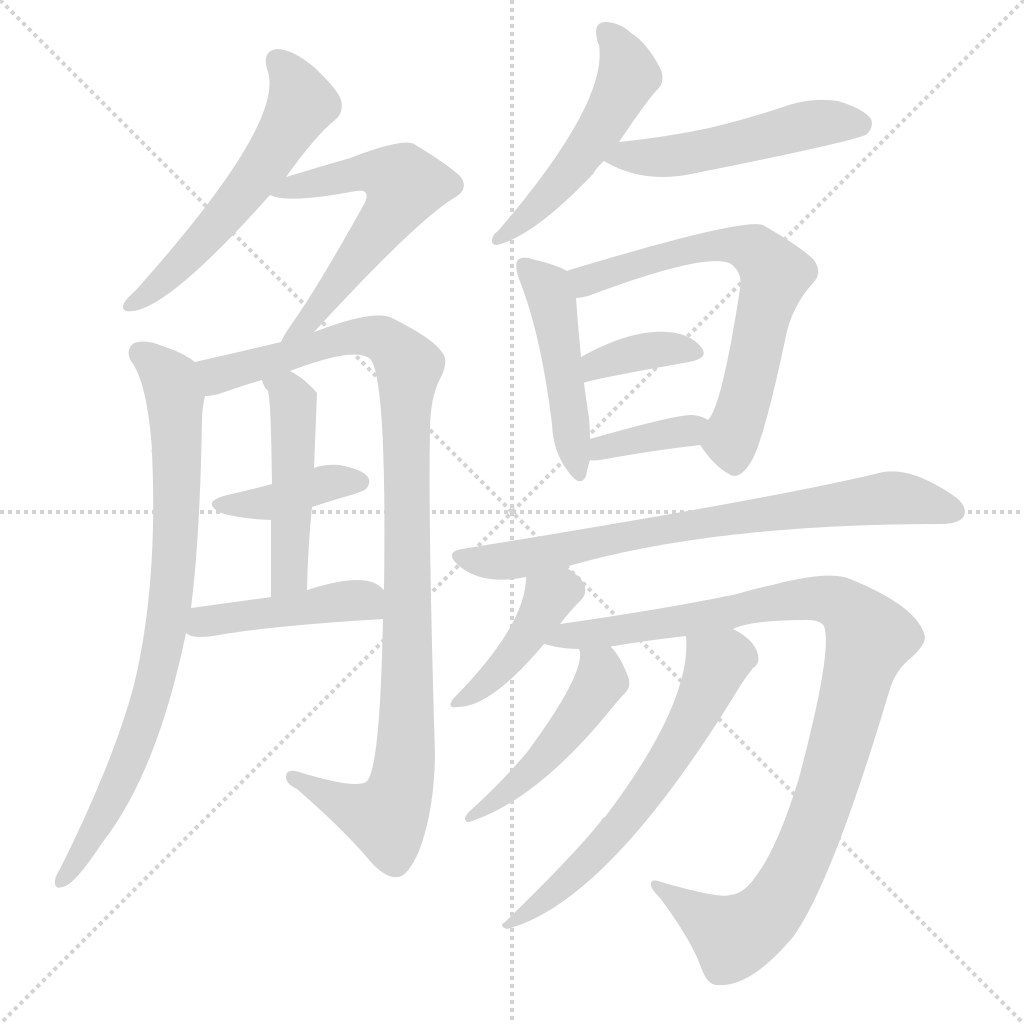
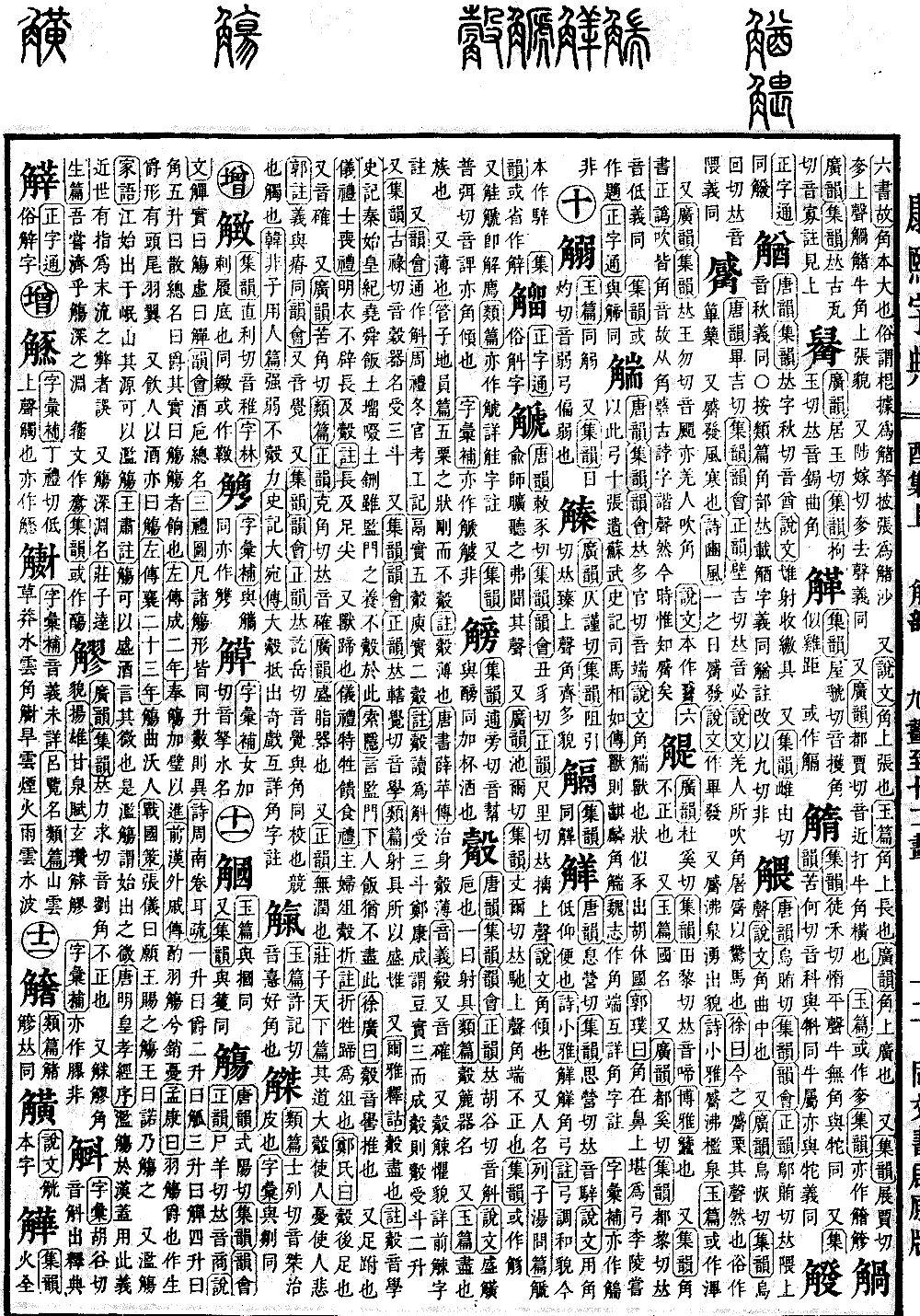
You Collection, Upper Volume
Radical: Horn (jiǎo)
Kangxi Strokes: 18
Page 1144, Entry 25
Pronounced shāng.
Shuowen Jiezi says: When a drinking vessel is full it is called shang; when it is empty it is called zhi.
Yunhui says: A general term for wine cups.
Sanli Tu says: All forms of these cups are similar, but their capacity in sheng varies.
Book of Odes (Shijing), Zhou Nan, Juan Er commentary says: One sheng is called jue, two sheng is called gu, three sheng is called zhi, four sheng is called jiao, five sheng is called san. The general term for these is jue; in reality, they are called shang. The word shang also implies to entertain with food and drink.
Zuo Zhuan, Year 2 of Duke Cheng says: Offering a cup with a jade disc presented to the guest.
Book of Han (Qianhan Shu), Biography of Imperial Relatives says: Pouring from a feathered cup to dispel sorrow.
Meng Kang says: A feathered cup is a jue. It is shaped like a living bird, with head, tail, and wings.
Also, to offer someone wine is called shang.
Zuo Zhuan, Year 23 of Duke Xiang says: Entertaining the people of Quwo with wine.
Strategies of the Warring States (Zhanguo Ce) records: Zhang Yi said: I wish for the King to bestow a cup upon him. The King said: Agreed. Then he entertained him with wine.
Also refers to lan shang (the source of a stream).
Family Sayings of Confucius (Kongzi Jiayu) says: The Yangtze River begins at Mount Min; at its source, it is shallow enough for a wine cup to float.
Wang Su commentary says: A cup can hold wine, referring to the smallness of the source. Thus, lan shang refers to the insignificance of something at its inception.
Emperor Xuanzong of Tang, Preface to the Classic of Filial Piety (Xiaojing Xu) says: The term lan shang originated in the Han dynasty, using this specific meaning. In recent times, those who interpret it as a metaphor for the corruption of the final stage of a movement are mistaken.
Also refers to Shangshen, the name of an abyss.
Zhuangzi, Da Sheng chapter says: I once crossed the abyss of Shangshen.
The seal script form is written as a variant form (zhòu).
Jiyun dictionary states: Sometimes also written in a variant form (yì).