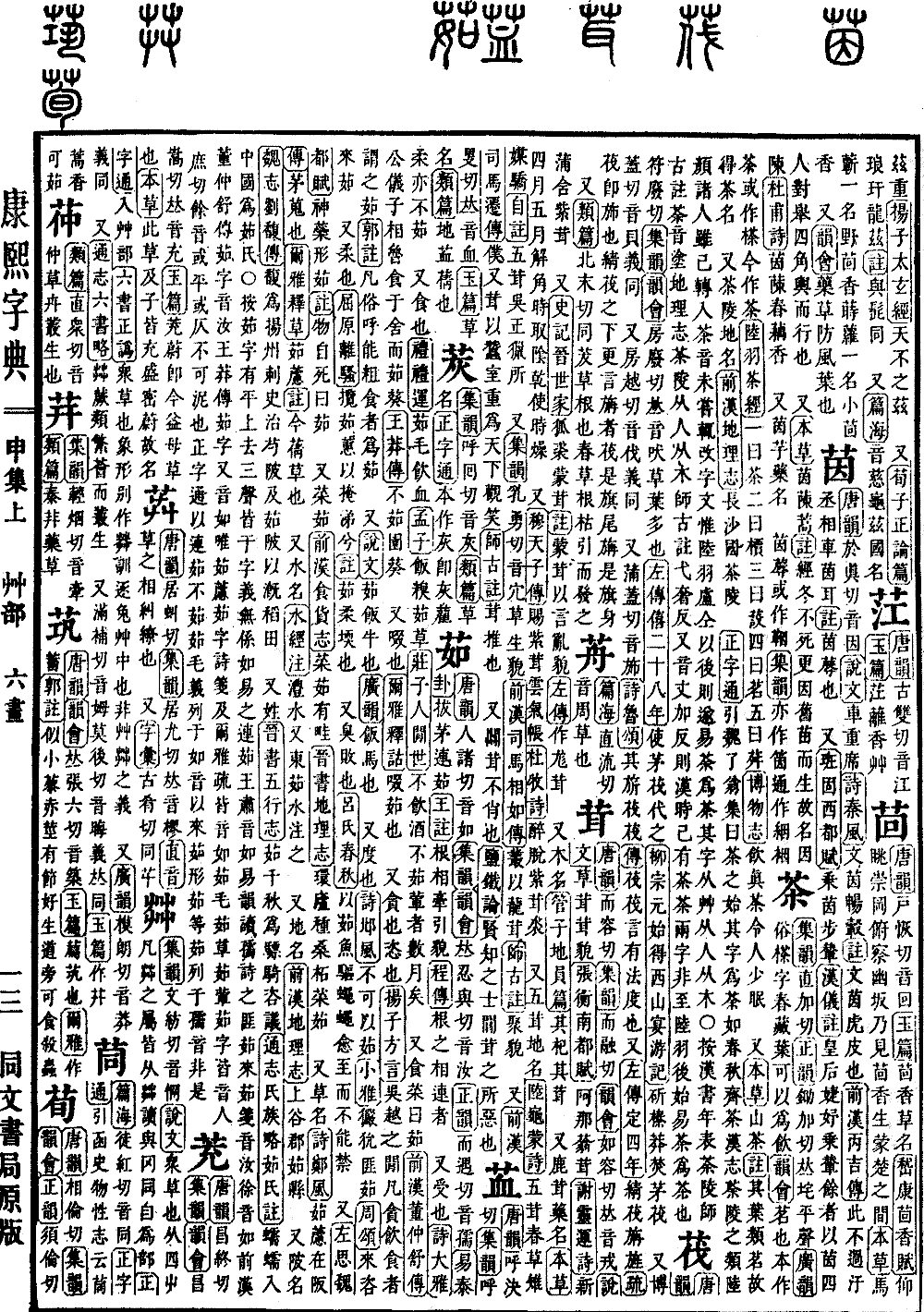
Shen Collection, Upper Volume
Radical: Grass (cǎo)
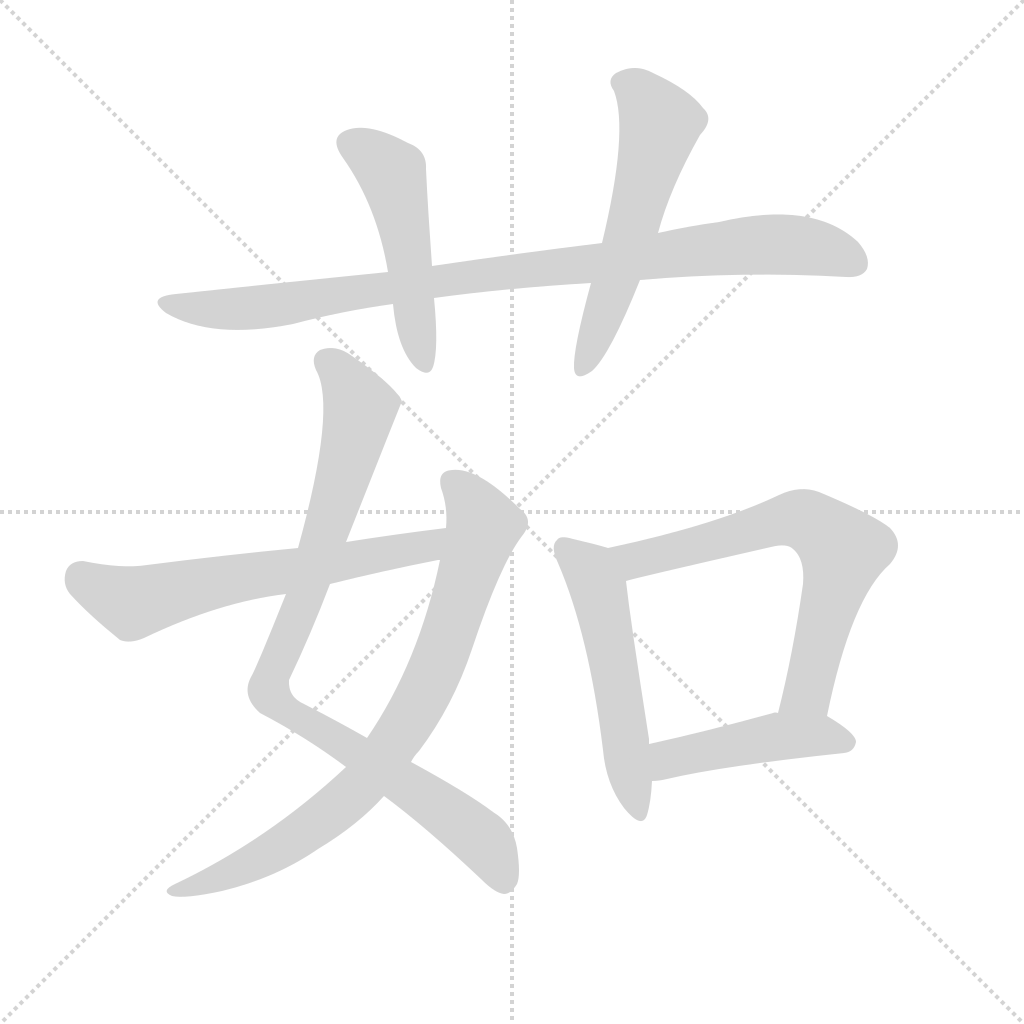
Ru
Kangxi strokes: 12
Page 1029, Entry 10
Tangyun dictionary: Pronounced ru
Jiyun dictionary, Yunhui dictionary: Pronounced ru
Zhengyun dictionary: Pronounced ru
Book of Changes (Yijing), Tai hexagram: To pull up reeds with their roots connected like those of madder. Wang commentary: Describing roots pulling on one another. Cheng commentary: Those roots that are connected.
Also, to receive. Book of Odes (Shijing), Danya: Even those who are gentle will not be subjected to it.
Also, to eat. Book of Rites (Liji), Liyun: Eating fur and drinking blood. Mencius: Eating dry rations and consuming herbs. Zhuangzi, Renjianshi: Not drinking alcohol or eating meat for several months.
Also, eating vegetables is called ru. History of the Former Han (Qianhan shu), Biography of Dong Zhongshu: Gongyi Zi was the minister of Lu; he ate mallow greens at his lodge. Biography of Wang Mang: Not eating garden mallow.
Also, to sip. Erya, Shigu: To sip is to ru.
Also, to be greedy; to be indulgent. Yangzi, Fangyan: In the regions of Wu and Yue, those who are greedy for food and drink are called ru. Guo commentary: Nowadays, common people refer to those who can eat coarse food as ru.
Also, Shuowen dictionary: Ru means to feed an ox. Guangyun dictionary: To feed a horse.
Also, to calculate; to measure. Book of Odes (Shijing), Beifeng: It cannot be calculated. Xiaoya: The Xianyun are not to be estimated. Zhousong: Come and consult, come and plan.
Also, soft. Qu Yuan, Lisao: Gathering soft orchids to wipe away tears. Commentary: Ru means soft and yielding.
Also, to be putrid. Lu's Spring and Autumn Annals (Lüshi chunqiu): Using rotten fish to drive away flies; the more flies come, the more they cannot be stopped.
Also, Zuo Si, Weidu fu: The divine stamens are withered in form. Commentary: Things that die naturally are called ru.
Also, vegetable greens. History of the Former Han (Qianhan shu), Treatise on Food and Money: Vegetable greens have plots. Book of Jin (Jin shu), Treatise on Geography: Around the cottages, they planted mulberry, wild mulberry, and vegetable greens.
Also, a plant name. Book of Odes (Shijing), Zhengfeng: Madder on the hillside. Commentary: This is rubia. Erya, Shicao: Ru is madder. Commentary: Today it is known as madder (qian).
Also, a river name. Commentary on the Water Classic (Shuijing zhu): The Li River, then flowing east, is joined by the Ru River.
Also, a place name. History of the Former Han (Qianhan shu), Treatise on Geography: Ru County, Shanggu Commandery.
Also, a reservoir name. Records of the Three Kingdoms (Wei zhi), Biography of Liu Fu: Liu Fu was the governor of Yangzhou; he managed the Que Reservoir and the Ru Reservoir to irrigate rice fields.
Also, a surname. Book of Jin (Jin shu), Treatise on the Five Elements: Ru Qianqiu was an advisor to the Cavalry General. Tongzhi, Clan Records: The Rouran people entered China and took the surname Ru.
Note: The character ru possesses three tones—level, rising, and departing—none of which are strictly tied to a specific meaning. For example, the connected ru in the Book of Changes is pronounced ru according to Wang Su. The Yiyun records it as pronounced ru. In the Book of Odes, the phrases fēi rú and lái rú are pronounced ru according to the Jian commentary, and ru according to Xu. In the Biography of Dong Zhongshu in the History of the Former Han, the character is pronounced ru; in the Biography of Wang Mang, it is pronounced ru. Only in the term for madder is it consistently pronounced ru according to the Jian commentary of the Book of Odes and the sub-commentary of the Erya. In the phrases for eating fur, eating grass, and eating meat, the character is pronounced ru. Other sounds vary between level and oblique, so one should not be overly rigid. The Zhengzitong lexicography incorrectly lists the meanings of connected ru, not yielding to something, and eating fur under the pronunciation of ru, and groups terms like coming to ru and withered appearance under the pronunciation of ru; this is incorrect.