Xu Collection, Upper Volume
Radical: Gate (mén)
Run; Kangxi strokes: 12; Page 1331, Entry 18
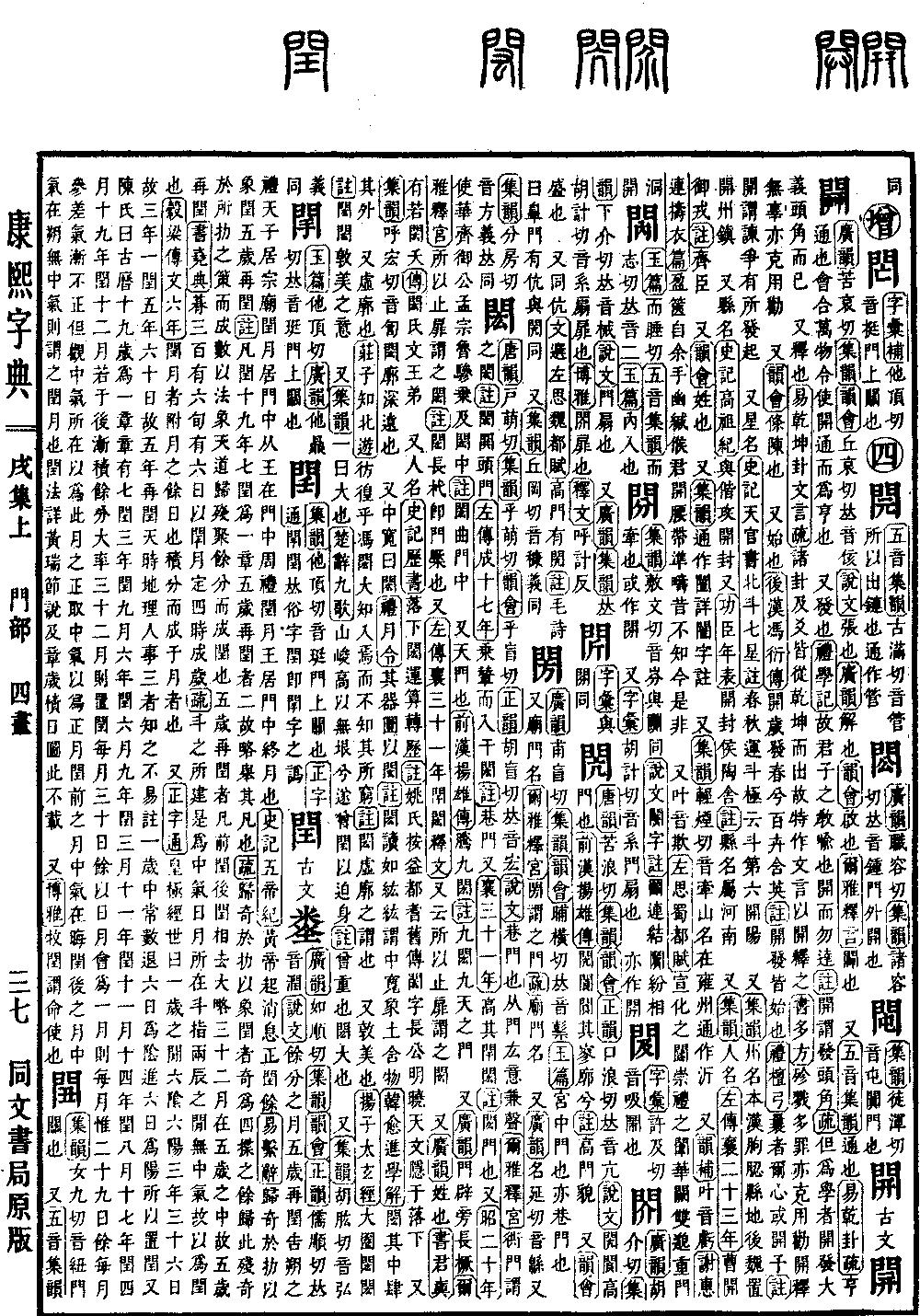
According to the Expanded Rhymes (Guangyun), the pronunciation is run. According to the Collected Rhymes (Jiyun), the Rhyme Anthology (Yunhui), and the Correct Rhymes (Zhengyun), the pronunciation is run, same as the word for moisten. The Explaining Graphs and Analyzing Characters (Shuowen Jiezi) defines it as an intercalary month; every five years there are two intercalary months. In ancient times, the emperor performed the rite of announcing the first day of the month at the ancestral temple; when an intercalary month occurred, the emperor would reside in the state audience chamber (luqin). The character is composed of the character for king within the character for gate. The Rites of Zhou (Zhouli) records: During an intercalary month, the king resided in the state audience chamber for the entire month. The Records of the Grand Historian (Shiji), Annals of the Five Emperors, records: The Yellow Emperor calculated the waxing and waning of yin and yang to calibrate the intercalary days. The Book of Changes (Yijing), Appended Remarks (Xici), states: One places the remainder of the milfoil stalks between the fingers to symbolize the intercalary month; there are two intercalary months in five years. The Commentary notes: Generally, there are seven intercalary months in nineteen years, which is called a chapter. The situation of two intercalary months occurring in five years happens twice, hence it is mentioned briefly here. The Subcommentary explains: Placing the remainder between the fingers symbolizes the intercalary month. The term odd refers to the remainder stalks left after four operations; these remainders are gathered between the fingers to count, thereby imitating the laws of heaven. It is like accumulating the remaining days to form an intercalary month. The phrase five years with two intercalations exists because the interval between two intercalary months is approximately thirty-two months, occurring within five years, thus two intercalations in five years. The Book of Documents (Shujing), Canon of Yao, states: A year consists of three hundred and sixty-six days; by establishing intercalary months, the four seasons are fixed and the year is formed. The Subcommentary explains: The orientation pointed to by the handle of the Big Dipper is called the central qi; if the sun and moon move such that they fall between the positions pointed to by the handle, and that month lacks a central qi, it is designated as an intercalary month. The Guliang Commentary (Guliang Zhuan), Sixth Year of Duke Wen, states: The intercalary month is a surplus of days attached to the regular months, formed by accumulating fractions into a month. Furthermore, the Standard Character Guide (Zhengzitong), citing the Supreme Ultimate World Chronology (Huangji Jingshi), says: In a year, there are six yin months and six yang months; in three years, thirty-six days accumulate, so one intercalary month is established every three years. In five years, sixty days accumulate, so two intercalary months are established every five years. The laws of celestial phenomena, geography, and human affairs are not easy to understand. The commentary says: In a year, the constant subtracts six days for yin and adds six days for yang, hence an intercalary month is needed to adjust. Other scholars say: In ancient calendars, nineteen years constitute one chapter. A chapter has seven intercalary months, specifically: in the third year an intercalary ninth month, in the sixth year an intercalary sixth month, in the ninth year an intercalary third month, in the eleventh year an intercalary eleventh month, in the fourteenth year an intercalary eighth month, in the seventeenth year an intercalary fourth month, and in the nineteenth year an intercalary twelfth month. Thereafter, the fractional remainders accumulate, and an intercalary month is established roughly every thirty-two months. If one calculates each month as slightly more than thirty days, but takes the conjunction of the sun and moon as a month, each month is only twenty-nine days and a fraction. The lengths of the months are uneven, and the solar terms gradually become inaccurate, so one must observe the location of the central qi to determine the proper name of the month, taking the month that contains a specific central qi as the first month. In the month before an intercalary month, the central qi falls at the end of the month; in the month after, the central qi falls at the beginning of the month. If a month has no central qi, it is called an intercalary month. The specific method for establishing intercalary months is detailed in the explanations of Huang Ruijie and the Chart of Accumulated Days in a Chapter Cycle, and is not recorded here. According to the Ya (Boya), to run means to appoint an envoy.