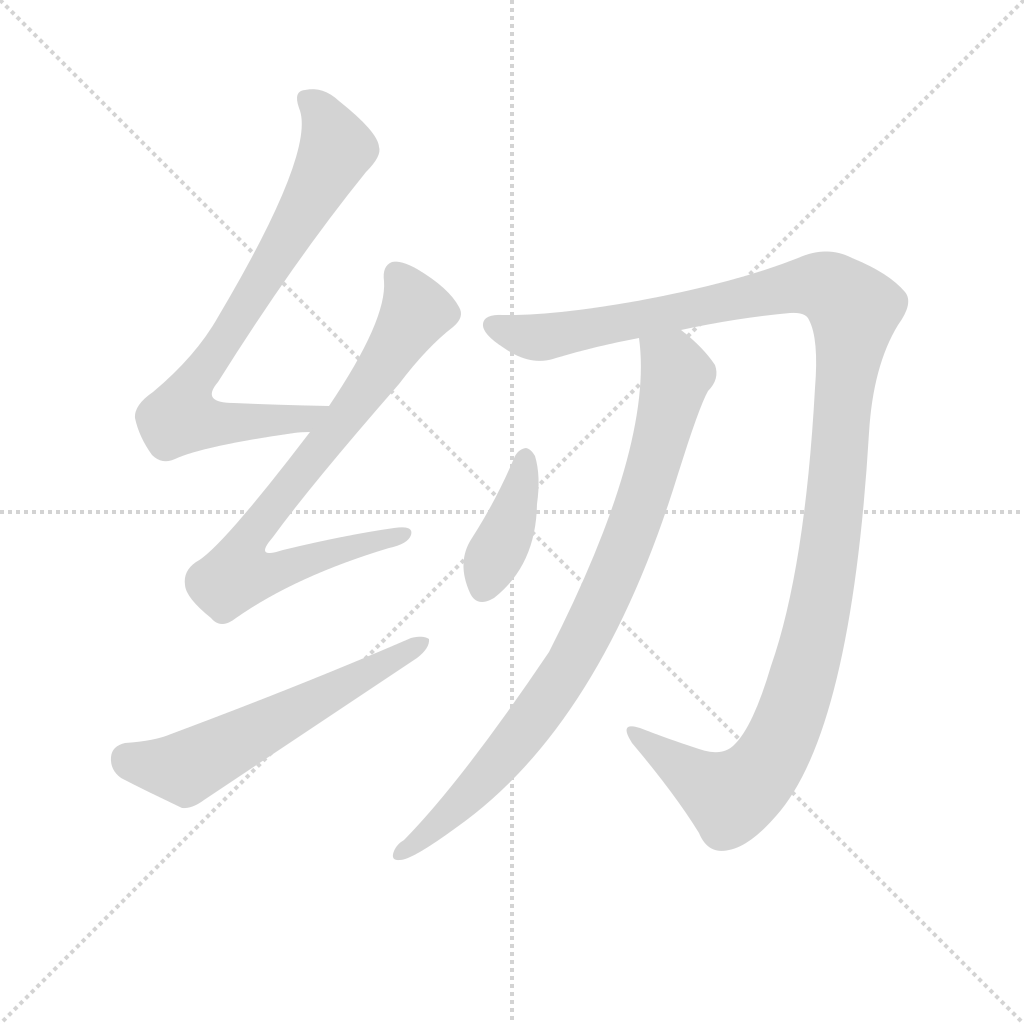
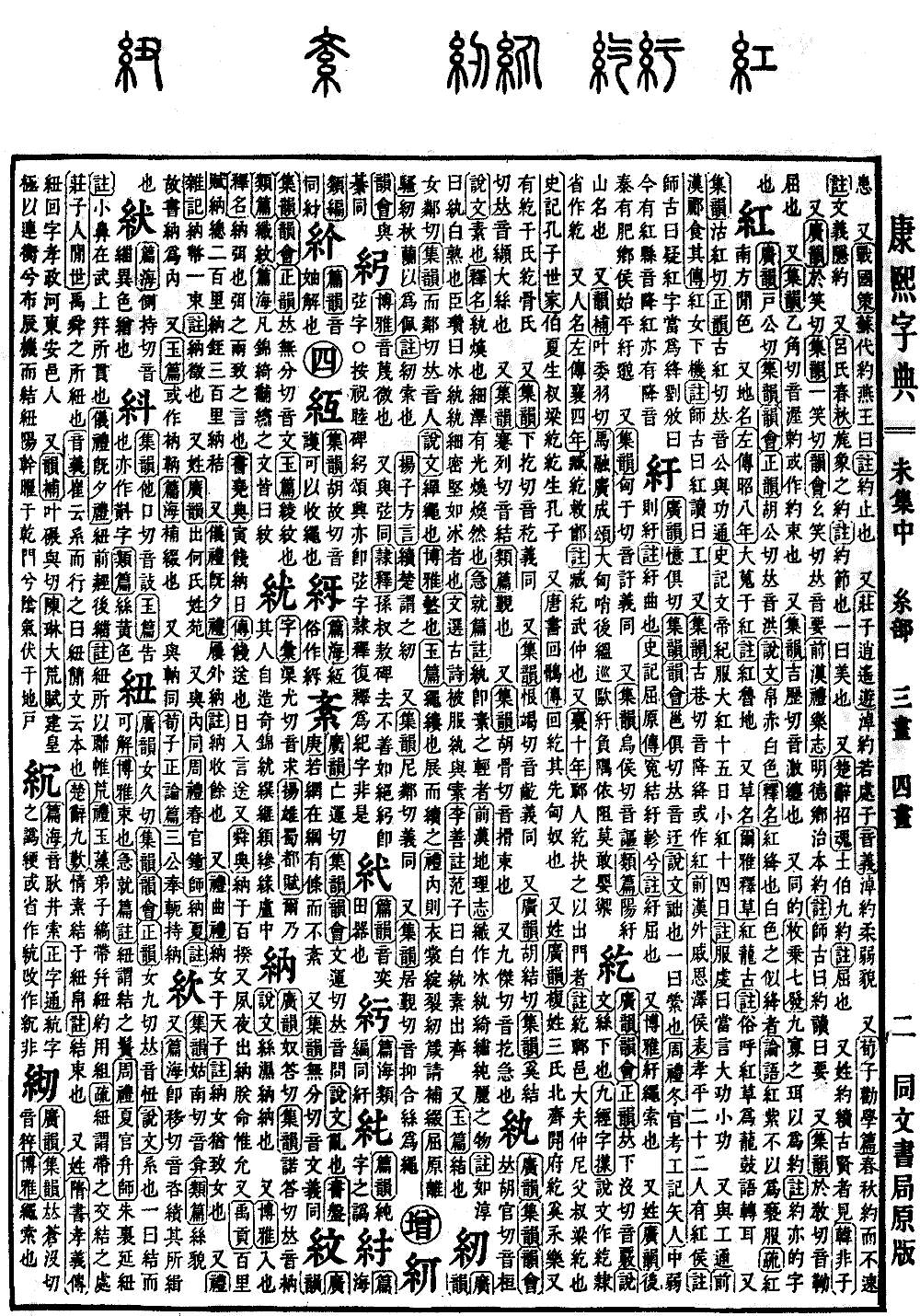
Wei Collection, Middle Volume
Radical: Silk (mì)
Ren
Kangxi stroke count: 9
Page 916, Entry 02
Pronounced nin (rising tone). According to the Shuowen Jiezi (Explaining Graphs and Analyzing Characters), it means to weave thread into cord. According to the Guangya (Broad Elegant), it means to be twisted or tangled. According to the Yupian (Jade Chapter), it means to cord or string; to spread out and continue. According to the Book of Rites (Liji), in the section Internal Rules (Neize), if garments are ripped or torn, one should thread a needle and request to mend them. In Qu Yuan's Li Sao (Encountering Sorrow), it is written: I string autumn orchids to use as my pendant. The commentary notes that ren means to cord. According to the Fangyan (Regional Speech) by Yang Xiong, in the Chu region, to tear or split is called ren. Also pronounced er (rising tone). The meaning is the same. Also pronounced jin (falling tone); to join silk to form a cord.
Textual research: In the Guangyun, it is given as nu lin qie, and in the Jiyun, it is given as er lin qie, with the pronunciation ren. We observe that nu lin qie belongs to the niang initial, and er lin qie belongs to the ri initial, neither of which produces the pronunciation ren. We have followed the Jiyun in correcting the base pronunciation of ren to ni lin qie, and corrected the pronunciation to nin (rising tone). In the Fangyan by Yang Xiong, it is written that xu (to continue), in the Chu region, is called ren. We have followed the original text to correct xu to bo (to split/tear). Also, according to the Jiyun, it is ni lin qie. We have followed the Jiyun regarding the variant pronunciation of ren to correct ni lin qie to er lin qie. Regarding the Jiyun entry for ju jin qie with the pronunciation yi (entering tone), we observe that ju jin qie does not produce the sound yi, and have therefore corrected it based on the primary character entry in the Jiyun.