Shen Collection, Upper Volume
Radical: Grass (cǎo)
Kangxi Strokes: 11
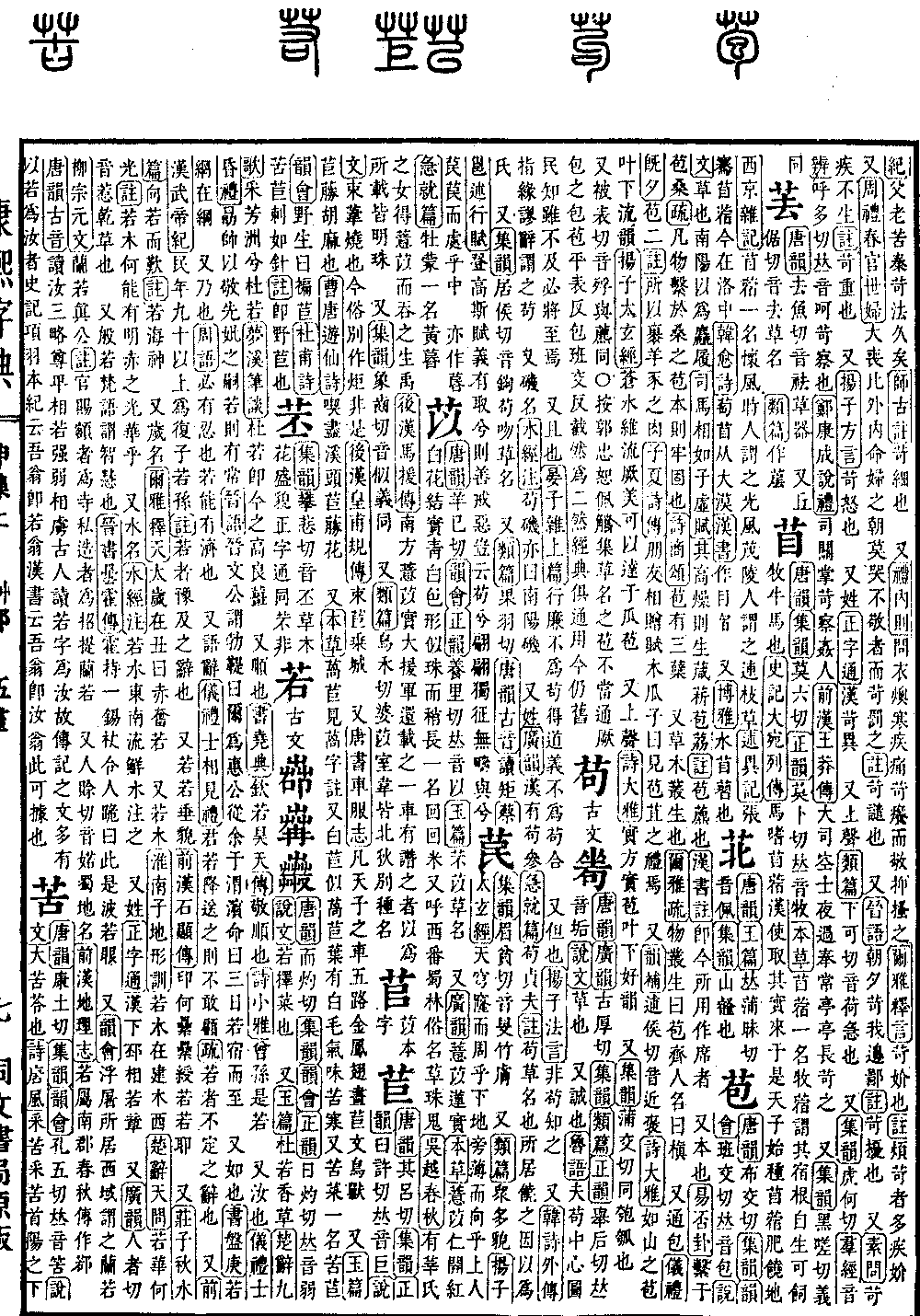
Page 1023, Entry 12
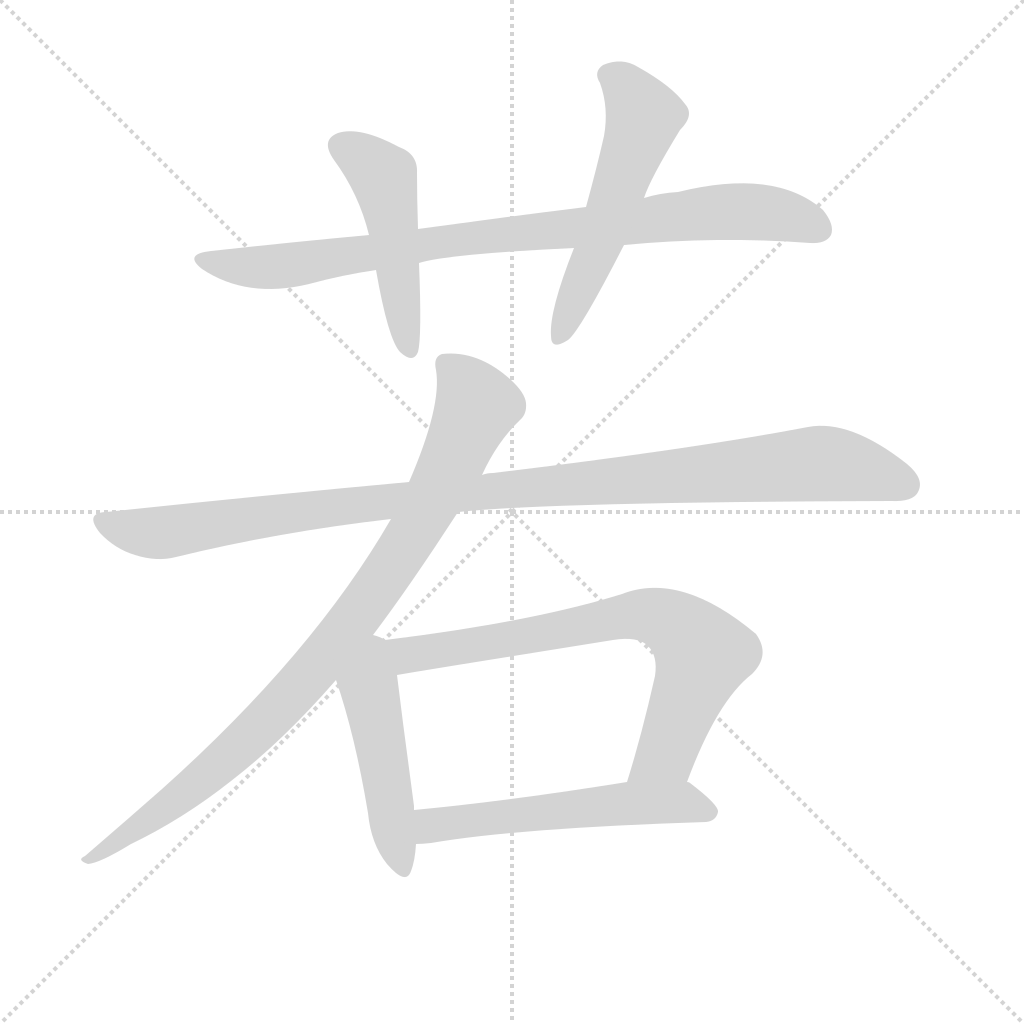
Pronounced ruo. According to Tang Rhymes (Tangyun), Collected Rhymes (Jiyun), Rhyme Compilation (Yunhui), and Orthodox Rhymes (Zhengyun), the pronunciation is similar to ruo.
Shuowen Jiezi explains: Ruo means to select vegetables.
Yupian records: Du ruo is a type of fragrant herb.
Chu Ci, Nine Songs (Jiuge) writes: Gathering du ruo on the fragrant isle.
Mengxi Bitan explains: Du ruo is what is currently known as galangal.
It also means to obey or comply.
Book of Documents (Shangshu), Canon of Yao (Yaodian) records: Respectfully complying with Heaven.
The Commentary (Zhuan) explains: To revere and comply.
Book of Odes (Shijing), Lesser Odes (Xiaoya) writes: The great-grandson is thus compliant.
It also functions as the pronoun you.
Book of Etiquette and Ceremonial (Yili), Marriage Rites for Gentlemen (Shihunli) writes: Strive to follow the ways to honor the inheritance of your late mother; you must maintain the standard practice.
Discourses of the States (Guoyu), Discourses of Jin (Jinyu) records: Duke Wen of Jin said to Bo Ti: You followed me at the Wei River for the sake of Duke Hui, and when commanded for three days, you arrived in one night.
It also means as or like.
Book of Documents (Shangshu), Pan Geng writes: Like a net on its main rope.
It also functions as a connective, meaning then or thereupon.
Discourses of the States (Guoyu), Discourses of Zhou (Zhouyu) writes: There must be endurance, and thereupon success can be achieved.
It is also a modal particle.
Book of Etiquette and Ceremonial (Yili), Ritual for Gentlemen’s Meeting (Shixiangjianli) writes: If the ruler descends to send him off, he dares not look back.
The Subcommentary (Shu) explains: Ruo indicates a word of uncertainty.
Book of Han (Qian Hanshu), Annals of Emperor Wu (Wudiji) records: Citizens ninety years of age or older may have the labor service of their sons or grandsons exempted.
The Annotations (Zhu) explain: Ruo indicates a prepositional phrase referring to something in advance.
Ruo ruo describes something hanging down.
Book of Han (Qian Hanshu), Biography of Shi Xian (Shixianzhuan) writes: Why are the official seals piled up, and why do the ribbons hang down?
Zhuangzi, Autumn Floods (Qiushuipian) writes: Sighing at the Sea God.
The Annotations (Zhu) explain: Ruo refers to the Sea God.
It is also a name of a year.
Erya, Explanation of the Heavens (Shitian) records: The Tai Sui (Jupiter) in the Chou year is called Chifenruo.
There is also the Ruo tree.
Huainanzi, Explanation of Topography (Dixingxun) records: The Ruo tree is to the west of the Jian tree.
Chu Ci, Heavenly Questions (Tianwen) writes: Why does the flower of the Ruo tree have brilliance?
The Annotations (Zhu) explain: How could the Ruo tree have a bright red luster?
It is also the name of a river.
Commentary on the Water Classic (Shuijingzhu) records: The Ruo River flows southeast, and the Xian River flows into it.
It is also a surname.
Orthodox Character Compilation (Zhengzitong) records: In the Han Dynasty, there was a Chancellor of Xiapi named Ruo Zhang.
Pronounced re. According to Guangyun, it means dry grass.
There is also prajna, which is Sanskrit for wisdom.
Book of Jin (Jinshu), Biography of Tan Huo (Tanhuozhuan) records: Tan Huo held a tin staff, made people kneel, and said: This is the prajna eye.
Rhyme Compilation (Yunhui) records: A place where Buddhists reside is called aranya in the Western Regions.
Liu Zongyuan's Essays write: Aranya of Master Zhen.
The Annotations (Zhu) explain: Those with plaques bestowed by the government are called temples, while those built privately are called zhaoti or aranya.
Pronounced ruo. It is the name of a place in the Shu region.
Book of Han (Qian Hanshu), Treatise on Geography (Dilizhi) records: Ruo belonged to Nanjun; the Spring and Autumn Commentary (Chunqiu Zhuan) writes it as Ruo.
Tang Rhymes Ancient Pronunciation (Tangyun Guyin) reads it as ru. The Three Strategies (Sanlue) notes that respect and status are similar, and strength and weakness capture one another. Ancient people read the character ruo as ru, so in commentaries and articles, ruo is often used as ru. Records of the Grand Historian (Shiji), Biography of Xiang Yu (Xiangyubenji) states: My father is your father; Book of Han (Hanshu) states: My father is your father, which can be taken as evidence.