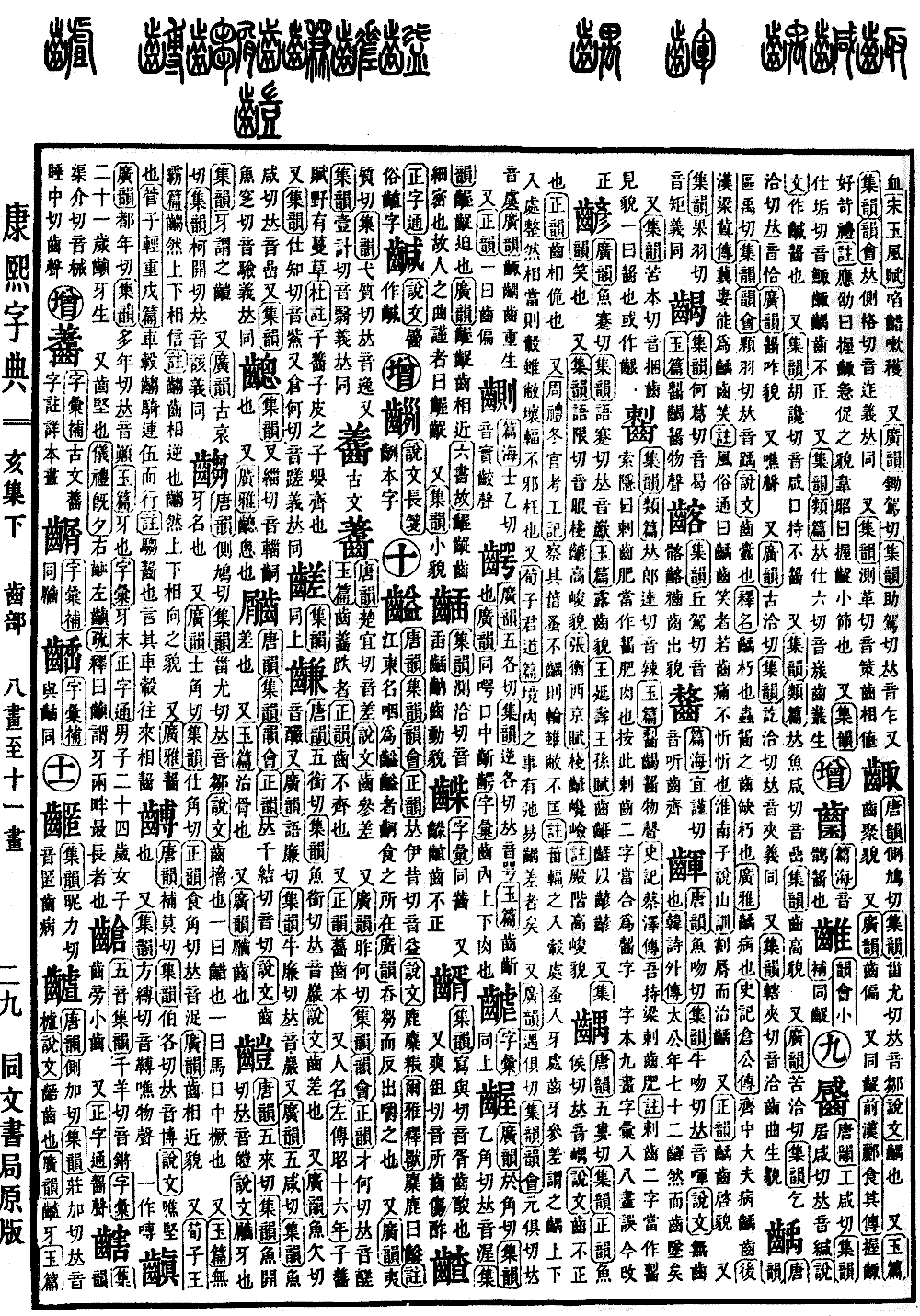
Hai Collection, Lower Volume
Radical: Tooth (chǐ)
Character: 齲
Kangxi Stroke Count: 24
Page 1535, Entry 06
Pronounced yu (rising tone).
Shuowen Jiezi (Explanation of Simple and Compound Characters): Tooth decay caused by worms.
Shiming (Explanation of Names): Qu means to rot. It refers to teeth eaten away by worms, leaving them chipped and decayed.
Guangya (Broad Refinement): Qu means a disease.
Records of the Grand Historian (Shiji), Biography of Physician Cang Gong: A middle grand master of Qi suffered from tooth decay.
Book of the Later Han (Hou Hanshu), Biography of Liang Ji: The wife of Liang Ji could perform the tooth decay smile.
Commentary: Fengsu Tong (Comprehensive Meaning of Customs) states: The tooth decay smile is when one does not smile happily due to a toothache.
Huainanzi (Huainan Masters), Discourses on Mountains: Cutting the lip to treat tooth decay.
Additionally, in Zheng Yun (Standard Rhymes), qu describes the appearance of teeth opening.
Also, according to Jiyun (Collected Rhymes), pronounced ju (rising tone). Same meaning.