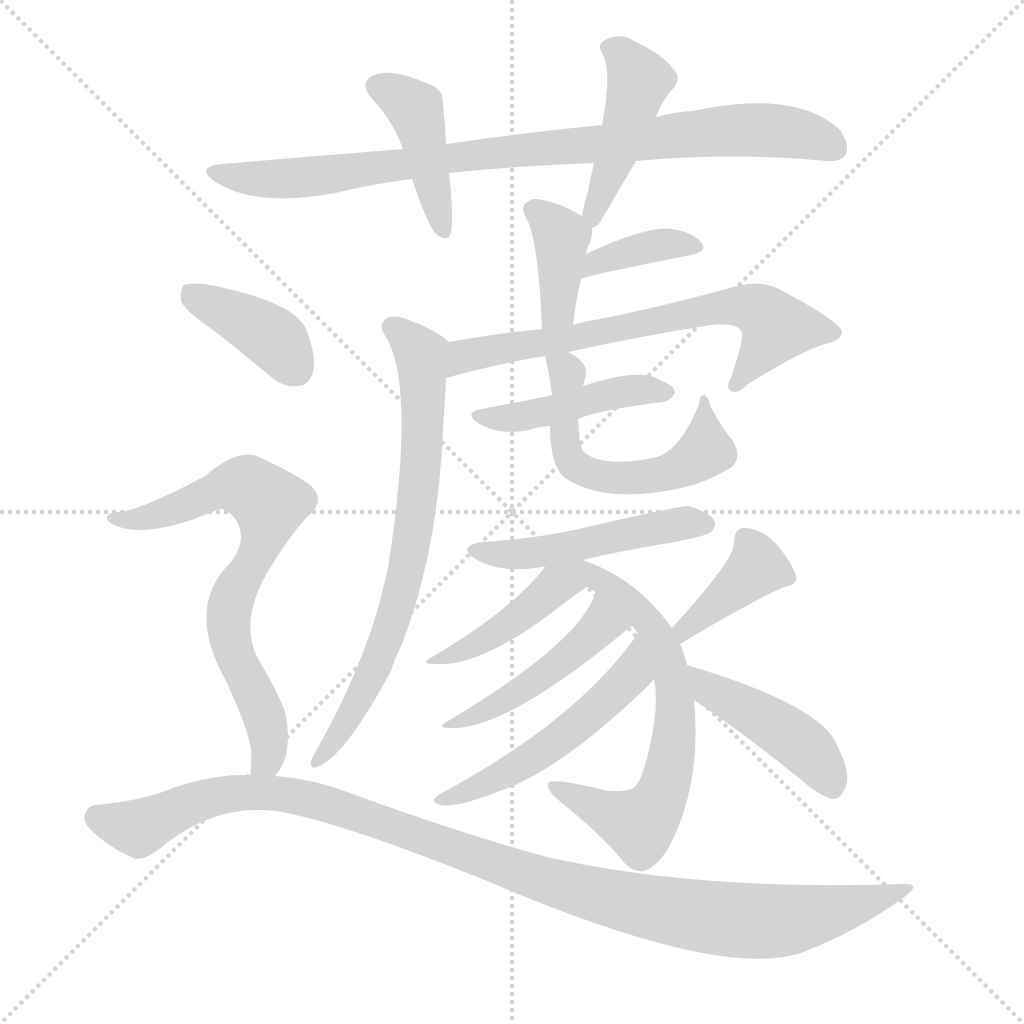
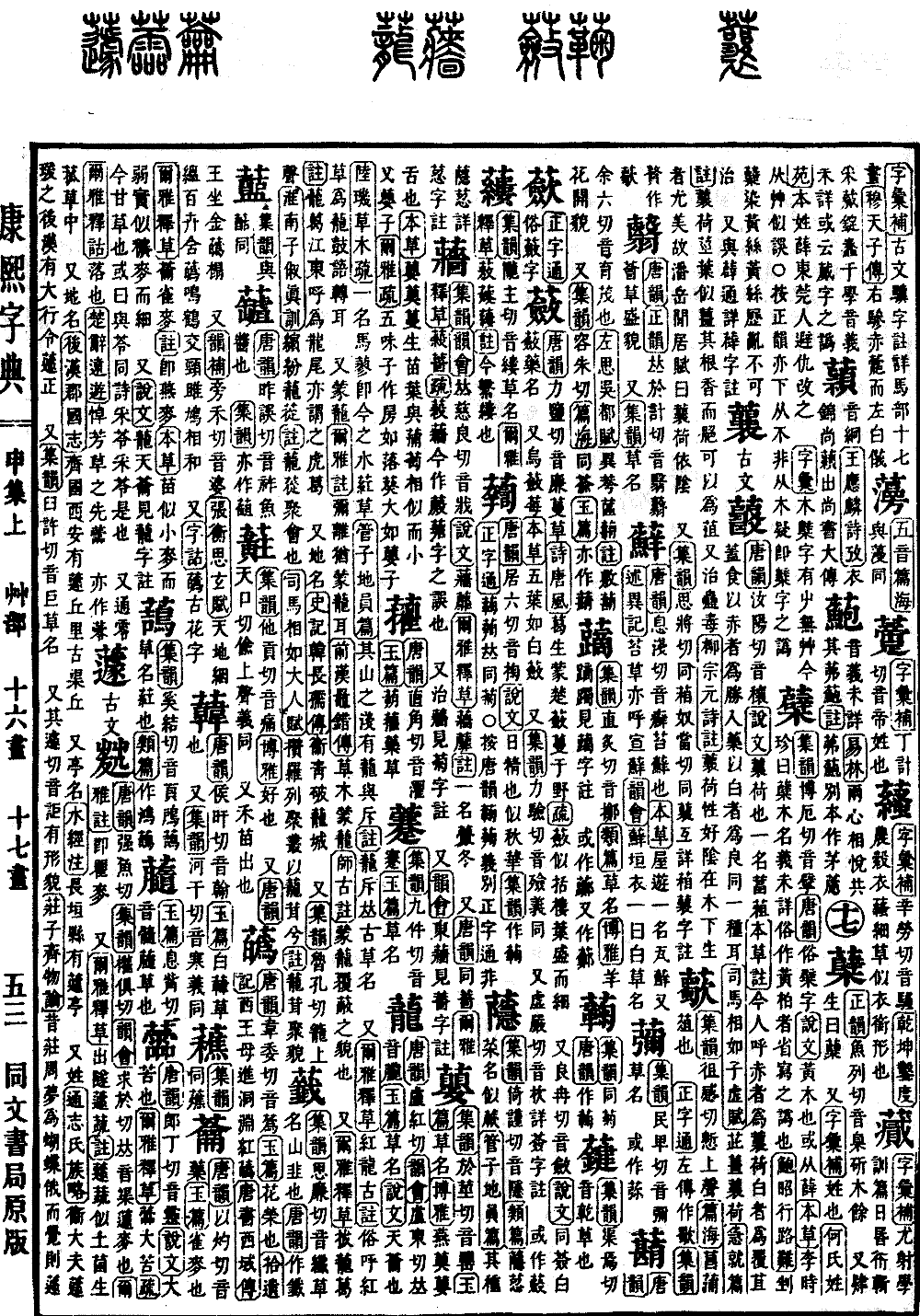
Shen Collection, Upper Volume
Radical: Grass (cǎo)
Kangxi Strokes: 23
Page 1069, Entry 40
According to Tang Rhymes (Tangyun), Collected Rhymes (Jiyun), and Rhyme Compilation (Yunhui), the pronunciation is the same as qu. Refers to the dianthus plant. Commentary on the Erya (Erya Zhu) states that it is the same as the dianthus.
Also, in the Erya, interpretation of grasses, it mentions the chusui and the qushu. Commentary: The qushu is a type of mushroom that grows among water bamboo (zizania).
Also refers to a place name. Records of Commanderies and States in the Book of the Later Han (Hou Hanshu Junguozhi) states that in the city of Xi'an in the State of Qi, there is the village of Quqiu, which is the ancient Quqiu.
Also refers to the name of a pavilion. Commentary on the Classic of Waterways (Shuijing Zhu) states that in Changyuan County, there is the Qu Pavilion.
Also acts as a surname. Brief History of Clans and Surnames (Tongzhi Shizulue) notes that the descendants of the State of Wei official Qu Yuan, and during the Han Dynasty, there was an official known as Qu Zheng.
Also, according to Collected Rhymes (Jiyun), pronounced ju. A type of grass.
Also, pronounced ju. Refers to the appearance of something. In the Zhuangzi, Treatise on the Equality of Things (Zhuangzi Qiwulun), it is written that in the past, Zhuang Zhou dreamed he was a butterfly; upon waking, he found himself to be ququ, still Zhuang Zhou. Rhyme Compilation (Yunhui) describes ququ as the appearance of being at ease with oneself. Pronounced with a level tone. According to Collected Rhymes (Jiyun), it can also be pronounced with a departing tone, and the character is sometimes written in a variant form (ju).