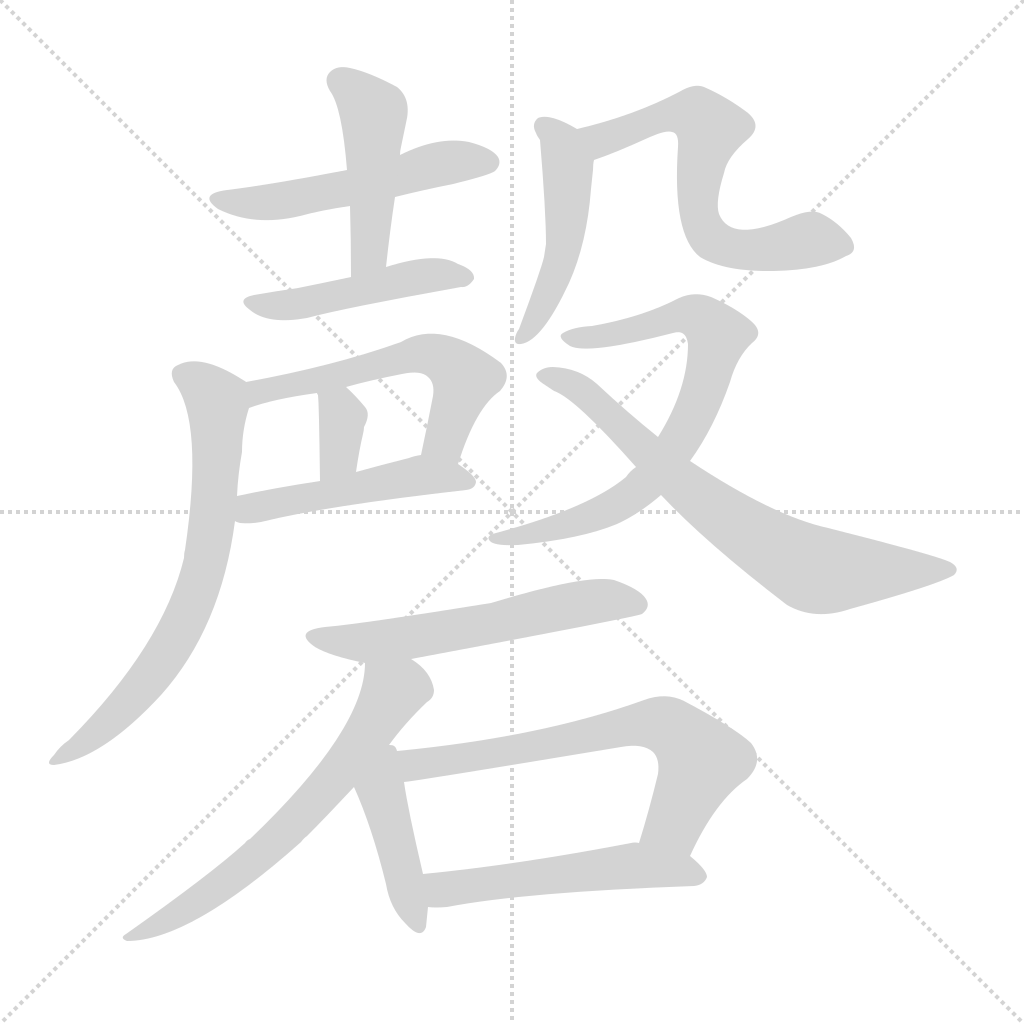
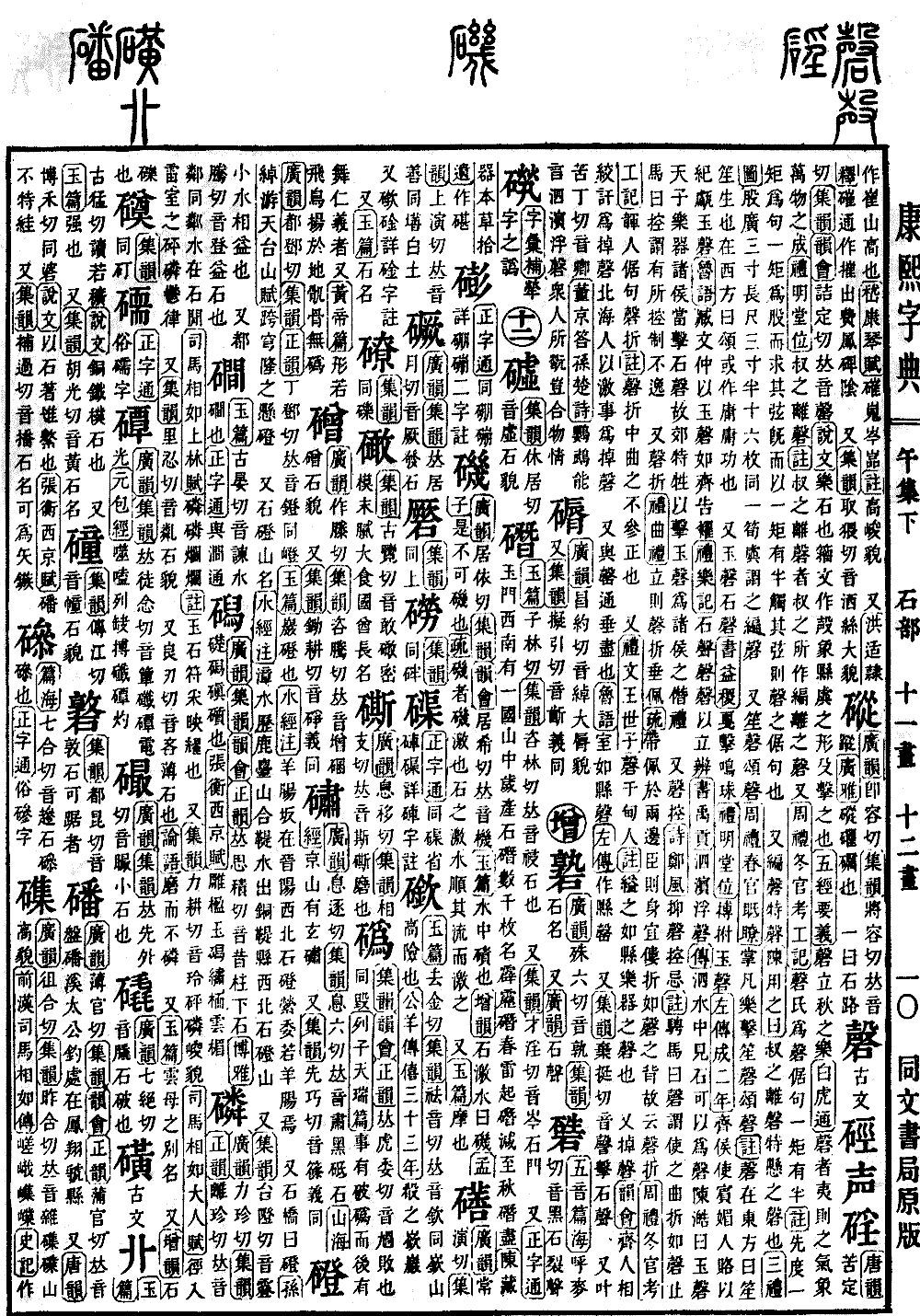
Wu Collection, Lower Volume
Radical: Stone (shí)
Kangxi stroke count: 16
Page 836, Entry 02
Ancient form: Kēng.
Pronounced qìng.
Shuowen Jiezi (Shuowen): A stone used for music. The seal script form (zhòuwén) is written as [character omitted], representing the shape of a suspended stand, struck by a mallet.
Essential Meanings of the Five Classics (Wujing Yaoyi): The qing is the instrument for the beginning of autumn.
Comprehensive Discussions in the White Tiger Hall (Baihu Tong): The qing represents the energy of the Yize (musical note), symbolizing the completion of all things.
Book of Rites (Liji), Hall of Distinction (Mingtang Wei): The "li" qing of the Shu. Commentary: The "li" qing of the Shu refers to the bianli (set of tuned stones) crafted by the Shu.
Rites of Zhou (Zhouli), Winter Officers, Artificers' Record (Kaogong Ji): The qing-maker makes a qing; the angle is one and a half times the square. Commentary: First measure one leg as the horizontal, one leg as the vertical, then find the hypotenuse. Then use one and a half squares to touch the hypotenuse; this determines the angle of the qing.
Also refers to bianqing (set of stone chimes) and teqing (a single stone chime). Usage: The "li" qing of the Shu is a single suspended chime.
Illustrations of the Three Rites (Sanli Tu): The base is three inches wide, thirteen and a half inches long, with sixteen pieces on a single frame, known as a bianqing.
Also refers to shengqing and songqing. Rites of Zhou (Zhouli), Spring Officers, Overseer of Music (Shiliao): Responsible for all music, striking the songqing and shengqing. Commentary: A chime in the east is called sheng. Sheng means birth. A chime in the west is called song. It is also written as yong. Yong means merit.
Also refers to jade chimes and stone chimes. Book of Documents (Shujing), Counsels of Yu the Great (Yiji): Striking the sounding jade. Book of Rites (Liji), Hall of Distinction (Mingtang Wei): Striking the jade chimes. Zuo Commentary (Zuo Zhuan), Second Year of Duke Cheng: The Marquis of Qi sent Bin Meiren to offer a bronze cauldron and jade chimes as a bribe. Discourses of the States (Luyu): Zang Wenzhong took jade chimes to Qi to request grain. Book of Rites (Liji), Record of Music (Yueji): The sound of stone is like the qing, used to establish distinctions. Book of Documents (Shujing), Tribute of Yu (Yugong): Floating chimes from the banks of the Si River. Commentary: Stones found in the Si River that can be made into chimes. Hao says: Jade chimes are instruments for the Son of Heaven. Feudal lords should strike stone chimes; therefore, the Jiao Te Sheng suggests that striking jade chimes by a feudal lord is a ritual usurpation.
Also refers to qing-kong. Book of Odes (Shijing), Odes of Zheng: Checking the horses and holding the reins. Commentary: To gallop horses is qing; it means to make them turn like a qing chime. To stop horses is kong; it means to control them so they do not bolt.
Also refers to qing-zhe (bending like a chime). Book of Rites (Liji), Summary of the Rules of Propriety (Qu Li): When standing, bend like a chime and let the pendants hang down. Commentary: Wearing pendants on both sides, a subject should bend their body like the back of a qing chime, hence the term qing-zhe. Rites of Zhou (Zhouli), Winter Officers, Artificers' Record (Kaogong Ji): The drum-maker's angle is like a qing-zhe. Commentary: Qing-zhe means the bending is not perfectly straight.
Also, Book of Rites (Liji), Royal Regulations (Wenwang Shizi): Hanged like a prisoner. Commentary: Strangled like a qing chime used in ritual music.
Also refers to diao-qing. Rhyme Anthology (Yunhui): People of Qi call malicious gossip diao-qing; people of Beihai call inciting trouble diao-qing.
Also interchangeable with qìng, meaning to be exhausted. Discourses of the States (Luyu): The room is as empty as a hanging chime. Zuo Commentary (Zuo Zhuan) writes it as a hanging qìng.
Also, pronounced qìng. The sound of striking stone.
Also, pronounced qīng. Dong Jing, Response to Sun Chu’s Poem: The parrot can speak, the floating chimes of the Si River banks; what the crowd plays with, how can it match the true nature of things.