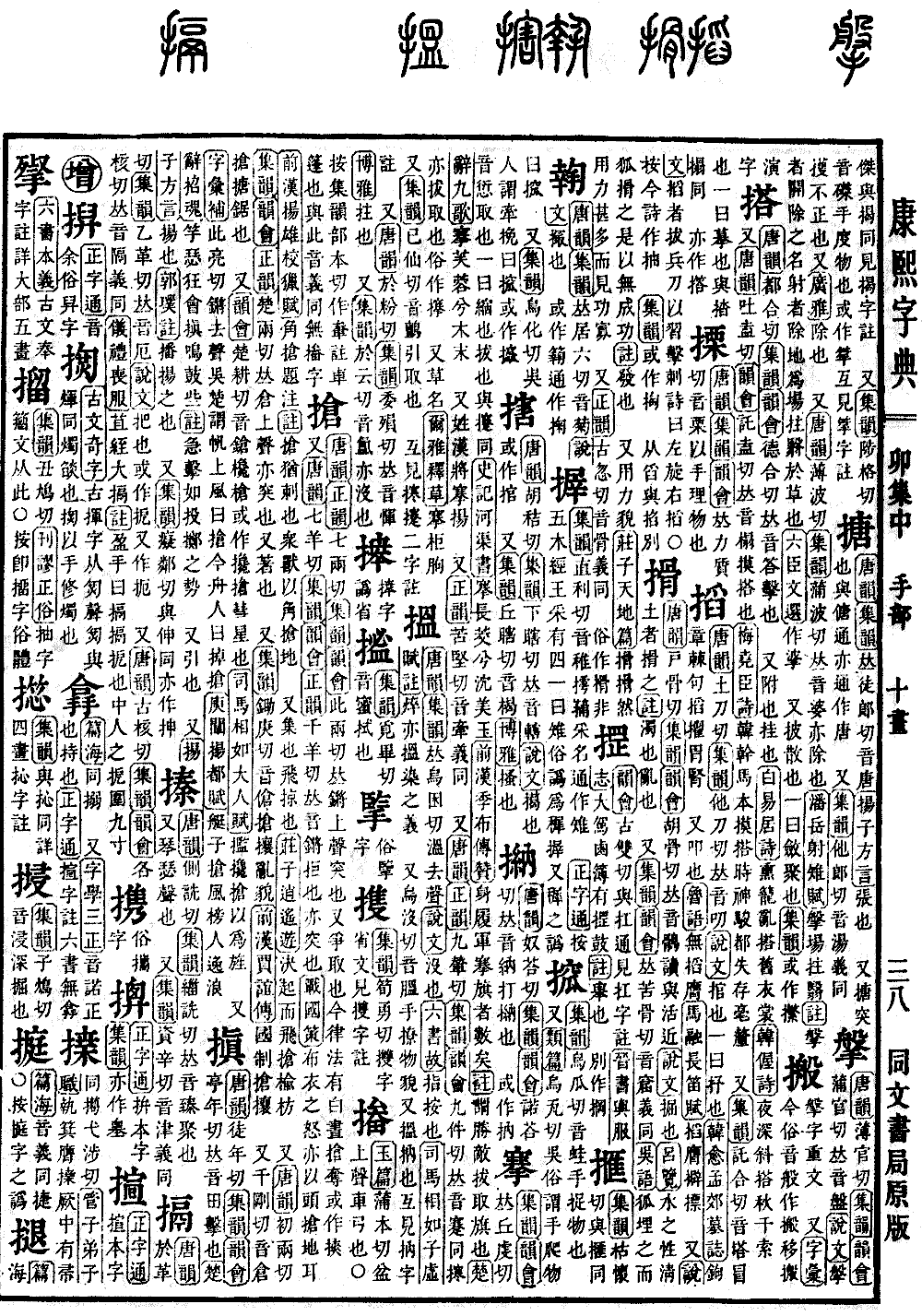
Mao Collection, Middle Volume. Radical: Hand (shǒu). Kangxi strokes: 14. Page 448, Entry 01.
Pronounced qiang (rising tone). To strike or rush forward. Also, to seize or snatch. Modern legal code includes the term for daylight robbery. Sometimes written in a variant form (qiang).
Pronounced qiang. To resist. Also, to strike or rush forward. From Strategies of the Warring States (Zhanguo Ce): The anger of a commoner is merely striking the earth with his head. From History of the Former Han (Qianhan Shu), Yang Xiong’s Rhymeprose on the Royal Hunt: Horns strike and gore the target. Commentary: To strike here means to pierce; the various beasts strike the earth with their horns.
Also, to gather or to graze in flight. From Zhuangzi, Free and Easy Wandering: Suddenly leaping up to fly, grazing the elm and sandalwood trees.
Pronounced chuang (rising tone). Also, to strike or rush forward. Also, to adhere or attach to.
Pronounced cang. In the phrase, chaotic in appearance. From History of the Former Han (Qianhan Shu), Biography of Jia Yi: The state institutions are in chaos.
Pronounced cang. In the phrase, a saw.
Pronounced qiang. In the phrase, or written as a variant form. Refers to a comet. From Sima Xiangru, Rhapsody on the Great Man: Using a comet as a banner.
Pronounced qiang (departing tone). In the regions of Wu and Chu, wind against a sail is called qiang; contemporary boatmen refer to it as adjusting the sail. From Yu Chan, Rhapsody on the Capital of Yang: Small boats veer into the wind, oarsmen drift upon the waves.