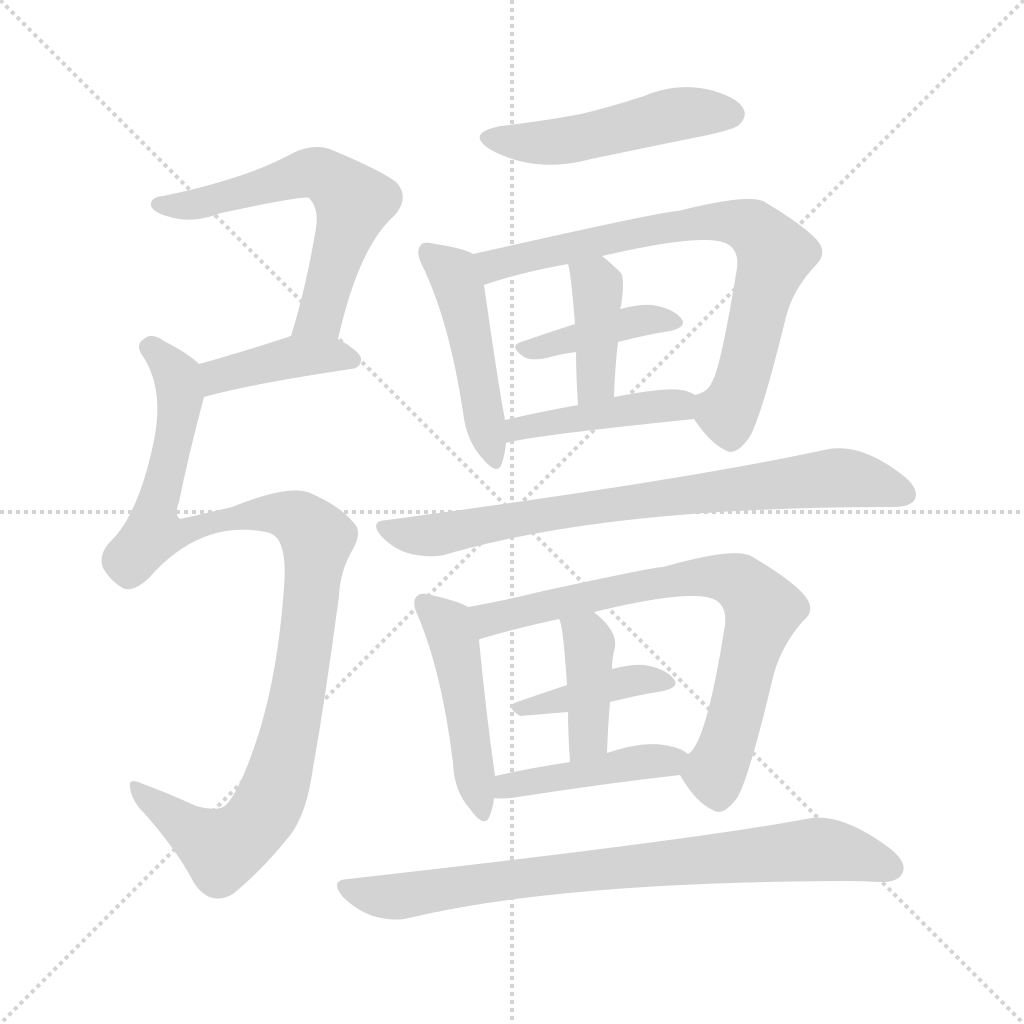
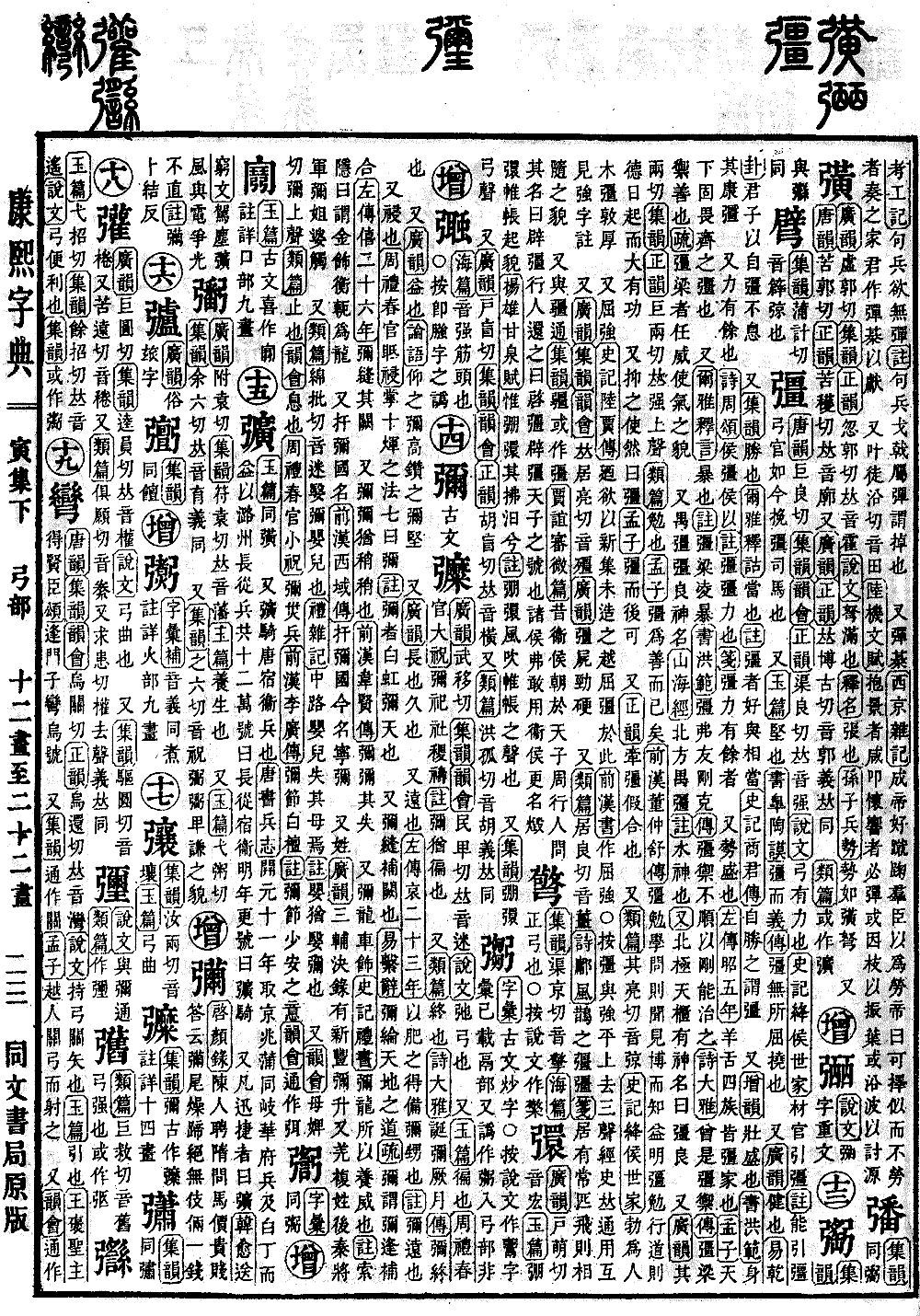
Yin Collection, Lower Volume
Radical: Bow (gōng)
Kangxi Strokes: 16
Page 361, Entry 06
Pronounced qiáng.
Pronounced qiáng, same sound as the character for strong.
Explaining Characters and Phrases (Shuowen Jiezi): Refers to a bow that possesses strength.
Records of the Grand Historian (Shiji): Officials with the strength to draw bows. Commentary: Refers to soldiers capable of drawing strong bows, similar to the position of the archer commander in contemporary times.
Also, Jade Chapters (Yupian): Refers to being solid or firm.
Book of Documents (Shujing): Firm and righteous. Commentary: Refers to being unyielding and persistent.
Also, Broad Rhymes (Guangyun): Refers to being robust or healthy.
Book of Changes (Yijing): The superior person exerts himself unceasingly.
Also, Collected Rhymes (Jiyun): Refers to overcoming or surpassing.
Erya: To be a match for someone. Commentary: Refers to taking pleasure in rivaling an opponent.
Records of the Grand Historian (Shiji): To overcome oneself is what is meant by being strong.
Also, Augmented Rhymes (Zengyun): Refers to being vigorous or flourishing.
Book of Documents (Shujing): May his body be peaceful and strong.
Also refers to having surplus strength.
Book of Odes (Shijing): Strong and ready. Commentary: Refers to great power. Notes: Refers to a person with strength to spare.
Also refers to having great power and influence.
Zuo Tradition (Zuo Zhuan): The four clans of Yangshe are all powerful families.
Mencius: The world truly fears the power of the State of Qi.
Also, Erya: Refers to being tyrannical or cruel. Commentary: Refers to being overbearing and oppressive.
Book of Documents (Shujing): The overbearing who will not be friendly, subdue with firmness. Commentary: Refers to those who are stubborn and disobedient; one should subdue them using firm measures.
Book of Odes (Shijing): These are the oppressive and defiant. Commentary: Refers to those who are overbearing and resist the virtuous path. Exegesis: The term qiangliang refers to an obstinate and impulsive temperament.
Also, Yuqiang and Qiangliang are names of deities.
Classic of Mountains and Seas (Shanhaijing): The Yuqiang of the north. Commentary: A water deity.
Ibid: In the north pole at the cabinet of heaven, there is a deity named Qiangliang.
Pronounced qiǎng, same sound as the rising tone of the character for strong.
Book of Categorized Characters (Leipian): Refers to exerting effort.
Mencius: One should simply exert oneself to do good.
Book of the Former Han (Qian Hanshu): By exerting effort in studying, one becomes knowledgeable and wise. By exerting effort in practicing righteousness, one's virtue improves and great merit is established.
Also refers to forcing someone to act in a certain way.
Mencius: Compelled then eventually agreed.
Also, Correct Rhymes (Zhengyun): Forced (qianqiang), meaning to force something to fit.
Also, Book of Categorized Characters (Leipian): Pronounced jiàng, same sound as the character for a snare.
Records of the Grand Historian (Shiji): Zhou Bo was a man who was simple, firm, and generous.
Also refers to being stubborn or unyielding.
Records of the Grand Historian (Shiji): Ultimately desiring to rely on this newly established and unstable State of Yue to remain stubbornly defiant here.
Book of the Former Han (Qian Hanshu): Written as the variant form qujiang.
Note: The character for strong and this character are used interchangeably across the three tones in classical texts. See the entry for the character for strong for further reference.
Also, Broad Rhymes (Guangyun), Collected Rhymes (Jiyun), and Rhyme Compendium (Yunhui): Pronounced jiāng, same sound as the character for stiff.
Broad Rhymes (Guangyun): Refers to a corpse being stiff.
Also, Book of Categorized Characters (Leipian): Pronounced jiāng, same sound as the character for ginger.
Book of Odes (Shijing): The magpies are flying in pairs. Commentary: Refers to the behavior of magpies having fixed partners when nesting and following one another when in flight.
Also interchangeable with the character for border (jiāng).
Collected Rhymes (Jiyun): The character for border is sometimes written as this character.
Jia Yi: Discourses on Subtle Matters (Shenwei Pian): Formerly, when the Marquis of Wei went to pay his respects to the Son of Heaven, the diplomat of the Zhou Dynasty asked his name, and he replied that it was Piqiang. The diplomat responded by saying Qiqiang. Piqiang is a name reserved for the Son of Heaven, and feudal lords are not permitted to use it. Consequently, the Marquis of Wei changed his name to Hui.