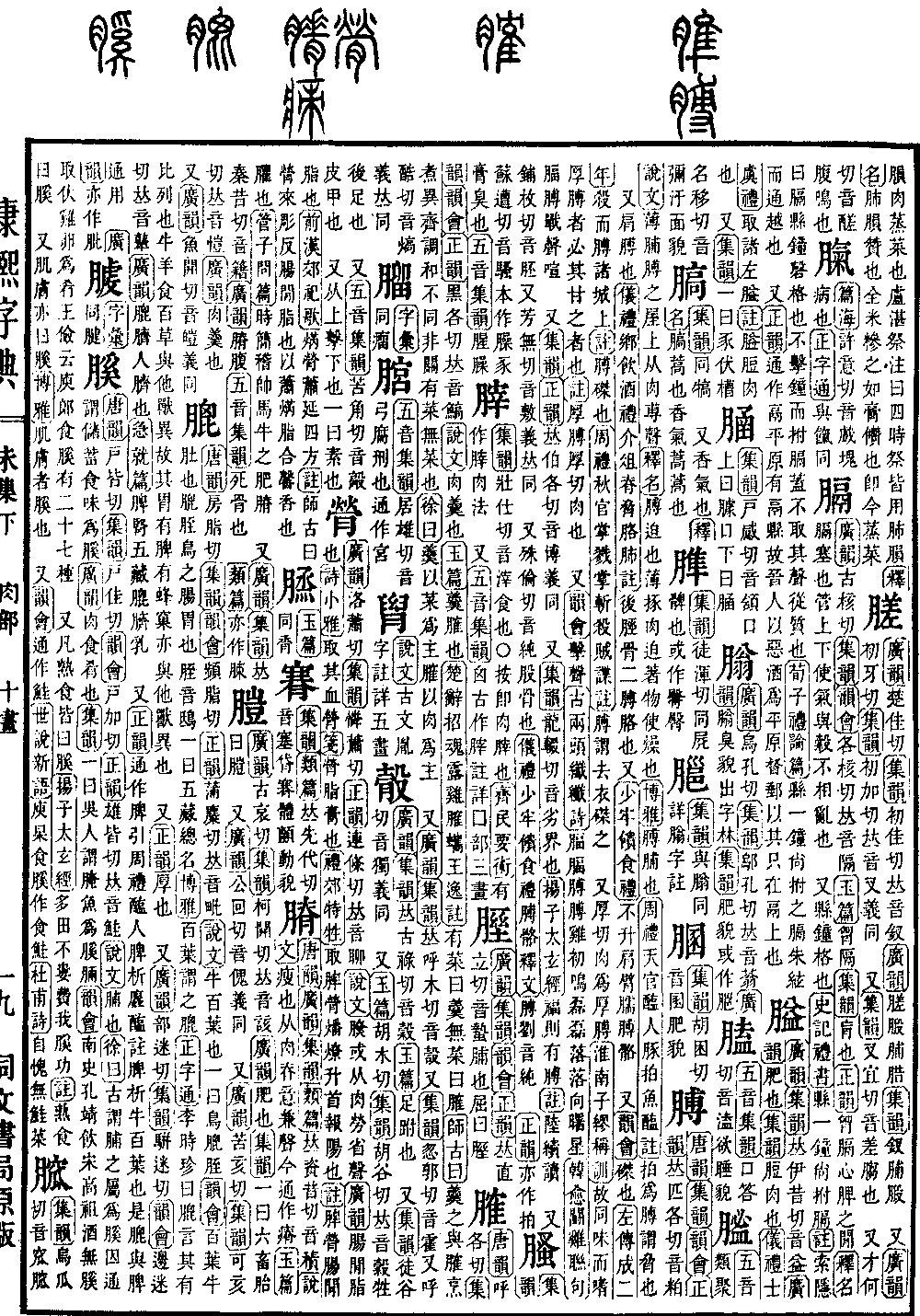
Wei Collection, Lower Volume
Radical: Meat (ròu)
Kangxi Strokes: 16
Page 991, Entry 27
Pronounced pi.
Shuowen Jiezi (Explaining and Analyzing Characters) defines it as the omasum of an ox. Another interpretation refers to the stomach of a bird.
Yunhui (Collection of Rhymes) states: The omasum is the belly of an ox. The term pichi refers to the intestines and stomach of a bird. Chi is pronounced like chi. Another interpretation defines it as a collective term for the five viscera.
Boya (Broad Glossary) states: The omasum is called pi.
Zhengzitong (True Character Guide) mentions Li Shizhen says: Pi indicates that it has an orderly, arranged appearance. Oxen and sheep consume a hundred herbs, differing from other beasts; thus, their stomachs possess a spleen and a honeycomb-like structure, also differing from other beasts.
Also, Zhengzitong defines it as meaning thick.
Pronounced pi.
Guangyun (Broad Rhymes) defines piqi as the human navel.
Jijiupian (Emergency Phrases) includes the phrase: Spleen, kidneys, five viscera, navel, and breasts.
Furthermore, Zhengzitong states it can be used interchangeably with pi (spleen). The commentary on the Zhou Li (Rites of Zhou), section on the official of salted meats, regarding the term pi-xi, explains: Pi-xi is the omasum of an ox. This indicates that pi and pi (spleen) can be used interchangeably.
Guangyun also records it written in a variant form (pi).