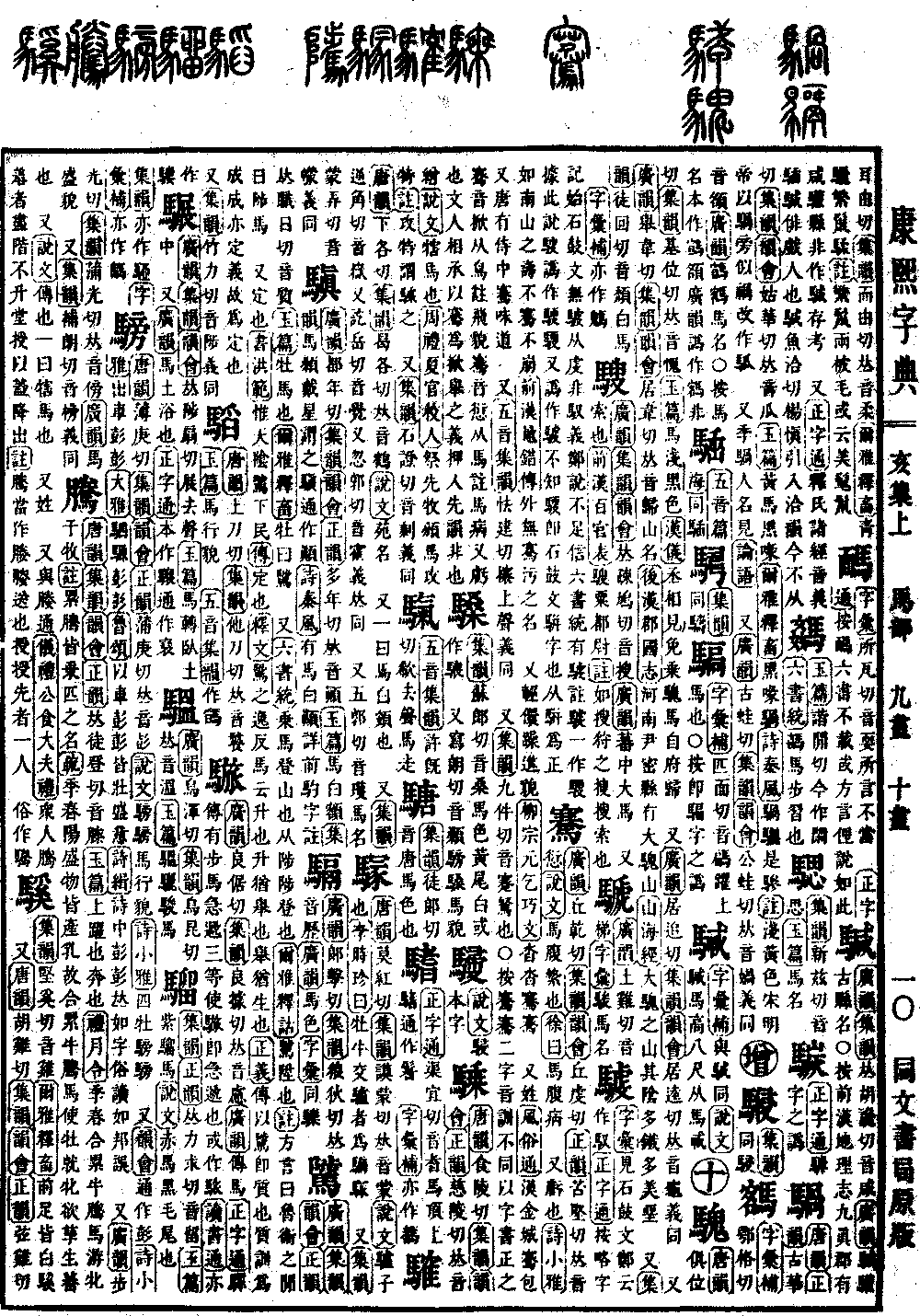
Hai Collection, Upper Volume
Radical: Horse (mǎ)
Entry: peng
Kangxi Stroke Count: 20
Page 1442, Entry 34
Pronounced peng.
As defined in Explaining Graphs and Analyzing Characters (Shuowen Jiezi), peng-peng describes the gait of a horse.
As mentioned in Book of Odes (Shijing), Xiaoya section: The four stallions go peng-peng.
Also, according to the Collection of Rhymes (Yunhui), it is commonly written as peng.
As mentioned in Book of Odes (Shijing), Xiaoya section: The war chariots are grand.
In the Daya section: The team of red horses is grand.
In the Lu Song section: The chariots are grand.
All these instances denote a sense of strength and grandeur.
According to the Commentary on the Odes (Shiji), the term peng-peng in the Odes should be read as written; the vulgar reading of it as bang is erroneous.
Pronounced bang.
According to the Expanded Rhymes (Guangyun), it describes a horse that is robust and grand.
Pronounced bang.
The meaning is the same as above.
In the Book of Odes (Shijing), Xiaoya section, Northern Mountain, one edition writes it as four stallions peng-peng.