Wu Collection, Upper Volume
Radical: Field (tián)
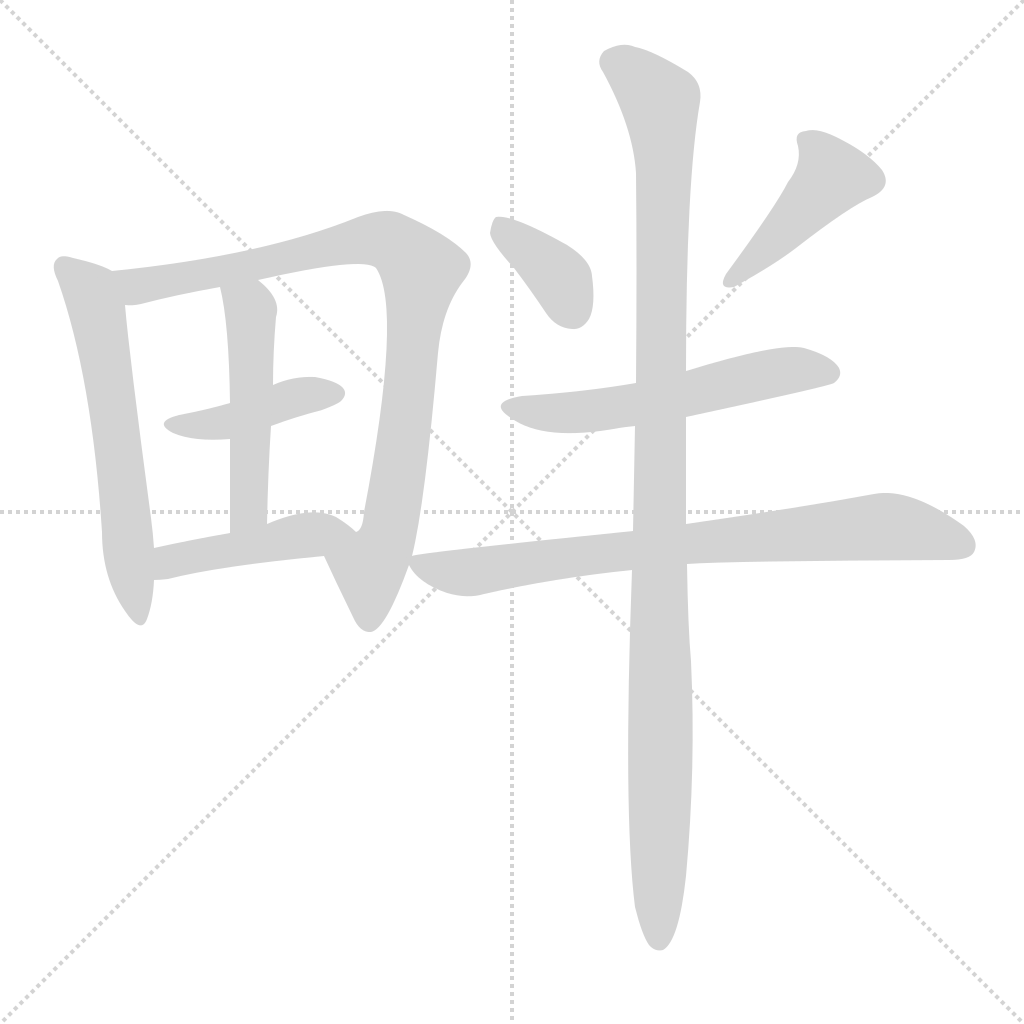
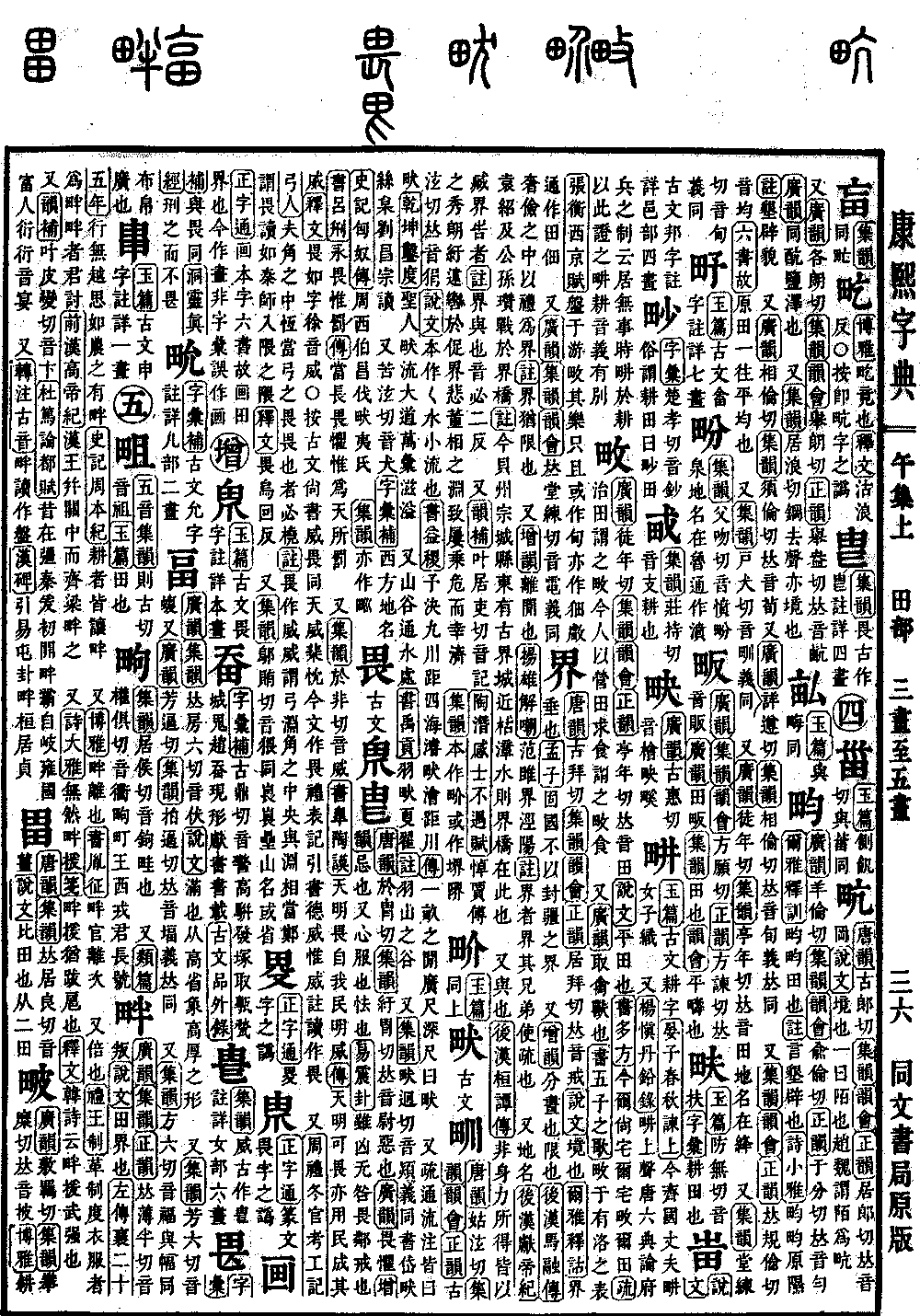
畔
Kangxi strokes: 10
Page 760, Entry 37
Broad Rhymes (Guangyun), Collected Rhymes (Jiyun), Standard Rhymes (Zhengyun): Pronounced pan (falling tone).
Shuowen (Explaining Graphs): Field boundary.
Zuo Tradition (Zuo Zhuan), 25th Year of Duke Xiang: Acting without overstepping considerations, like farm fields having boundaries.
Records of the Grand Historian (Shiji), Annals of the Zhou: Those who till the fields all mutually concede the field boundaries.
Also, Broad Etymology (Boya): Pan, the meaning of turning one's back or deviating.
Book of Documents (Shangshu), Expedition of Yin: To arbitrarily abandon one's post.
Also, interchangeable with pan (rebel), the meaning of betraying.
Book of Rites (Liji), Royal Regulations: Those who alter established systems and attire are rebels; against rebels, the sovereign will launch a punitive expedition.
History of the Former Han (Qian Hanshu), Annals of Emperor Gao: The King of Han annexed Guanzhong, while the King of Qi and the King of Liang rebelled against him.
Also, Book of Odes (Shijing), Greater Odes (Daya): Do not be so overbearing.
Commentary (Jian): Panyuan means to be overbearing.
Explanation of Text (Shiwen): Han School of Odes says: Panyuan means to be brave, martial, and tyrannical.
Also, Rhyme Supplements (Yunbu): Rhyming variant pronounced bian (falling tone).
Du Du, Rhapsody on the Capital (Lun du fu): In the past, the powerful Qin state began to expand its territory. Hegemony began at Mount Qi and Yongzhou, with the nation flourishing and the population multiplying. Yan is pronounced yan (falling tone).
Also, Transferred Meanings and Ancient Sounds (Zhuanzhu guyin): Pan is read as pan.
Han: Citing the Book of Changes (Yijing), Tun hexagram: Hesitating and remaining firm.