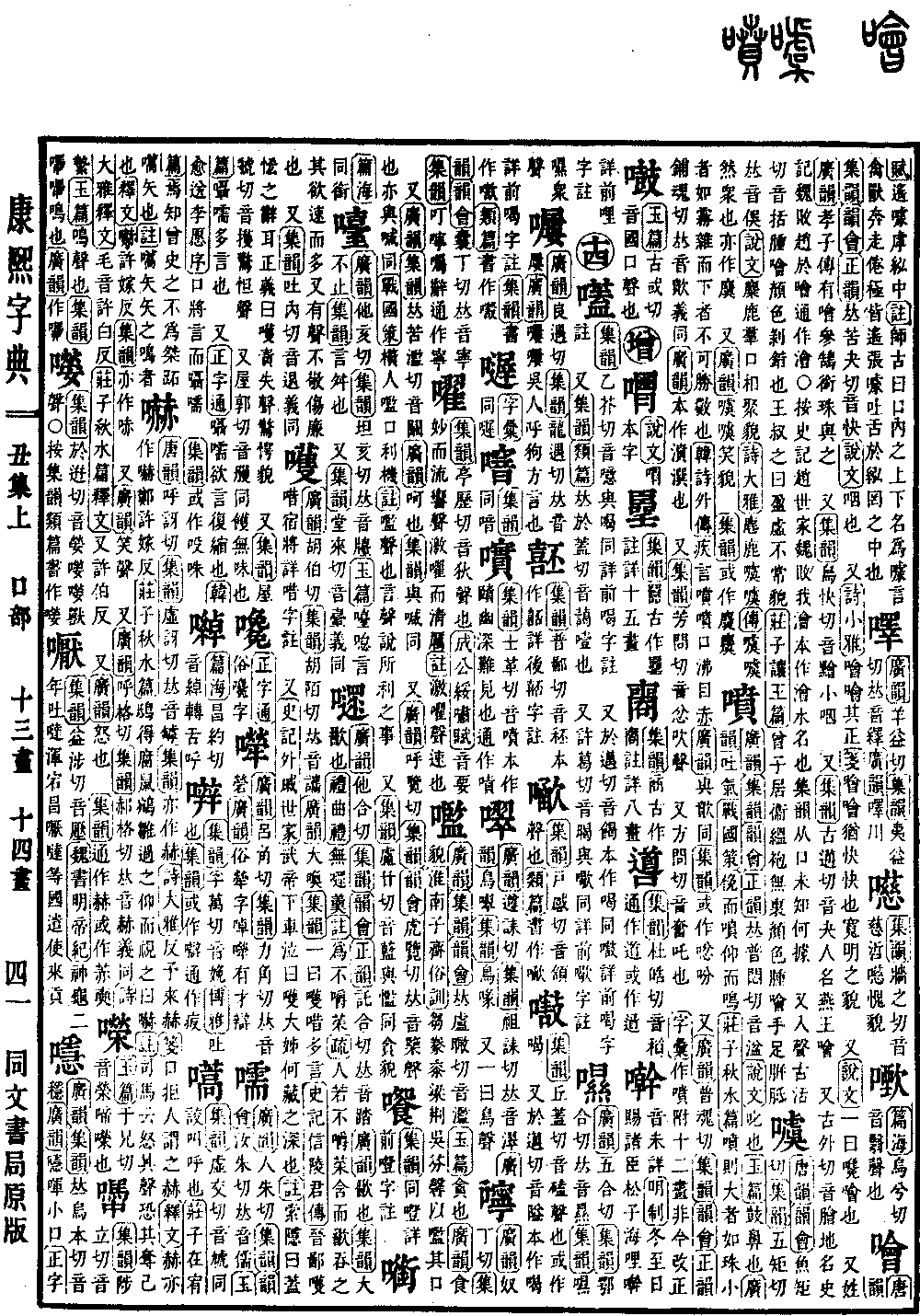
Chou Collection, Upper Volume
Radical: Mouth (kǒu)
Character: Pen
Kangxi stroke count: 16
Page 211, Entry 06
Broad Rhymes (Guangyun), Collected Rhymes (Jiyun), Rhyme Meetings (Yunhui), and Orthodox Rhymes (Zhengyun): Pronounced pen (falling tone).
Explanation of Characters (Shuowen): To scold.
Jade Chapters (Yupian): To snort or blow through the nose.
Broad Rhymes (Guangyun): To puff out air.
Strategies of the Warring States (Zhanguoce): Bowing the head to snort, raising the head to cry out.
Master Zhuang (Zhuangzi), Autumn Floods Chapter: When spraying, the large droplets are like pearls, the small ones like mist; those that descend in a mixed manner are too numerous to count.
Outer Commentary to the Han Version of the Book of Odes (Hanshi waizhuan): Speaking rapidly and sputtering, mouth bubbling and eyes reddened.
Broad Rhymes (Guangyun): Equivalent to the character pen (to spray).
Collected Rhymes (Jiyun): Sometimes written as fen (a variant form).
Also, Broad Rhymes (Guangyun): Pronounced hun (level tone). Collected Rhymes (Jiyun), Rhyme Meetings (Yunhui), and Orthodox Rhymes (Zhengyun): Pronounced pen (level tone). Meaning is the same.
Broad Rhymes (Guangyun): Originally written as fen (to spray). Also means to spray or spurt liquid.
Also, Collected Rhymes (Jiyun): Pronounced fen (falling tone). The sound of blowing.
Also: Pronounced fen (falling tone). To scold.
Dictionary of Characters (Zihui): Writes this as pen, placing it under the twelve-stroke section, which is incorrect. Now corrected. The character pen is derived from the standard form.