Mao Collection, Upper Volume
Radical: Heart (xīn)
Kangxi stroke count: 9
Page 380, Entry 08
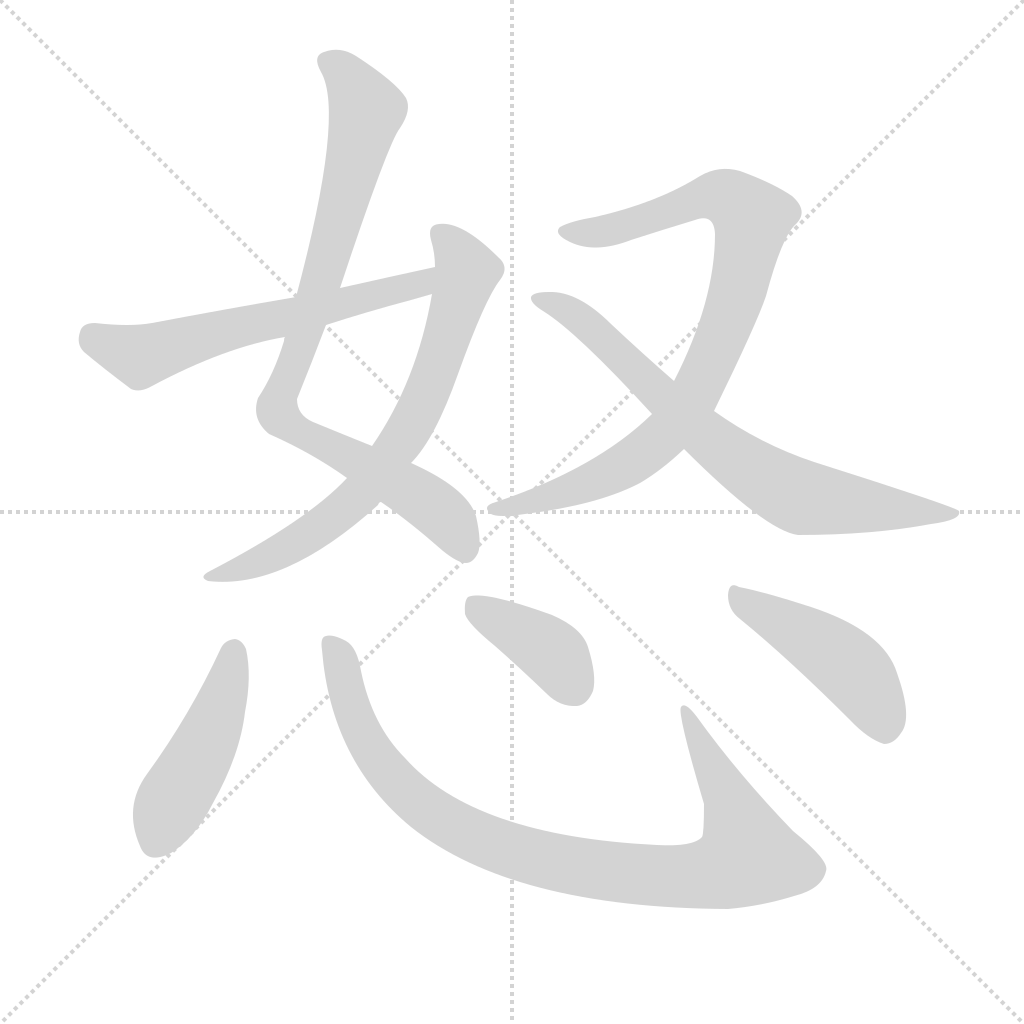
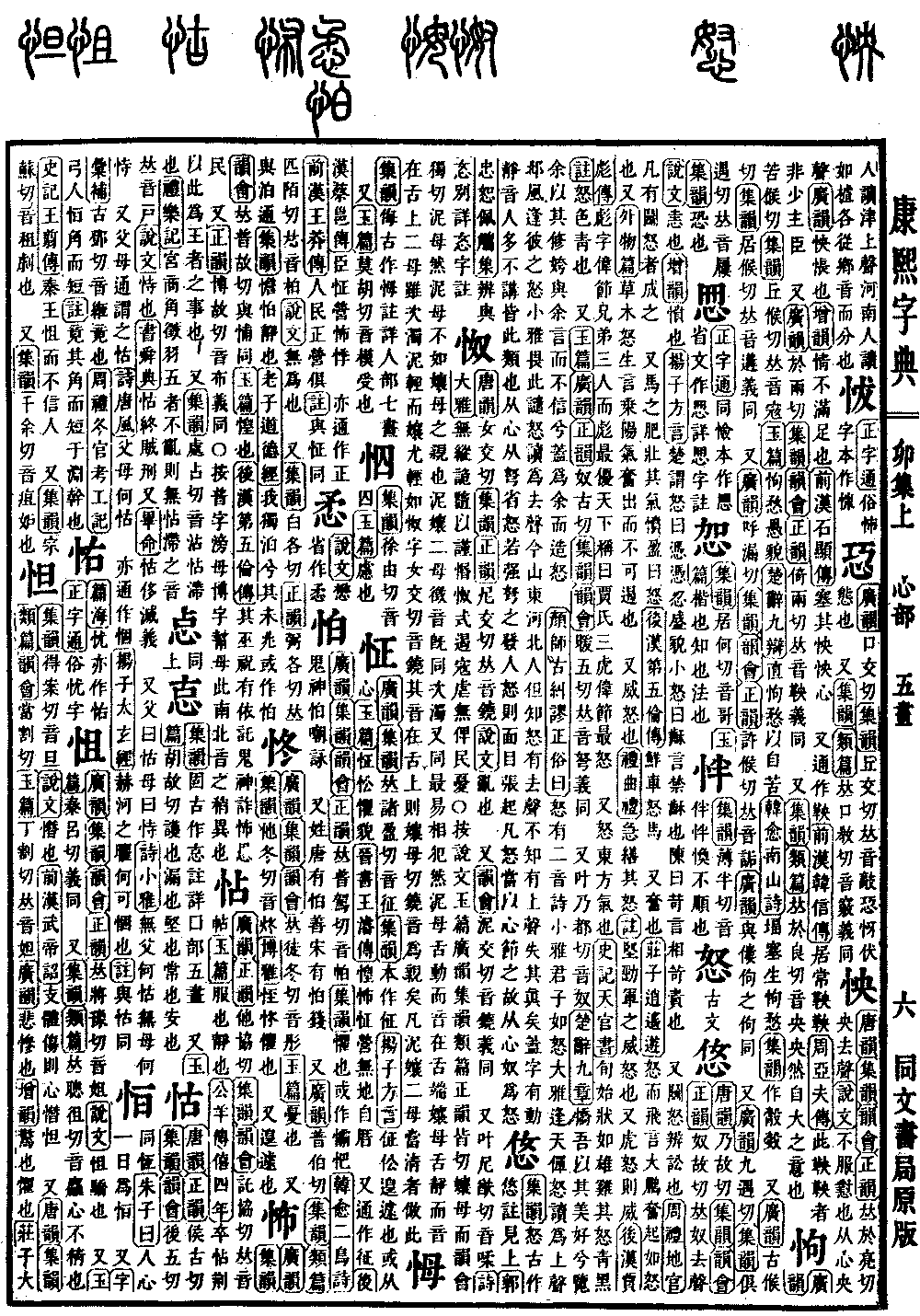
Ancient form. Pronounced nu (falling tone). According to the Shuowen Jiezi (Explaining Graphs and Analyzing Characters), it means to be angry. According to the Zengyun, it means to be resentful. According to the Fangyan (Regional Dialects) by Yang Xiong, in the state of Chu, anger is called ping. Ping describes an appearance of suppressed intensity. Minor anger is called xian. This refers to restraint. It is also called ke, referring to mutual reproach. It also refers to disputation. According to the Rites of Zhou (Zhouli), all those who have grievances shall be reconciled. It also refers to the robust, fat state of a horse where its energy is overflowing, referred to as nu. In the Biography of Diwu Lun in the Book of the Later Han (Hou Hanshu), it mentions carriages and horses in their prime. It also means to exert or rise up. In the Zhuangzi, the Great Peng bird rises up and flies. This indicates the Great Peng exerts itself as if in anger. In the Outer Things chapter, it describes vegetation growing with great intensity, meaning it rides the solar energy to burst forth, unable to be stopped. It also refers to majestic wrath. In the Book of Rites (Liji), one should quickly prepare their battle spirit. The commentary explains this as the majestic wrath of a resolute army. Furthermore, a tiger is majestic when it is angry. In the Biography of Jia Biao in the Book of the Later Han (Hou Hanshu), it is said that among the three brothers of the Jia family, Biao was the most excellent; the world called them the Three Tigers of the Jia family, with Weijie being the most fierce. Anger is also considered the energy of the east. In the Records of the Grand Historian (Shiji), the Xunshi star is described as resembling a rooster, its anger appearing blue-black. The commentary notes that the color of the anger is blue. Also pronounced nu (rising tone). The meaning is the same. It also rhymes with nu (level tone). In the Chu Ci (Songs of Chu), the verse reads: They pride themselves on their beauty and look at me with their fine figures. They speak to me without sincerity, creating anger on my behalf. Yan Shigu in his Correction of Errors and Customs states: The word nu has two pronunciations. In the Book of Odes (Shijing), in the poems Junzi ru nu and Feng tian dan nu, it is read with a rising tone. In the poem Feng bi zhi nu and Wei ci qian nu, it is read with a falling tone. People in Shandong and Hebei today only know the falling tone and are unaware of the rising tone, thus losing the authentic pronunciation. This is because characters have dynamic and static pronunciations, a subject which many do not study. The character is composed of heart and a shortened form of crossbow. Anger is like the release of a strong crossbow; when a person is angry, their face and eyes swell up. Since all anger should be regulated by the heart, it is composed of heart and nu as a phonetic component.