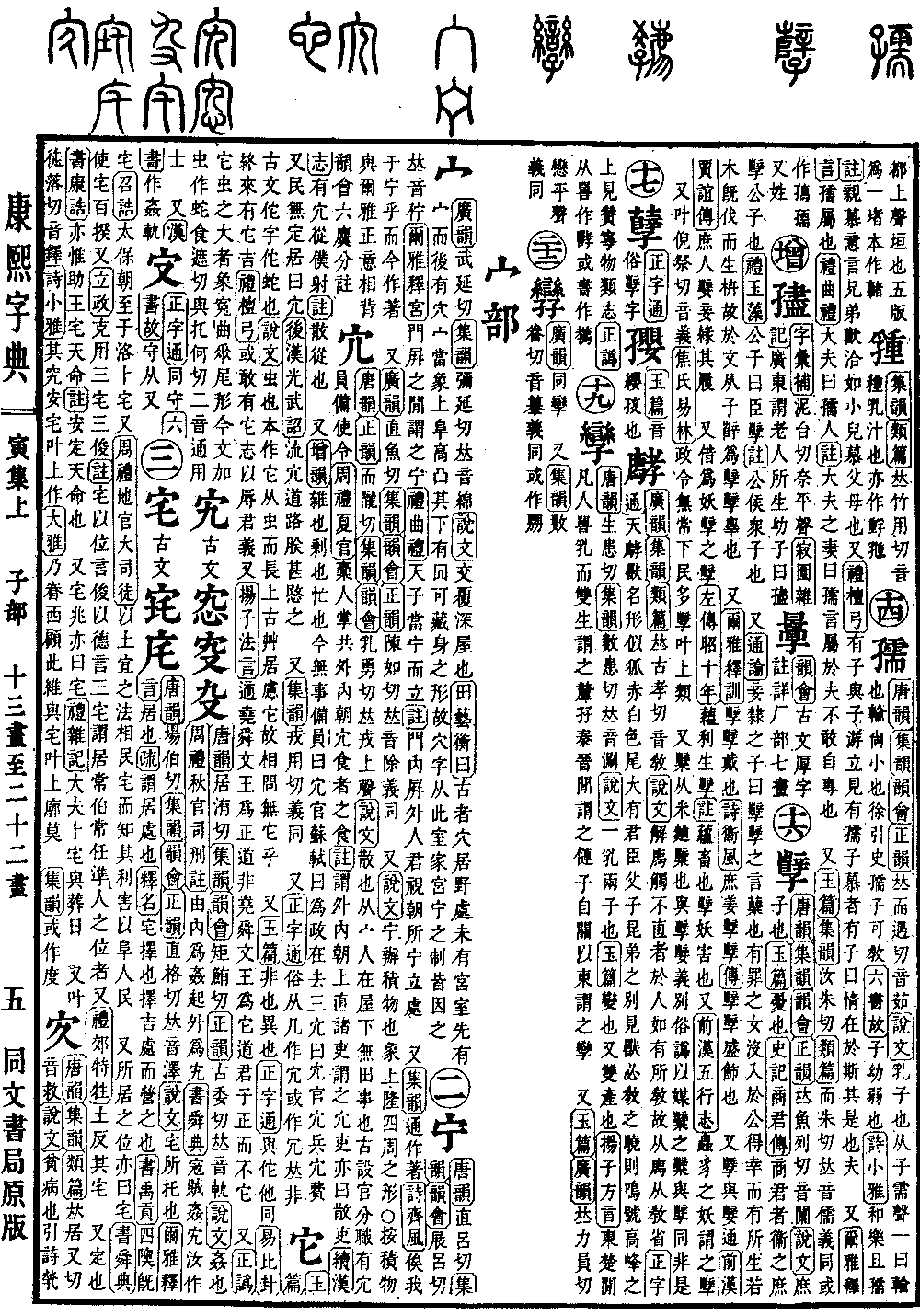
Yin Collection, Upper Volume
Radical: Roof (bù)
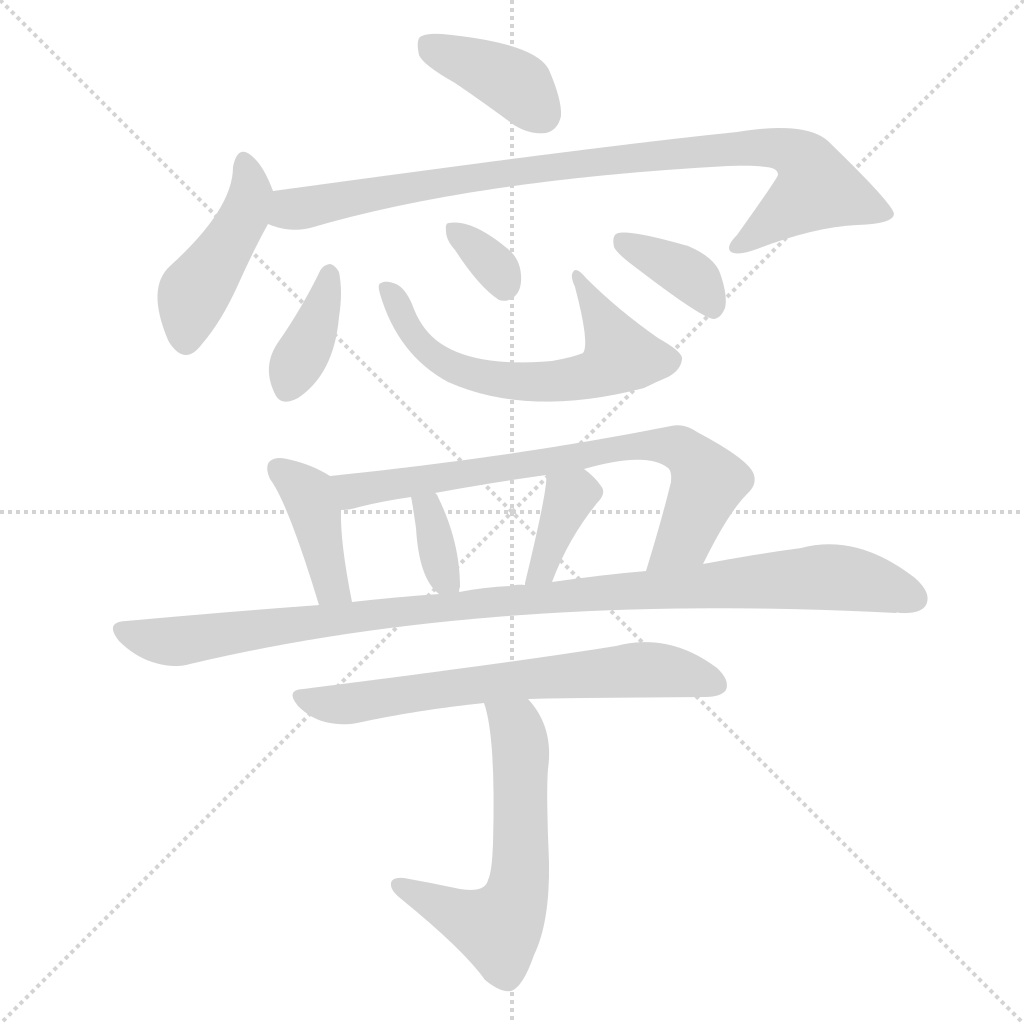
NING
Kangxi Dictionary Stroke Count: 14
Page 281, Entry 02
Ancient form: NING
Pronounced ning (level tone)
According to the Shuo Wen (Explaining Graphs and Analyzing Characters), it is a term expressing a wish. The character is formed by the radical roof, with NING as the phonetic component.
It also expresses peace and tranquility.
I Ching (Book of Changes): All things begin to grow, and all states under heaven are at peace.
Book of Odes (Shijing): King Wen has a beautiful reputation, and what he seeks is the peace of the nation.
Book of Documents (Shangshu): Implement generous policies to bring stability to the people.
Note: Implementing lenient governance leads to the stability of the people.
Also, Book of Documents (Shangshu): Among the five blessings, the third is health and tranquility.
Note: This refers to the absence of illness.
Also, when a woman returns to visit her parents after marriage, it is called NING.
Book of Odes (Shijing): Returning home to visit parents.
Also, YU NING refers to mourning for parents.
History of the Former Han Dynasty (Qian Hanshu): When the parents of a scholar student pass away, the children observe mourning for three years.
Also, WU NING is equivalent to NING, a term expressing a wish.
Zuo Commentary (Zuo Zhuan): Would rather let the Duke of Xu regain control of his state.
Also, Year 26 of Duke Xiang: If by misfortune there is a deviation, it is better to reward excessively than to punish excessively.
Book of Documents (Shangshu): Rather than killing the innocent, it is better to commit the error of acting against convention.
Also, DING NING refers to repeated instructions and admonitions.
History of the Former Han Dynasty (Qian Hanshu): Repeatedly instructed. Common variant form is written as DING NING.
Also, DING NING is a type of ZHENG (ancient musical instrument).
Zuo Commentary (Zuo Zhuan): Recorded on the DING NING.
Exegesis: It states it is recorded on the DING NING, therefore DING NING is a type of object.
Discourses of the States (Jinyu): When attacking, bells and drums are prepared to proclaim guilt. In battle, CHUNYU and DING NING are used to alert the people. This indicates that DING NING is used during combat.
Also, the name of a prefecture. In the Qin Dynasty, it was the Northern Commandery; the Wei state established Hua Prefecture, and it was renamed Ning Prefecture during the Western Wei.
Also, a surname.
Also, pronounced ning (falling tone). Interchangeable with NING.
History of the Former Han Dynasty (Qian Hanshu): Abundant and numerous, returning to the right path, fulfilling past wishes.
Shigu Note: Read with the level tone for rhyme. The meaning is that the received blessings are already many, and having returned to the right path, one is able to fulfill past desires.
Also, read with the rising tone for rhyme.
Zhang Zai, Seven Commands (Qi Ming): The Kingly Way extends to the four directions; the Middle Kingdom is peaceful and quiet. The beacons in the south are extinguished; the alarms in the east are lifted.
Also, read with the sound of NIANG for rhyme.
Su Shi, Fu Zheng Gong: The dignified Han Gong, of equal prestige to Lai Gong. Employed again in the Yan territory, the world is at peace because of this. WANG is read in the level tone.
Yunchui: The original character is written as NING; in the Classics and Histories, it is written as NING; the common variant is written as NING. The character NING is formed with the radical roof.