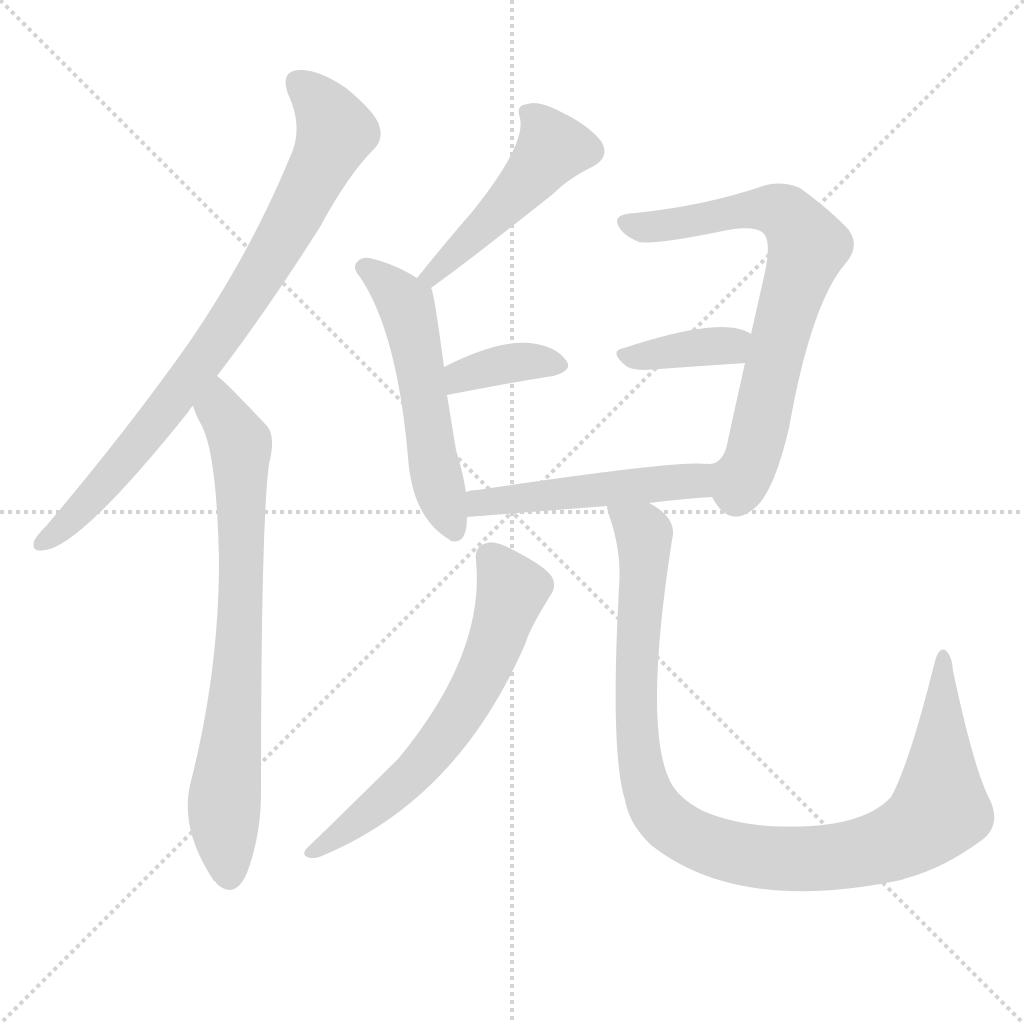
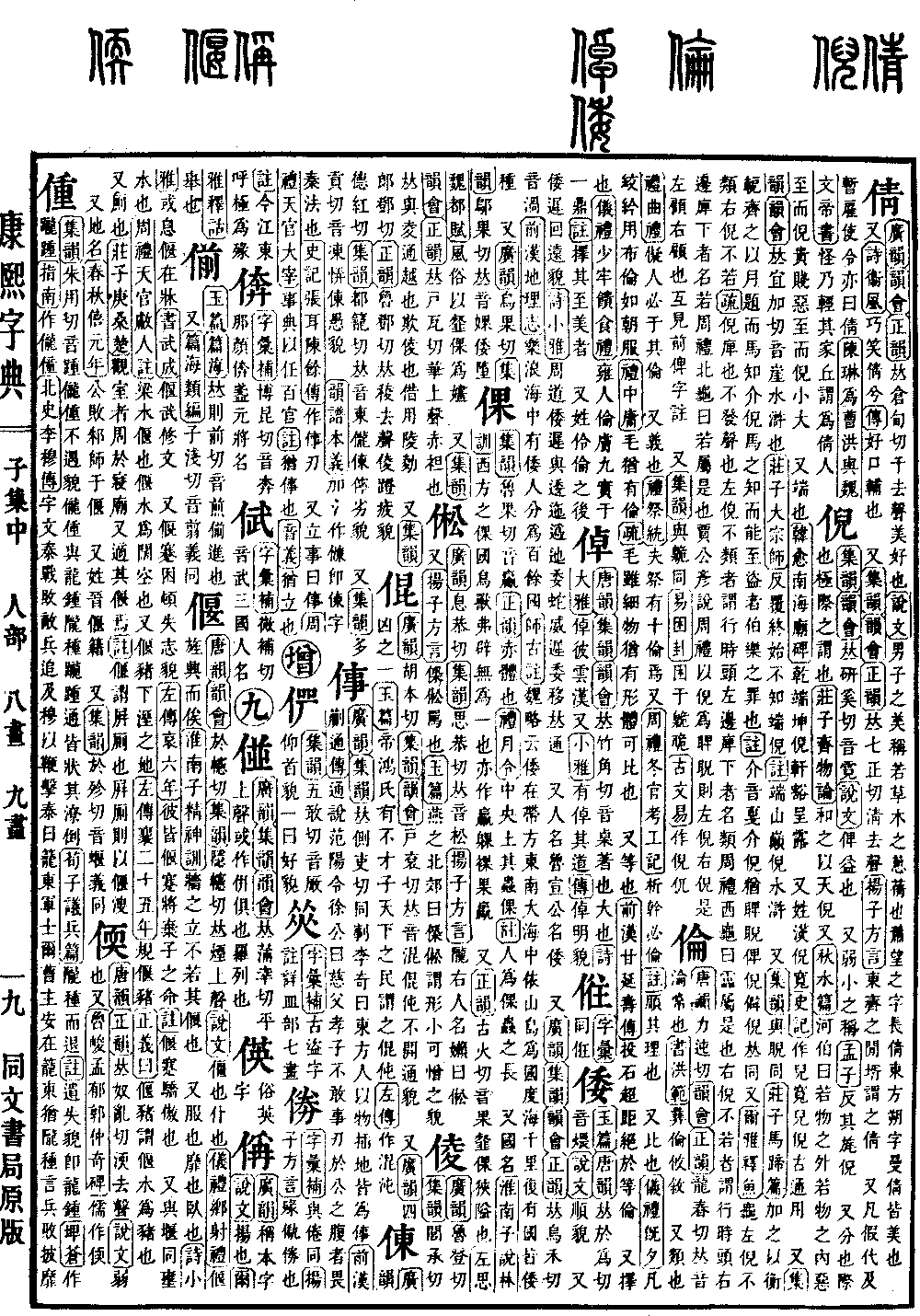
Zi Collection, Middle Volume. Radical: Person (rén). Character: Ní. Kangxi Stroke Count: 10. Page 109, Number 02.
According to the Collection of Rimes (Jiyun) and the Meeting of Rimes (Yunhui), the pronunciation follows the fanqie method of yan and xi, sounding like ni. The Explaining Graphs and Analyzing Characters (Shuowen Jiezi) defines it as to assist or benefit. It is also a term used for the weak and the young. As seen in the Mencius (Mengzi): Returning the elderly and the young. It also means to distinguish, an interface, or an extreme boundary. As seen in the Zhuangzi, section Adjustment of All Things (Qiwulun): Harmonize them by means of the boundaries of Heaven. Also in the Autumn Waters (Qiushui) chapter, the Earl of the River says: Regarding the exterior and interior of things, how does one distinguish between the noble and the mean, or distinguish between the great and the small. It also means a beginning or a clue. Han Yu writes in the South Sea Temple (Nanhaimiao): The clues of Heaven and the boundaries of Earth are clearly revealed. It is also a surname, such as Ni Kuan of the Han Dynasty. In the Records of the Grand Historian (Shiji), this is written as Er Kuan. The characters er and ni were used interchangeably in ancient times.
According to the Collection of Rimes and the Meeting of Rimes, it is also pronounced with the fanqie of yi and jia, sounding like ya. This means the edge of the water. As seen in the Zhuangzi, section Great and Venerable Teacher (Dazongshi): Reversing from end to beginning, without knowing the origin or the edge. The annotation states that duan refers to a mountain peak and ni refers to the water's edge. According to the Collection of Rimes, it is also the same as the character ni meaning to glance askance. In the Zhuangzi, section Horses Hooves (Mati): Adding the crossbar and the yoke, aligning them with the forehead ornament, until the horses learned to look askance. The annotation states that jie is pronounced like jia, and ni is like pini, meaning to look askance. The terms bieni and pini are the same.
In the Approaching the Refined (Erya), section Explaining Fish (Shiyu): If a turtle tilts to the left it is not of the lei type, and if it tilts to the right it is not of the ruo type. The sub-commentary states that ni means to lower or to remain silent. Tilting to the left means that while walking the head is lowered to the left side, which is called lei; in the Rites of Zhou (Zhouli), the western turtles belong to the lei category. Tilting to the right means that while walking the head is lowered to the right side, which is called ruo; in the Rites of Zhou, the northern turtles belong to the ruo category. Jia Gongyan states that since the Rites of Zhou treats ni as glancing askance, then tilting to the left or right means looking to the left or right. Refer also to the previous entry for the character bi. According to the Collection of Rimes, it is also synonymous with the character nie. In the Book of Changes (Yijing), under the hexagram for Oppression (Kun): Oppressed by instability. In the ancient text version of the Book of Changes, this is written as ni.