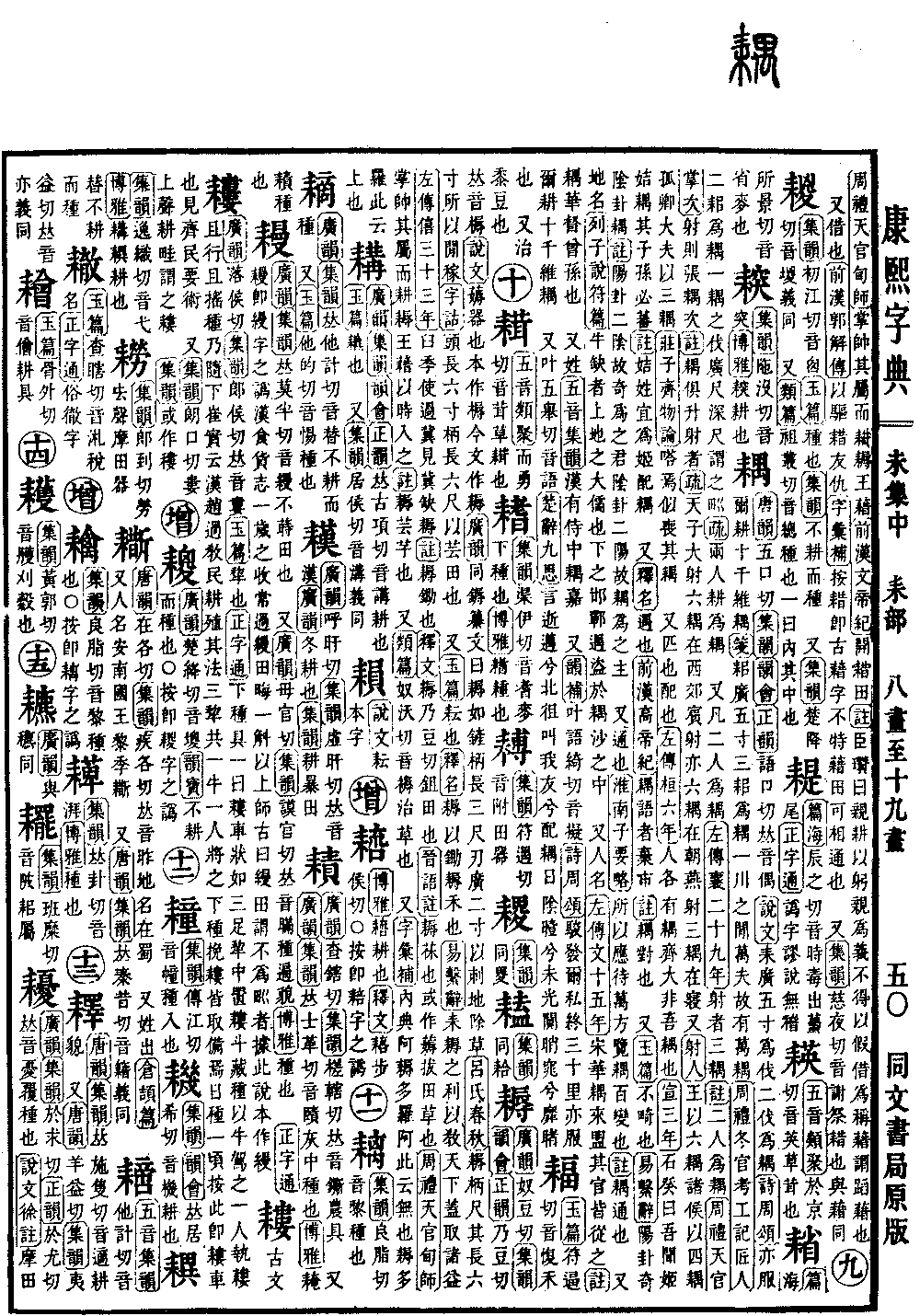
Wei Collection, Middle Volume
Radical: Plow (lěi)
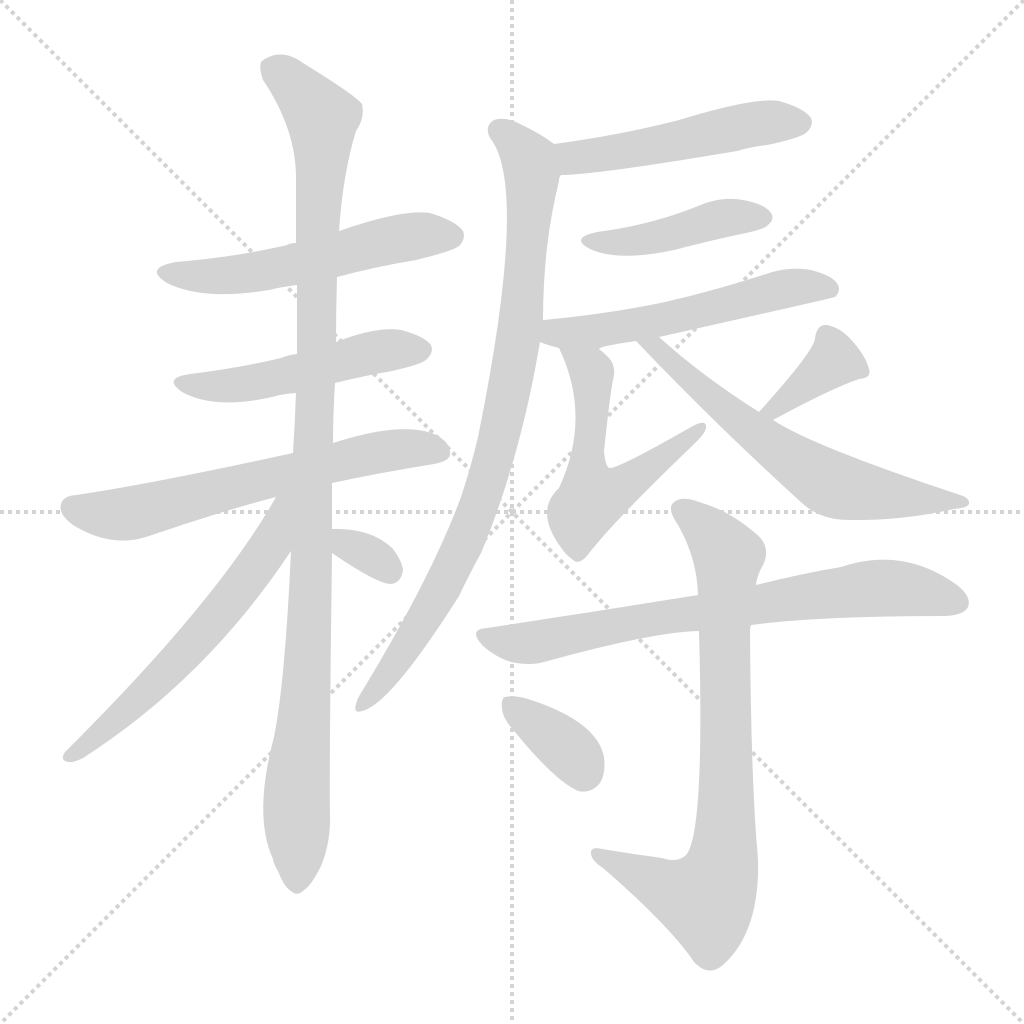
Entry: 耨
Kangxi Stroke Count: 16
Page 964, Entry 13
Broad Rhymes (Guangyun): Pronounced nou (falling tone). Collected Rhymes (Jiyun), Rhyme Meetings (Yunhui), Correct Rhymes (Zhengyun): Pronounced nou (falling tone).
In the Explanation of Writing (Shuowen), it is defined as a tool for weeding. Originally written as 槈, the modern character is written as 耨. In Broad Rhymes (Guangyun), it is the same as 鎒. The Record of Collected Texts (Zuanwen) states: The hoe is like a shovel, with a handle three feet long and a blade two inches wide, used for piercing the earth and removing weeds. The Spring and Autumn of Master Lu (Lüshi Chunqiu) states: The handle of the hoe is one foot long, with a head six inches long, used for weeding between crops. The Explication of Characters (Zigu) states: The head is six inches long and the handle is six feet long, used for weeding fields.
Also, according to the Jade Compendium (Yupian), it means to weed. According to the Explanations of Names (Shiming), a hoe is used to hoe and weed crops. The Book of Changes (Yijing), Appended Statements (Xici) states: The benefit of the plow and hoe was used to teach the world, derived from the hexagram of Increase (Yi). The Zuo Commentary (Zuo Zhuan), 33rd year of Duke Xi, records: Jiji made a journey through Ji and saw Ji Que weeding. The commentary notes: To weed is to hoe. The Explanatory Text (Shiwen) says: 耨 is pronounced nou (falling tone), meaning to hoe a field. The commentary on the Discourses of Jin (Jinyu) says: 耨 means to clear away weeds; it is sometimes written as 薅, meaning to pull up field weeds. The Rites of Zhou (Zhouli), Offices of Heaven, Superintendents of the Fields (Dianshi) states: Command the subordinates to plow and weed the king's fields at the proper time. The commentary notes: To weed is to remove grass and mulch.
Also, according to the Classified Chapters (Leipian), it is pronounced ru, meaning to clear away grass.
Also, in the Supplement to the Collection of Characters (Zihuibu), regarding Buddhist scriptures: Anoutuoluo (Anuttara). An here means none, and tuoluo here means superior.